Begin with Dutch as used in Belgium
Belgian Dutch is Dutch as used in Belgium, including a standard variety appropriate in public communication. It is not a separate language that requires a different basic grammar. Taaladvies uses the label “standard language in Belgium” for forms accepted in the relevant Belgian public contexts. The label describes a national standard usage; it does not mean that every resident uses the same vocabulary, pronunciation or address form in every interaction.
For a beginner, this distinction supports two goals. You can produce clear standard Dutch that travels across settings, and you can learn to recognize local choices without assuming they are mistakes. Address is a particularly useful place to apply that approach. You may hear familiar forms that differ from your course model, while a written notice uses a more formal style. Rather than trying to imitate every form immediately, first identify the relationship between speakers and the purpose of the exchange. Then select a consistent form for your own message.
References for this explanation
Choose u or je by the relationship
Standard Dutch uses u for formal address and je or stressed jij for familiar singular address. The pronoun jullie is familiar plural, while u can address one person or several formally. The Vlaanderen guidance stresses that relationship and situation matter: u can communicate respect or distance, and je can create a more informal relationship. These are contextual effects rather than a universal chart based only on a person’s age.
For the exercises here, use u when a prompt explicitly says to address an unfamiliar person formally. Use je when it says one familiar person. Real interactions may establish another preference, so listen to how people address each other and respond to an explicit invitation to change. A friendly tone does not automatically require je, and u is not proof that the speaker is unfriendly. Treat the grammar as a way to implement a relationship choice rather than a substitute for noticing the relationship itself.
Watch the decision
Model: ask an unfamiliar person formally to repeat something.
- Choose u for the context specified by the exercise. The requested action is repetition, so retrieve herhalen and keep it as an infinitive.
- Use kunt as the conjugated verb that opens the question, followed by the subject u. Add dat to identify the material you want repeated.
- Close the sentence with herhalen. Check that the request tells the listener what to do and that the personal pronoun does not acquire the possessive w.
Kunt u dat herhalen?
References for this explanation
Recognize ge and gij without making them the default
The forms ge and gij occur in informal speech in much of Belgium and in parts of the southern Netherlands. Vlaanderen’s language advice does not present them as the general neutral standard forms for ordinary new writing. Their presence therefore tells you something about usage and setting, but not that you have encountered a separate language. Regional and social variation is more detailed than a single national boundary.
This lesson asks you to recognize these forms while producing the standard je, jij and u patterns. Do not replace every je in a sentence with gij and assume the rest of the grammar will remain correct. The associated verb and object patterns need their own learning. Informal Belgian speech can also use u or uw within a familiar system, so hearing those forms does not always prove that a conversation is socially formal. Listen to the full pattern and context instead of interpreting one isolated word as a complete social signal.
References for this explanation
Keep u and uw separate in writing
Standard written u is a personal pronoun, while uw means “your” before a noun. Compare Hoe heet u?, “What is your name?”, with Is dit uw boek?, “Is this your book?” The final w is grammatical information, not an optional spelling choice. Write u with a lowercase letter inside an ordinary sentence. Capitalization at the start of a sentence follows the normal sentence rule; it does not create a special more respectful pronoun.
The same person may be represented by either form depending on the role. Heeft u uw boek? contains both: u is the subject and uw marks possession of the book. Work through this distinction by asking whether the word stands alone as the person or accompanies a noun meaning that person’s thing. A message can be polite while using the wrong spelling, so check grammar independently of tone. You do not need a more elaborate sentence to make the relationship clear.
References for this explanation
Match the verb and remember accepted alternatives
With formal u, ordinary regular present verbs keep their singular t even when the verb comes first: Werkt u hier? Familiar je after the verb behaves differently: Werk je hier? This distinction is shared standard Dutch grammar and remains useful in Belgium. The fact that both questions may occur in courteous interactions does not make their verb forms interchangeable. Match the form to the chosen subject.
With hebben, “to have,” both u hebt and u heeft are accepted. An institution may recommend one for its house style, but a preference is not a universal grammatical ban on the other. This lesson uses hebt in some models so that the contrast with je after the verb stays visible. Recognize Heeft u tijd? as equally grammatical. Keep a note distinguishing accepted alternatives from actual mismatches, such as a bare regular stem before u. That prevents unnecessary corrections of normal language you hear or read.
Complete the reasoning
Guided: ask whether this is the listener’s book.
- The intended meaning is possession, so the word before boek must mean “your.” The sentence already has dit as the identifying subject.
- Before checking, decide between u and uw by grammatical role rather than by how formal the interaction feels.
- Open the yes or no question with is. The possessive form accompanies the noun; it does not serve as the subject in this question.
Compare your reasoning
Is dit uw boek?
References for this explanation
Make a request the listener can act on
A useful standard request is Kunt u mij helpen?, “Can you help me?” The conjugated verb opens the question and helpen remains an infinitive at the end. Kunt u dat herhalen? asks the listener to repeat that. Kunt u wat langzamer spreken? asks for slower speech. These requests identify a concrete action, making them easier to answer than a vague announcement that everything is difficult.
The word alstublieft can add courtesy in a formal interaction. A complete phrase such as Een koffie, alstublieft can also work in a clear ordering context without a full question. The context supplies the intended request. Do not assume that adding a courtesy word repairs a mismatched subject and verb, or that every polite interaction must use the longest available wording. For production, choose one short request, keep its grammar consistent and use a tone suited to the situation. Clear meaning and courteous delivery support each other.
References for this explanation
Read the pattern before copying it
A learner in Belgium may encounter a mixture of standard wording, local vocabulary and informal speech within one day. The useful skill is to distinguish what you want to understand from what you are ready to produce. Recognizing gij can prevent confusion without requiring you to adopt its whole system immediately. Knowing that u hebt and u heeft are both accepted prevents you from treating a valid form as an error. These are different kinds of variation and deserve different notes.
Before the game, write one formal request for repetition and one familiar question about working here. Explain the pronoun and verb choice in each. Then identify u and uw in a sentence containing both. After a pause, recreate the messages from their intended meaning. Check social context, grammatical role and spelling separately. If a source labels a form informal or regional, preserve that qualification in your own notes instead of reducing it to simply Belgian or simply wrong.
References for this explanation
See it in a sentence
Hoe heet u?
What is your name?
The pronoun u stands alone as the formal subject.
Is dit uw boek?
Is this your book?
The word uw marks possession before boek.
Hebt u tijd?
Do you have time?
With formal u, the verb keeps its t after inversion.
Heeft u tijd?
Do you have time?
The form heeft is also accepted with u.
Werkt u hier?
Do you work here?
The formal regular form retains t.
Werk je hier?
Do you work here?
When familiar je follows the verb, the verb loses its regular t ending.
Kunt u mij helpen?
Can you help me?
The infinitive closes the request.
Kunt u dat herhalen?
Can you repeat that?
The word dat identifies what should be repeated.
Kunt u wat langzamer spreken?
Can you speak a little more slowly?
The request specifies the needed adjustment.
Een koffie, alstublieft.
A coffee, please.
A short phrase can be a clear request in context.
Heeft u uw boek?
Do you have your book?
The pronoun u is the subject, and uw marks the possessed noun.
Jullie werken hier.
You all work here.
The pronoun jullie is familiar plural and takes a plural verb.
Notice the difference
Common mistakes
Separate personal and possessive forms
Instead ofIs dit u boek?
For this meaningIs dit uw boek?
The word modifies boek and means “your,” so it needs the possessive spelling uw.
Do not erase the formal ending
Instead ofWerk u hier?
For this meaningWerkt u hier?
With standard formal u, the verb keeps its t even when it comes first.
Do not conjugate both verbs
Instead ofKunt u dat herhaalt?
For this meaningKunt u dat herhalen?
The form kunt is the conjugated verb; herhalen is the infinitive expressing the requested action.
From understanding to using
Make your own example.
Try these without answer choices. Say your answer aloud or write it below, then compare your reasoning with the model.
Your turn 1
Ask formally for help and then for slower speech.
Compare with a model
Kunt u mij helpen? Kunt u wat langzamer spreken?
Can you help me? Can you speak a little more slowly?
The second request specifies the kind of assistance needed. Both use u consistently and keep the action verbs as infinitives at the end. These are standard requests usable in Belgian settings without imitating an informal regional pronoun system.
- Use u consistently.
- Keep helpen and spreken infinitive.
- Make the second request specific.
Your turn 2
Write one familiar and one formal question about working here.
Compare with a model
Werk je hier? Werkt u hier?
Do you work here? Do you work here?
The meaning remains the same, but the address choice changes both the pronoun and the written ending. Inversion removes the regular t with familiar je and retains it with u.
- Use je for one familiar listener.
- Retain t with u.
- Explain the difference without treating it as a rule based on age.
Put it into practice
Make the next choice.
Choose a response and learn why it works. Your score reflects your first answer to each question. You can revisit anything you miss.
Choose an answer, then open the explanation to check your reasoning.
Question 1
Choose the standard written form that means “your” before a noun.
- uw boek
- u boek
Check the answer
Answer: uw boek
uw boek: The word uw is the possessive form accompanying boek.
u boek: The word u is the personal pronoun, not the possessive determiner.
Question 2
Choose the correct formal question.
- Werk u hier?
- Werkt u hier?
Check the answer
Answer: Werkt u hier?
Werk u hier?: The familiar je exception does not apply to u.
Werkt u hier?: With u, the verb keeps its regular singular t in inversion.
Question 3
How should a beginner interpret ge or gij in Belgian speech?
- An informal usage to recognize in context
- Proof that the speaker uses a separate language
Check the answer
Answer: An informal usage to recognize in context
An informal usage to recognize in context: The forms occur in regional informal Dutch patterns.
Proof that the speaker uses a separate language: Belgian Dutch is Dutch, and one pronoun does not establish a separate language.
Question 4
What does standard Dutch accept for “you have” with formal u?
- Only u hebt
- Both u hebt and u heeft
Check the answer
Answer: Both u hebt and u heeft
Only u hebt: The combination u heeft is also accepted.
Both u hebt and u heeft: Both are standard; an institutional preference is narrower than a language rule.
Question 5
Ask for repetition.
- Kunt u dat herhalen?
- Kunt u dat herhaalt?
Check the answer
Answer: Kunt u dat herhalen?
Kunt u dat herhalen?: After kunt, herhalen stays infinitive.
Kunt u dat herhaalt?: The form herhaalt is conjugated, but after kunt the action verb stays an infinitive.
Question 6
Which pronoun addresses several familiar people?
- jij
- jullie
Check the answer
Answer: jullie
jij: The pronoun jij addresses one familiar person.
jullie: The pronoun jullie is familiar plural.
Question 7
Choose the ordinary spelling inside a sentence.
- Kunt u helpen?
- Kunt U helpen?
Check the answer
Answer: Kunt u helpen?
Kunt u helpen?: The ordinary personal pronoun u is lowercase inside the sentence.
Kunt U helpen?: A capital letter is not required to make u respectful.
Question 8
Recall the meaning of Hoe heet u?
- You all work here.
- What is your name?
Check the answer
Answer: What is your name?
You all work here.: That meaning belongs to Jullie werken hier. The pronoun u stands alone as the formal subject.
What is your name?: The pronoun u stands alone as the formal subject. The complete meaning is “What is your name?”
Question 9
Recall the meaning of Is dit uw boek?
- Is this your book?
- Do you have time?
Check the answer
Answer: Is this your book?
Is this your book?: The word uw marks possession before boek. The complete meaning is “Is this your book?”
Do you have time?: That meaning belongs to Heeft u tijd? The word uw marks possession before boek.
Question 10
Recall the meaning of Hebt u tijd?
- A coffee, please.
- Do you have time?
Check the answer
Answer: Do you have time?
A coffee, please.: That meaning belongs to Een koffie, alstublieft. With formal u, the verb keeps its t after inversion.
Do you have time?: With formal u, the verb keeps its t after inversion. The complete meaning is “Do you have time?”
Question 11
Recall the meaning of Heeft u tijd?
- Do you have time?
- What is your name?
Check the answer
Answer: Do you have time?
Do you have time?: The form heeft is also accepted with u. The complete meaning is “Do you have time?”
What is your name?: That meaning belongs to Hoe heet u? The form heeft is also accepted with u.
Question 12
Recall the meaning of Werkt u hier?
- Do you have time?
- Do you work here?
Check the answer
Answer: Do you work here?
Do you have time?: That meaning belongs to Heeft u tijd? The formal regular form retains t.
Do you work here?: The formal regular form retains t. The complete meaning is “Do you work here?”
Question 13
Recall the meaning of Werk je hier?
- Do you work here?
- Can you speak a little more slowly?
Check the answer
Answer: Do you work here?
Do you work here?: When familiar je follows the verb, the verb loses its regular t ending. The complete meaning is “Do you work here?”
Can you speak a little more slowly?: That meaning belongs to Kunt u wat langzamer spreken? When familiar je follows the verb, the verb loses its regular t ending.
Question 14
Recall the meaning of Kunt u mij helpen?
- Can you repeat that?
- Can you help me?
Check the answer
Answer: Can you help me?
Can you repeat that?: That meaning belongs to Kunt u dat herhalen? The infinitive closes the request.
Can you help me?: The infinitive closes the request. The complete meaning is “Can you help me?”
Keep the conversation going
What to practice next
After a break, go back to your own examples above and do each task again without looking at the models. Compare the meaning and form with the models, and fix each mistake by explaining its cause. Then use one of your sentences in a short conversation of your own.
Keep it going in the app
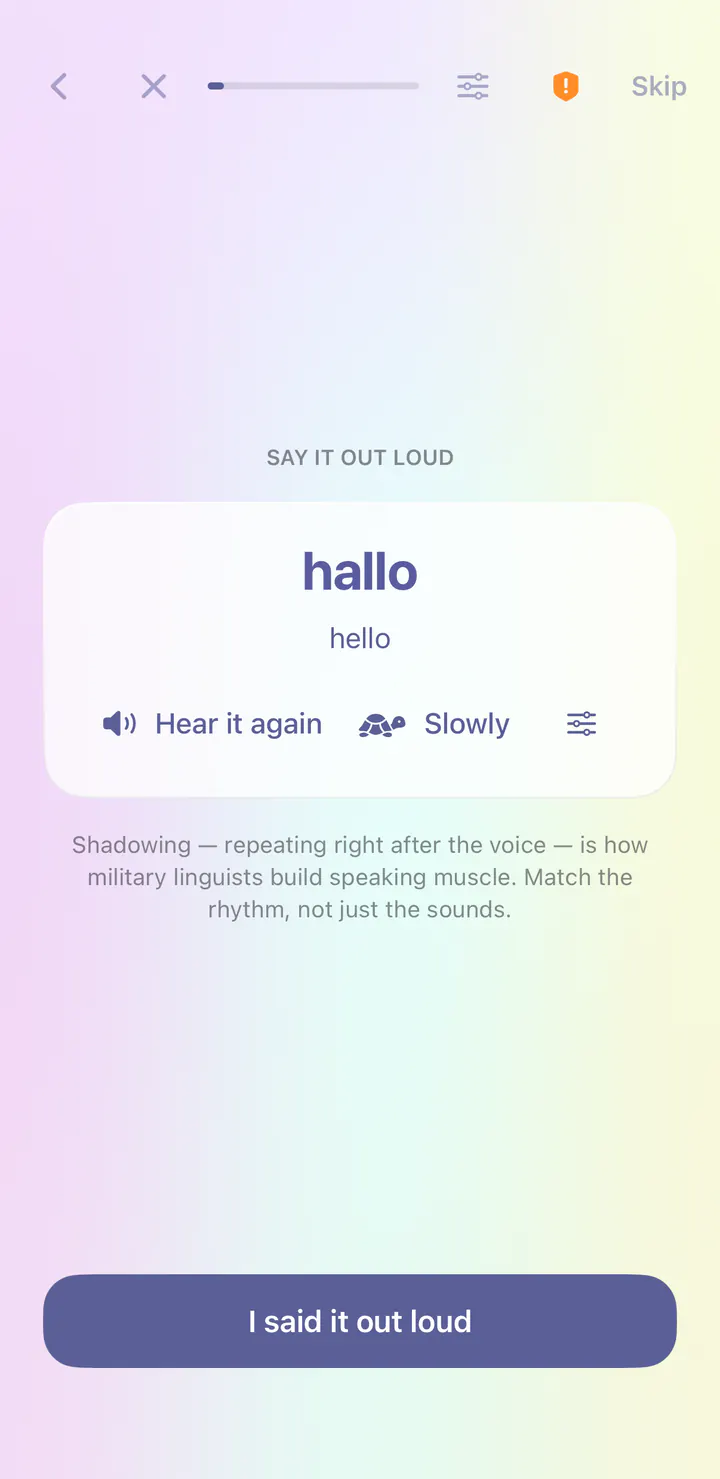
Say it out loud next.
The Loquus app turns lessons like this into guided conversations and speaking practice, with normal and slow audio. On iPhone and iPad, speech recognition runs on your device.
Free to start. No account needed.
By Loquus ·
Sources
- Taaladvies: Standaardtaal in België
- Vlaanderen Team Taaladvies: Gij, ge (gebruik)
- Vlaanderen.be: U of je?
- Taaladvies: U heeft / hebt
- Taaladvies: D / dt (tegenwoordige tijd): u rijd / u rijdt
- Taaladvies: Inversie
- Taaladvies: Vraagzin
- Taaladvies: Voornaamwoord
- Taaladvies: Infinitief
- Taaladvies: Persoonsvorm
Learning research behind the practice
Worked examples, retrieval practice, and later review inform the activities. These studies do not establish the effectiveness of this specific lesson.