Let the needed answer choose the question
Before building a question, decide what a helpful reply would contain. Ben je hier? asks whether the listener is here, while Waar ben je? asks for a location. A yes or no question requests confirmation. An information question requests a particular missing detail. The distinction is practical: an answer can be grammatically correct and still be unhelpful if the question asked for a place but the speaker supplies a time.
Use a small inventory of question intentions at first. Ask for a person, an object or activity, a place, a time and a manner. Connect each intention to an ordinary situation such as meeting a friend or finding a room. Do not memorize the question word without imagining its answer. When you later hear the same word in a longer sentence, that meaning will help you identify the important missing information even if some surrounding vocabulary is unfamiliar.
References for this explanation
Put the conjugated verb first for confirmation
A neutral yes or no question normally begins with the conjugated verb, the verb form that agrees with the subject. Compare Je hebt tijd and Heb je tijd? The subject follows the verb in the question, an order called inversion. With familiar singular je or jij, the regular present t disappears in this inverted position. Formal u keeps its ending: Hebt u tijd? The alternative Heeft u tijd? is also standard. Choose one consistent model while recognizing both acceptable forms.
English often inserts do to form a present question. Dutch generally uses the conjugated verb already in the sentence. Werk je hier? asks whether you work here, without an extra verb. If a sentence contains a modal verb such as willen, “to want”, and an infinitive, the conjugated modal opens the question and the infinitive goes to the end: Wil je koffie drinken? Keep the question's intended meaning in view. Asking whether someone wants coffee is different from asking whether they are already drinking it.
Watch the decision
Model: ask where a friend works.
- Identify the missing information as a place. Choose waar, then retrieve werken for the activity and je for the familiar listener.
- The question phrase comes first and the conjugated verb follows. Since je follows the verb, use werk without the added t.
- Check the intended reply category. A location such as here fits; a time such as tomorrow would answer a different question.
Waar werk je?
Choose wie and wat by the missing role
The word wie asks about a person and wat often asks about a thing, activity or content. Wie werkt hier? asks who works here. The question word itself serves as subject, so there is no extra subject pronoun after the verb. Wat drink je? asks what the listener drinks; here je is the subject and wat asks about the object. The surface sequence differs because the question words fill different grammatical roles.
Read a prospective answer into the gap. A person’s name can answer Wie werkt hier? A drink can answer Wat drink je? This substitution test makes the role concrete. It also shows why a question word should not be chosen merely because it resembles an English word. In production, keep the verb familiar and vary the missing role. You will learn more from explaining a short who versus what contrast than from copying a long question whose structure you cannot yet identify.
References for this explanation
Ask for place and time
The word waar asks where and wanneer asks when. Compare Waar werk je? and Wanneer werk je? The shared verb and subject make the contrast clear. One reply should identify a place, and the other should identify a time. The word hier, “here”, fits a place question. The word morgen, “tomorrow”, fits a time question. Longer replies can add detail, but the basic category should still match what was asked.
For movement, a more specific question can use waarheen, where to, or a phrase such as waar ... naartoe. This beginner lesson focuses production on ordinary location and time questions, while reminding you that English where can hide direction distinctions. Do not assume that one isolated question pattern covers every preposition or movement verb. When you need a practical answer, a short question with clear context is often sufficient. Build complexity only when the destination or origin genuinely needs to be distinguished from current location.
References for this explanation
Use hoe in familiar expressions
The word hoe asks how and appears in several useful expressions. Hoe heet je? asks a familiar listener's name, literally using the verb for being called. Hoe heet u? asks the same information formally. Hoe gaat het? asks how things are going. These are useful complete phrases to learn, because translating every English word separately can produce an unnatural or incorrect question.
Question phrases can contain more than one word, such as hoe laat, what time, and hoeveel, how much or how many depending on the noun. Hoe laat is het? asks the current time. The whole question phrase occupies the opening position before the conjugated verb. This is another reason to think in phrases rather than counting printed words. Learn the expression, identify the verb and the information it requests, then try a reply that fits. A name, a reply about how someone is doing and a clock time are not interchangeable answers.
Complete the reasoning
Guided: answer yes when asked whether you have time.
- The other speaker addresses you with je. In your own response, identify yourself with ik. This perspective shift is part of the meaning, not only a grammar exercise.
- Recall the first person form of hebben. Build a statement after the initial affirmative word rather than copying the question order.
- Read the full answer and confirm that it describes your availability, not the other person’s availability.
Compare your reasoning
Ja, ik heb tijd.
References for this explanation
Keep address and clause type consistent
The familiar and formal forms change more than the pronoun in some questions. Werk je hier? and Werkt u hier? show the ending difference. Heb je tijd? and Hebt u tijd? do the same. A formal question is not made simply by adding a word for “please” to a familiar verb form. Choose the relationship first and use a matching subject and verb. Context determines which address form is appropriate; the grammar then follows that choice.
An indirect question inside a statement has another pattern. Waar werkt hij? is direct, while Ik weet waar hij werkt places the conjugated verb at the end of the embedded clause. The same information can therefore appear in different word orders depending on whether you ask it directly or report knowing it. Keep your first independent questions short and direct, but learn to recognize the embedded arrangement so it does not look like a random reversal of the rule.
References for this explanation
Answer with the right perspective
A conversation changes who is speaking. If someone asks Heb je tijd?, your full positive answer is Ja, ik heb tijd. The question's je becomes the answer's ik. Copying the question's subject into the reply would change the person being discussed. This perspective change is simple in meaning but useful to practice explicitly. A short answer may be natural, yet a full practice reply reveals whether you understand the participants.
Before ordering the dialogue, assign each turn a job: opening, location question, answer, time question and closing acknowledgment. Then produce a similar exchange from memory with one changed detail. The game checks whether you understand how the turns connect; the production tasks check whether you can create those turns yourself. Return later and ask the questions without seeing their models. When checking, inspect the requested information, address choice, verb ending and word order separately so you know exactly what needs improvement.
References for this explanation
See it in a sentence
Heb je tijd?
Do you have time?
The conjugated verb opens the familiar question.
Hebt u tijd?
Do you have time?
Formal u keeps the t ending.
Werk je hier?
Do you work here?
Dutch does not add a verb like English do.
Wie werkt hier?
Who works here?
The word wie itself is the subject.
Wat drink je?
What are you drinking?
The word wat asks about the drink.
Waar werk je?
Where do you work?
The word waar asks for a place.
Wanneer werk je?
When do you work?
The word wanneer asks for a time.
Hoe heet je?
What is your name?
The familiar name question uses heten.
Hoe heet u?
What is your name?
The formal name question retains the same spelling heet.
Hoe laat is het?
What time is it?
The phrase hoe laat requests a clock time.
Ja, ik heb tijd.
Yes, I have time.
The answer shifts perspective to the speaker.
Ik weet waar hij werkt.
I know where he works.
The embedded question ends with werkt.
Notice the difference
Common mistakes
Use wanneer, not waar, to ask about a time
Instead ofWaar werk je? Morgen.
For this meaningWanneer werk je? Morgen.
The reply morgen names a time, not a place, so the question must use wanneer, not waar.
Do not duplicate the subject
Instead ofWie hij komt?
For this meaningWie komt?
The word wie itself asks for the subject, so a separate hij is unnecessary in this neutral question.
Keep the t ending with formal u
Instead ofHeb u tijd?
For this meaningHebt u tijd?
Formal u retains the t ending. Heeft u tijd? is also accepted.
From understanding to using
Make your own example.
Try these without answer choices. Say your answer aloud or write it below, then compare your reasoning with the model.
Your turn 1
Ask where and when a friend works.
Compare with a model
Waar werk je? Wanneer werk je?
Where do you work? When do you work?
Only the requested information changes. Keeping the subject and action constant makes the difference between location and time easy to explain and hear.
- Use waar for place.
- Use wanneer for time.
- Keep werk without t before je.
Your turn 2
Ask a formally addressed listener their name and whether they have time.
Compare with a model
Hoe heet u? Hebt u tijd?
What is your name? Do you have time?
The first question uses a learned name expression. The second begins directly with its conjugated verb. Both preserve formal address, and hebt retains its t after inversion.
- Use u consistently.
- Keep heet in the name expression.
- Accept heeft as another valid form in the second question.
Put it into practice
Make the next choice.
Choose a response and learn why it works. Your score reflects your first answer to each question. You can revisit anything you miss.
Choose an answer, then open the explanation to check your reasoning.
Question 1
Ask for a workplace location.
- Waar werk je?
- Wanneer werk je?
Check the answer
Answer: Waar werk je?
Waar werk je?: The word waar asks for the place.
Wanneer werk je?: The word wanneer asks for a time.
Question 2
Ask who works here.
- Wie hij werkt hier?
- Wie werkt hier?
Check the answer
Answer: Wie werkt hier?
Wie hij werkt hier?: Adding hij duplicates the subject.
Wie werkt hier?: The word wie is already the subject.
Question 3
Ask a friend their name.
- Hoe heet je?
- Wat naam je?
Check the answer
Answer: Hoe heet je?
Hoe heet je?: Dutch uses the established expression with heten.
Wat naam je?: This has no appropriate conjugated verb or normal question structure.
Question 4
Ask for the current clock time.
- Hoe heet het?
- Hoe laat is het?
Check the answer
Answer: Hoe laat is het?
Hoe heet het?: Hoe heet het? asks what something is called.
Hoe laat is het?: The phrase hoe laat requests time.
Question 5
Choose a full reply to Heb je tijd? from your own perspective.
- Ja, ik heb tijd.
- Ja, je hebt tijd.
Check the answer
Answer: Ja, ik heb tijd.
Ja, ik heb tijd.: The word ik identifies the person now answering.
Ja, je hebt tijd.: The word je would make a statement about the other person.
Question 6
Ask formally whether the listener works here.
- Werk u hier?
- Werkt u hier?
Check the answer
Answer: Werkt u hier?
Werk u hier?: The jij ending exception does not apply to u.
Werkt u hier?: The pronoun u retains its t in inversion.
Question 7
Choose the reply that fits Wat drink je?
- Koffie.
- Morgen.
Check the answer
Answer: Koffie.
Koffie.: Coffee identifies what is being drunk.
Morgen.: Tomorrow answers a time question.
Question 8
Recall the meaning of Heb je tijd?
- Who works here?
- Do you have time?
Check the answer
Answer: Do you have time?
Who works here?: That meaning belongs to Wie werkt hier? The conjugated verb opens the familiar question.
Do you have time?: The conjugated verb opens the familiar question. The complete meaning is “Do you have time?”
Question 9
Recall the meaning of Hebt u tijd?
- Do you have time?
- When do you work?
Check the answer
Answer: Do you have time?
Do you have time?: Formal u keeps the t ending. The complete meaning is “Do you have time?”
When do you work?: That meaning belongs to Wanneer werk je? Formal u keeps the t ending.
Question 10
Recall the meaning of Werk je hier?
- When do you work?
- Do you work here?
Check the answer
Answer: Do you work here?
When do you work?: That meaning belongs to Wanneer werk je? Dutch does not add a verb like English do.
Do you work here?: Dutch does not add a verb like English do. The complete meaning is “Do you work here?”
Question 11
Recall the meaning of Wie werkt hier?
- Who works here?
- What time is it?
Check the answer
Answer: Who works here?
Who works here?: The word wie itself is the subject. The complete meaning is “Who works here?”
What time is it?: That meaning belongs to Hoe laat is het? The word wie itself is the subject.
Question 12
Recall the meaning of Wat drink je?
- Do you have time?
- What are you drinking?
Check the answer
Answer: What are you drinking?
Do you have time?: That meaning belongs to Heb je tijd? The word wat asks about the drink.
What are you drinking?: The word wat asks about the drink. The complete meaning is “What are you drinking?”
Question 13
Recall the meaning of Waar werk je?
- Where do you work?
- Who works here?
Check the answer
Answer: Where do you work?
Where do you work?: The word waar asks for a place. The complete meaning is “Where do you work?”
Who works here?: That meaning belongs to Wie werkt hier? The word waar asks for a place.
Question 14
Recall the meaning of Wanneer werk je?
- What is your name?
- When do you work?
Check the answer
Answer: When do you work?
What is your name?: That meaning belongs to Hoe heet je? The word wanneer asks for a time.
When do you work?: The word wanneer asks for a time. The complete meaning is “When do you work?”
Conversation builder
Find out where and when
Put the turns in a coherent order. Use the question and response meanings before checking.
- Hallo. Heb je tijd?
Hello. Do you have time?
- Ja, ik heb tijd. Wat wil je weten?
Yes, I have time. What would you like to know?
- Waar werk je?
Where do you work?
- Ik werk in Gent.
I work in Ghent.
- Wanneer werk je in Gent?
When do you work in Ghent?
- Morgen.
Tomorrow.
Keep the conversation going
What to practice next
After a break, go back to your own examples above and do each task again without looking at the models. Compare the meaning and form with the models, and fix each mistake by explaining its cause. Then use one of your sentences in a short conversation of your own.
Keep it going in the app
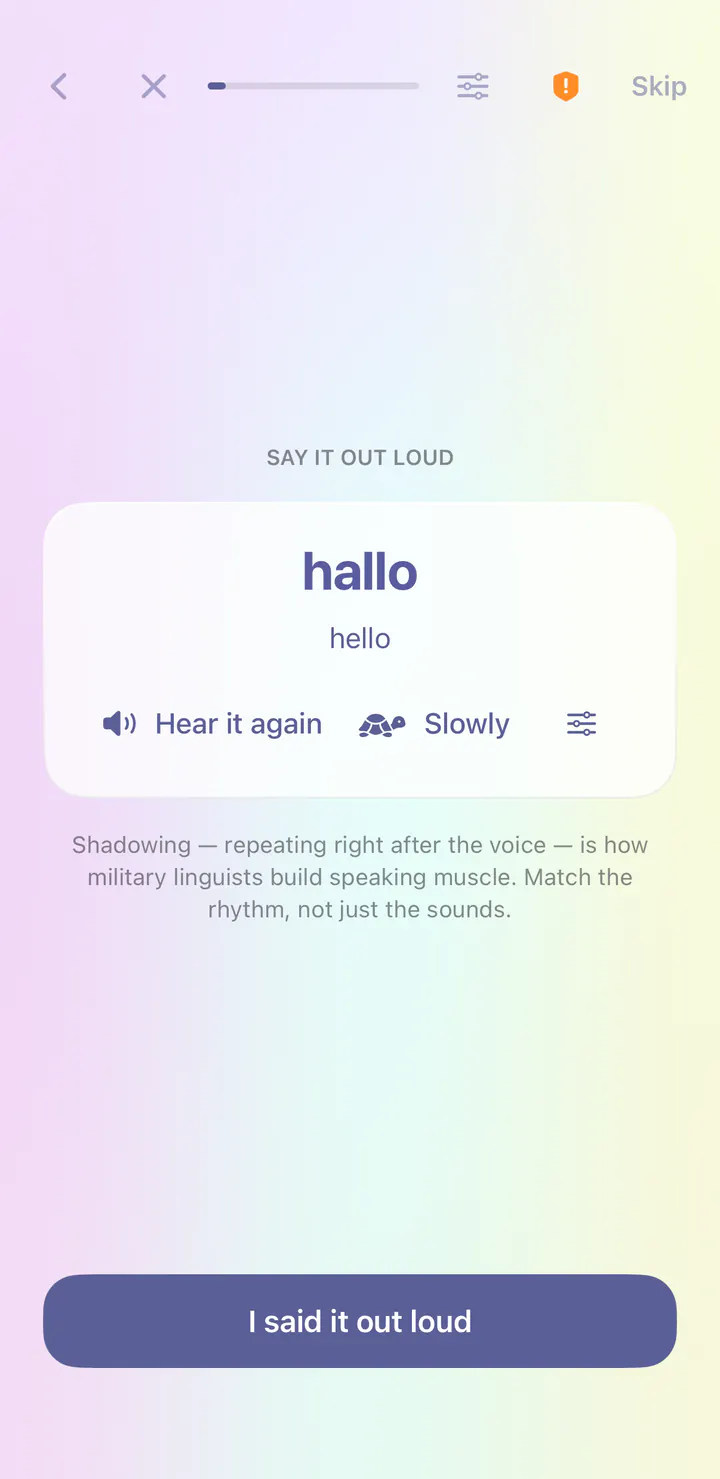
Say it out loud next.
The Loquus app turns lessons like this into guided conversations and speaking practice, with normal and slow audio. On iPhone and iPad, speech recognition runs on your device.
Free to start. No account needed.
By Loquus ·
Sources
- Taaladvies: Vraagzin
- Taaladvies: Inversie
- Taaladvies: Persoonsvorm
- Taaladvies: Onderwerp
- Taaladvies: Hoofdzin
- Taaladvies: Bijzin
- Taaladvies: Voornaamwoord
- Taaladvies: D / dt (tegenwoordige tijd): u rijd / u rijdt
- Taaladvies: U heeft / hebt
- Taaladvies: Infinitief
Learning research behind the practice
Worked examples, retrieval practice, and later review inform the activities. These studies do not establish the effectiveness of this specific lesson.