Choose the kind of answer you need
A useful question begins with an information need. Do you need confirmation that someone is here, or do you need the person's location? Ist er hier? allows a yes or no answer. Wo ist er? asks for a place. Choosing the question type before arranging words helps you avoid grammatically correct questions that request the wrong information. Imagine what a helpful reply would contain, then choose a structure that invites that reply.
In English, question formation often requires do or does. German normally uses the conjugated verb itself in the opening structure. A simple present action question does not need an added equivalent of do. Keep the subject and verb agreement from the statement you are transforming. If you change the addressee from familiar du to formal Sie, that is a separate change requiring another verb form. Work with one intended person and one intended answer at a time while the patterns are new.
References for this explanation
Build a yes or no question
Start with a short statement such as Du hast Zeit. Its conjugated verb is hast, and its subject is du. To ask whether that statement is true, say Hast du Zeit? The conjugated verb opens the question and the subject follows. With sein, compare Sie sind hier and Sind Sie hier? when Sie means formal you. The question changes the communicative purpose while keeping the person and content stable.
With a modal, the conjugated modal comes first and its infinitive remains at the end. Kannst du kommen? asks whether a familiar listener can come. Do not move the infinitive to the front simply because it expresses the main action in English. Identify which verb carries the person ending. A short answer such as Ja may be sufficient in conversation, but practice full replies too: Ja, ich kann kommen. The fuller answer makes the changed speaker perspective visible.
Watch the decision
Model: ask when one familiar listener is coming.
- Identify the missing information as time, so choose wann. The listener is one familiar person, so use du.
- Retrieve kommen and form kommst. The opening question word is not the subject; the conjugated verb follows it, and du follows the verb.
- Check that a time expression such as heute could answer the question. If your expected reply were a place, you would need a different question word.
Wann kommst du?
Ask what, who and when
For information questions, useful words include was, what, wer, who, and wann, when. Was lernst du? asks about the thing being learned. Wann kommst du? asks about time. In these examples, the question word or phrase comes first, followed by the conjugated verb and then the subject. An answer should fill the missing information rather than merely repeat the question word. The adverb heute can answer wann, but it does not identify what someone studies.
When wer itself is the subject, the structure is different in an important way: Wer kommt? already contains its subject in the question word. There is no need to add er or sie. For a person as the direct object, use wen, as in Wen siehst du? This is a case distinction, not a difference between formal and familiar address. For a first conversation, master wer as a subject and recognize wen as the question word for the person receiving the action.
References for this explanation
Distinguish location, origin and destination
English where can hide several intentions. German makes a useful distinction among wo, where at, woher, where from, and wohin, where to. Wo bist du? asks where someone is. Woher kommst du? commonly asks where someone comes from. Wohin gehst du? asks for a destination. These words help the listener know whether to name a current place, an origin or the endpoint of movement.
Do not choose the word merely because a verb involves motion. A question can ask where an activity happens, where a journey begins or where it ends. Focus on the missing relationship. If the intended answer is “here,” a location question is appropriate. If the intended answer is “to Berlin,” you need a destination question. This lesson keeps the replies short because prepositions and place names introduce further grammatical patterns. Learn the three question words as a meaningful contrast, then expand the answers as your vocabulary grows.
References for this explanation
Ask how with wie and keep the question phrase together
The question word wie often asks how, as in Wie geht es dir?, which asks how a familiar person is. Useful combinations can contain several words. The phrase wie lange asks how long and wie viel asks how much. The entire question phrase occupies the opening position before the conjugated verb. Counting words instead of phrases would give the wrong explanation of why a verb is not visually the second word.
Begin by learning a few complete expressions whose meaning you need. Wie heißen Sie? asks a formally addressed person's name. German expresses this with heißen, rather than mechanically translating each word of What is your name? The familiar question is Wie heißt du? Both request the same kind of information while adjusting address and agreement. Question words are productive tools, but many everyday questions also have established wording. Store the useful expression and understand enough of its structure to change the person accurately.
Complete the reasoning
Guided: ask where the listener is going to.
- Decide whether the missing place is a location, an origin or a destination. Here it is the endpoint of movement, which selects one of the three place question words.
- Use gehen with familiar singular du. Before viewing the answer, place the conjugated form after the question word and the subject after the verb.
- Read the result as a practical request for a destination. Keep the choice of question word distinct from the later choice of a preposition in the reply.
Compare your reasoning
Wohin gehst du?
References for this explanation
Keep a direct question separate from a reported one
A direct question such as Wo wohnt er? has question order. If it becomes part of a larger sentence, the order changes: Ich weiß, wo er wohnt. The second clause reports the information rather than asking the listener directly. Its conjugated verb is at the end. You can recognize this difference without trying to produce long sentences immediately. First find the clause boundary and identify whether the words form the question being asked or an embedded piece of information.
A yes or no question can be embedded with ob, whether: Ich weiß nicht, ob er kommt. The direct version is Kommt er? In the longer sentence, kommt ends the dependent clause. This exception to the pattern of starting a yes or no question with the verb has a clear reason: the clause type has changed. Do not learn both orders as interchangeable alternatives. Attach each pattern to its communicative job, and keep your own initial questions direct until the embedded contrast is familiar.
References for this explanation
Practice listening for the missing information
To answer well, listen first for the question word and then for the verb and subject. The question word wann directs you toward a time, wo toward a location and wer toward a person. The rest of the sentence tells you whose time, location or identity matters. A correct noun from the lesson can still be an unhelpful answer if it fills the wrong slot. Match the reply to the question's intention before checking details of the verb.
For retrieval practice, write six intentions without German models: ask whether a friend has time, ask where the friend is, ask when the friend is coming, ask where the friend is going, ask a formal listener's name, and ask who is coming. Produce the German aloud and then check one decision at a time. Return later and answer your own questions from another speaker's perspective. This moves the skill from recognizing a question word to maintaining a short exchange with a coherent purpose.
See it in a sentence
Hast du Zeit?
Do you have time?
A yes or no question begins with the conjugated verb.
Sind Sie hier?
Are you here?
Formal Sie takes sind.
Kannst du kommen?
Can you come?
The modal opens and the infinitive closes the question.
Was lernst du?
What are you learning?
The question word was requests the object of learning.
Wann kommst du?
When are you coming?
The question word wann asks for a time.
Wer kommt?
Who is coming?
The question word wer is the subject.
Wen siehst du?
Whom do you see?
The question word wen asks about a person as the direct object.
Wo bist du?
Where are you?
The question word wo asks about location.
Woher kommst du?
Where do you come from?
The question word woher asks about origin.
Wohin gehst du?
Where are you going?
The question word wohin asks about destination.
Wie heißen Sie?
What is your name?
The established name question uses heißen.
Ich weiß, wo er wohnt.
I know where he lives.
The indirect question places wohnt last.
Notice the difference
Common mistakes
Use wohin, not woher, for a destination
Instead ofWoher gehst du?
For this meaningWohin gehst du?
For the intended destination question, use wohin. The question word woher would ask about a starting point.
Do not add English do
Instead ofTust du Deutsch lernen?
For this meaningLernst du Deutsch?
The ordinary neutral present question uses the conjugated form of lernen directly. The extra construction is not the basic question pattern taught here.
Put the verb last in an indirect question
Instead ofIch weiß, wo wohnt er.
For this meaningIch weiß, wo er wohnt.
The question is embedded after weiß, so its conjugated verb comes last.
From understanding to using
Make your own example.
Try these without answer choices. Say your answer aloud or write it below, then compare your reasoning with the model.
Your turn 1
Ask a friend whether they have time and when they are coming.
Compare with a model
Hast du Zeit? Wann kommst du?
Do you have time? When are you coming?
The first question requests confirmation and starts with its conjugated verb. The second requests a particular time and begins with wann. Both retain the familiar singular addressee.
- Use hast with du.
- Start the information question with wann.
- Imagine a plausible answer to each.
Your turn 2
Ask a friend where they are, where they come from and where they are going.
Compare with a model
Wo bist du? Woher kommst du? Wohin gehst du?
Where are you? Where do you come from? Where are you going?
The three questions distinguish a location from an origin and a destination. Each uses a verb suited to the intended relationship, so the exercise is more than swapping the first word mechanically.
- Choose wo, woher and wohin by meaning.
- Keep all three verbs matched to du.
- Explain how the answers would differ.
Put it into practice
Make the next choice.
Choose a response and learn why it works. Your score reflects your first answer to each question. You can revisit anything you miss.
Choose an answer, then open the explanation to check your reasoning.
Question 1
Ask for a destination.
- Wohin gehst du?
- Woher kommst du?
Check the answer
Answer: Wohin gehst du?
Wohin gehst du?: The question word wohin asks where someone is going to.
Woher kommst du?: The question word woher asks about origin, not destination.
Question 2
Ask about someone’s current location.
- Wann bist du hier?
- Wo bist du?
Check the answer
Answer: Wo bist du?
Wann bist du hier?: The question word wann requests a time.
Wo bist du?: The question word wo requests a place.
Question 3
Choose the question that heute can answer.
- Wann kommst du?
- Wer kommt?
Check the answer
Answer: Wann kommst du?
Wann kommst du?: The adverb heute gives a time, so it answers wann.
Wer kommt?: The question word wer asks for a person.
Question 4
Ask who is coming.
- Wer er kommt?
- Wer kommt?
Check the answer
Answer: Wer kommt?
Wer er kommt?: Adding er duplicates the subject in this neutral question.
Wer kommt?: The question word wer itself serves as the subject.
Question 5
Ask a formally addressed person their name.
- Wie heißen Sie?
- Wie heißt Sie?
Check the answer
Answer: Wie heißen Sie?
Wie heißen Sie?: Formal Sie requires heißen.
Wie heißt Sie?: The form heißt matches du, ihr or a third person singular subject, not formal Sie.
Question 6
Choose a direct question.
- Wo er wohnt?
- Wo wohnt er?
Check the answer
Answer: Wo wohnt er?
Wo er wohnt?: That order belongs inside a dependent clause in this lesson.
Wo wohnt er?: A neutral direct question puts the conjugated verb after wo.
Question 7
Ask about a person you see.
- Wen siehst du?
- Wer siehst du?
Check the answer
Answer: Wen siehst du?
Wen siehst du?: The person seen is an accusative object, so use wen.
Wer siehst du?: The question word wer is nominative and does not fill the direct object role here.
Question 8
Recall the meaning of Hast du Zeit?
- I know where he lives.
- Do you have time?
Check the answer
Answer: Do you have time?
I know where he lives.: That meaning belongs to Ich weiß, wo er wohnt. A yes or no question begins with the conjugated verb.
Do you have time?: A yes or no question begins with the conjugated verb. The complete meaning is “Do you have time?”
Question 9
Recall the meaning of Sind Sie hier?
- Are you here?
- What are you learning?
Check the answer
Answer: Are you here?
Are you here?: Formal Sie takes sind. The complete meaning is “Are you here?”
What are you learning?: That meaning belongs to Was lernst du? Formal Sie takes sind.
Question 10
Recall the meaning of Kannst du kommen?
- Whom do you see?
- Can you come?
Check the answer
Answer: Can you come?
Whom do you see?: That meaning belongs to Wen siehst du? The modal opens and the infinitive closes the question.
Can you come?: The modal opens and the infinitive closes the question. The complete meaning is “Can you come?”
Question 11
Recall the meaning of Was lernst du?
- What are you learning?
- Where are you going?
Check the answer
Answer: What are you learning?
What are you learning?: The question word was requests the object of learning. The complete meaning is “What are you learning?”
Where are you going?: That meaning belongs to Wohin gehst du? The question word was requests the object of learning.
Question 12
Recall the meaning of Wann kommst du?
- Do you have time?
- When are you coming?
Check the answer
Answer: When are you coming?
Do you have time?: That meaning belongs to Hast du Zeit? The question word wann asks for a time.
When are you coming?: The question word wann asks for a time. The complete meaning is “When are you coming?”
Question 13
Recall the meaning of Wer kommt?
- Who is coming?
- What are you learning?
Check the answer
Answer: Who is coming?
Who is coming?: The question word wer is the subject. The complete meaning is “Who is coming?”
What are you learning?: That meaning belongs to Was lernst du? The question word wer is the subject.
Question 14
Recall the meaning of Wen siehst du?
- Where are you?
- Whom do you see?
Check the answer
Answer: Whom do you see?
Where are you?: That meaning belongs to Wo bist du? The question word wen asks about a person as the direct object.
Whom do you see?: The question word wen asks about a person as the direct object. The complete meaning is “Whom do you see?”
Keep the conversation going
What to practice next
After a break, go back to your own examples above and do each task again without looking at the models. Compare the meaning and form with the models, and fix each mistake by explaining its cause. Then use one of your sentences in a short conversation of your own.
Keep it going in the app
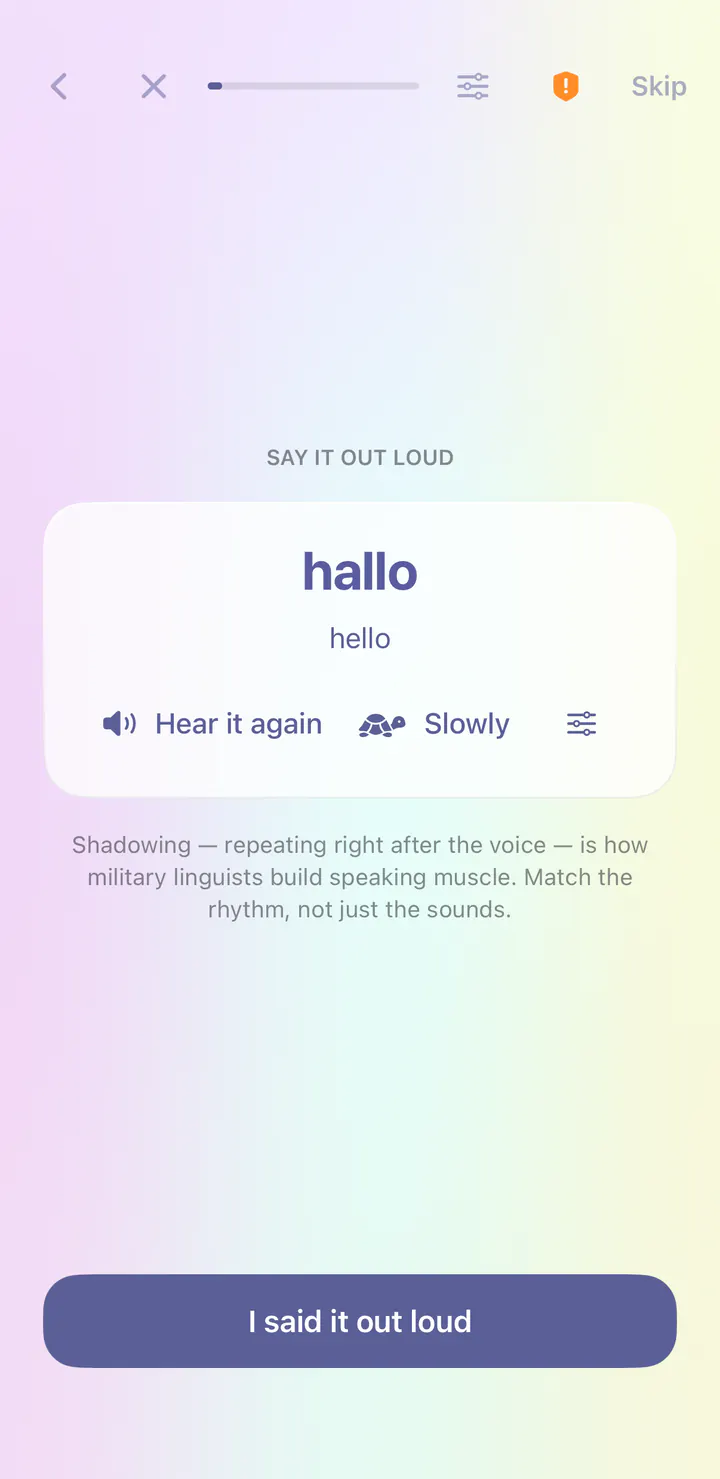
Say it out loud next.
The Loquus app turns lessons like this into guided conversations and speaking practice, with normal and slow audio. On iPhone and iPad, speech recognition runs on your device.
Free to start. No account needed.
By Loquus ·
Sources
- University of Texas Grimm Grammar: Interrogatives
- University of Texas Grimm Grammar: Word order
- University of Texas Grimm Grammar: Nominative pronouns
- University of Texas Grimm Grammar: Present regular verbs
- University of Texas Grimm Grammar: Sein
- University of Texas Grimm Grammar: Haben
- University of Texas Grimm Grammar: Modal verbs present tense
- University of Texas Grimm Grammar: Adverbs of time, frequency, quantity, intensity
- University of Texas Grimm Grammar: Adverbs of manner and place
- University of Texas Grimm Grammar: Subordinating conjunctions
- University of Texas Grimm Grammar: Accusative case
Learning research behind the practice
Worked examples, retrieval practice, and later review inform the activities. These studies do not establish the effectiveness of this specific lesson.