1. Identify the class before building the description
An adjective describes a property, such as size, temperature, convenience, or quietness. Japanese does not put all these words into one identical pattern. The two beginner classes are commonly called i adjectives and na adjectives. 大きい, “big,” belongs to the first; 静か, “quiet,” belongs to the second. The class determines how the word joins a noun and how a complete predicate, the part that ends the sentence and makes its statement, changes for negation or past time.
A visible final い is a useful clue, but it is not a complete classification rule. きれい, “clean” or “beautiful,” and きらい, “disliked,” are na adjectives even though their kana spellings end in い. A dictionary class label or a confirmed phrase such as きれいな部屋 is better evidence than the final letter of a romanized word. Learn an adjective with one noun phrase and one complete sentence to make its behavior memorable.
English can conceal the distinction because both classes often appear after is. A phrase such as is quiet therefore does not tell you to search for a separate Japanese verb meaning “is” and then attach the adjective unchanged, as English does. Start with the Japanese adjective and its known pattern. That approach also helps when reading a short label, where a noun phrase may appear without a full sentence ending.
The class is grammatical, not a ranking of intensity or politeness. Both classes can describe ordinary objects, and either can appear in a polite conversation. A room can be big and quiet at the same time, but the two descriptions still follow different patterns. For this lesson, build one description at a time before combining several properties. That keeps the choice of ending visible and prevents a correct meaning from hiding an incorrect grammatical form.
大きい部屋
ōkii heya
A big room.
静かな部屋
shizuka na heya
A quiet room.
2. Use an i adjective before a noun or with です
An i adjective can directly modify a following noun. 新しい本 means “a new book”: the adjective 新しい comes before 本, without な between them. The final い belongs to this dictionary form. Do not remove it merely because another word follows. Likewise, 大きいかばん means “a big bag,” with the adjective immediately before the noun it describes.
To make a polite statement about a known object, place the adjective at the end and add です. この本は新しいです means “This book is new.” Here the whole noun phrase この本 is the topic, the thing the sentence is about, and 新しいです supplies the description. The adjective remains before です. English places is before the adjective, but that word order is not copied into Japanese.
A noun phrase and a full statement serve different jobs. 新しい本 can identify which book you mean inside a larger sentence. この本は新しいです tells the listener something about the book. If you place です inside the noun phrase, as in 新しいです本, you interrupt the modifier relationship. First decide whether you are naming a described object or making a statement about it. Then choose the appropriate structure rather than adding a polite ending after every descriptive word you recognize.
新しい本
atarashii hon
A new book.
この本は新しいです。
Kono hon wa atarashii desu.
This book is new.
3. Add な only where the noun pattern needs it
A na adjective uses な when it directly modifies a noun in the affirmative present pattern, which also covers future descriptions. 静かな部屋 means “a quiet room,” and 便利な店 means “a convenient store.” The な connects the descriptive stem, the part before な, to the following noun. It is not an English article, and it does not tell you whether the noun is singular or plural.
In a basic polite predicate, use the stem with です and omit that attributive な. この部屋は静かです means “This room is quiet.” The sentence does not need 静かなです. Compare the two complete patterns side by side: 静かな部屋 names a room with a property, while 部屋は静かです states the property. The change reflects the adjective’s grammatical position rather than a change in the meaning “quiet.”
Do not replace な with の simply because earlier lessons connected two nouns with の. A noun modifier and a na adjective modifier are different patterns. Japanese has words whose usage can cross categories, but that does not make every connection interchangeable. With the ordinary adjective 静か, learn 静かな部屋. With the noun 日本語, learn 日本語の本. The reliable beginner strategy is to keep the word’s confirmed category and its model phrase together, then extend that model to a new noun.
便利な店
benri na mise
A convenient store.
この部屋は静かです。
Kono heya wa shizuka desu.
This room is quiet.
Worked example: name a quiet room
Build the noun phrase meaning “a quiet room” from 静か and 部屋.
- Identify 静か as a na adjective.
- Because it directly modifies 部屋, insert な after the adjective stem.
- Do not add です inside the noun phrase.
静かな部屋。 Shizuka na heya. “A quiet room.”
4. Negate each class with its own pattern
For an i adjective, replace the final い with くない to make the ordinary negative form. 高い, “expensive” or “high,” becomes 高くない. Add です for a polite conversational predicate: 高くないです. Another polite negative is 高くありません. Both patterns are legitimate; do not mark one incorrect merely because an exercise happened to introduce the other first.
A na adjective keeps its descriptive stem and uses a nounlike negative pattern. 静かではありません means “is not quiet.” In conversation, じゃありません or じゃないです is also common. For a stable first production pattern, use 静かではありません. Do not apply the i adjective operation to the final syllable of 静か and invent a form resembling 静くない.
The adjective いい, “good,” has an important irregularity. Its negative is よくない, not いくない; the alternative affirmative よい helps make that relationship visible. Learn いいです and よくないです as a pair. The negative does not automatically supply an opposite adjective. “Not expensive” is not necessarily “cheap,” and “not quiet” is not a precise measurement of noise. When an exercise asks you to negate a description, deny that description without adding a stronger judgment the context did not provide.
この本は高くないです。
Kono hon wa takakunai desu.
This book is not expensive.
この部屋は静かではありません。
Kono heya wa shizuka dewa arimasen.
This room is not quiet.
Guided example: deny an expensive price
The book is not expensive. Use 高い and a polite conversational negative.
- 高い is an i adjective.
- Replace final い with くない to make 高くない.
- Add です and make this book the topic.
Compare your reasoning
この本は高くないです。 Kono hon wa takakunai desu. “This book is not expensive.”
5. Put a past description in the adjective’s form
An i adjective changes its final い to かった for an affirmative past description. 寒い becomes 寒かった, and the polite form is 寒かったです. 昨日は寒かったです means “Yesterday was cold.” The past information is already in the adjective, so the ordinary beginner pattern does not use 寒いでした.
For an i adjective past negative, use くなかったです or the alternative くありませんでした. Thus 寒くなかったです means “was not cold.” The adjective いい again uses the よ form: よかったです means “was good,” and よくなかったです means “was not good.” Keep the affirmative and negative meanings separate while learning these forms. A familiar ending can still report the opposite of what you intend if you lose the negative part.
A na adjective uses でした for a polite past affirmative: 静かでした means “was quiet.” Its past negative can be 静かではありませんでした. This resembles the noun predicate pattern because the descriptive stem itself does not undergo the i adjective changes. A travel report might say that a room was quiet yesterday but is noisy today. The time frame and adjective ending work together. Do not assume that a quality described in the past must still hold now, or that a past description necessarily refers to a permanent trait.
昨日は寒かったです。
Kinō wa samukatta desu.
Yesterday was cold.
昨日の教室は静かでした。
Kinō no kyōshitsu wa shizuka deshita.
The classroom was quiet yesterday.
6. Adjust the degree and ask for an impression
A degree word can make a description more precise. とても before an adjective means “very” in the ordinary affirmative patterns practiced here. とても静かです describes a high degree of quietness. It does not change the adjective class or remove a required な before a noun. The degree word and the adjective’s grammatical form do different jobs.
あまり with a negative commonly means “not very.” あまり高くないです says “not very expensive” or “not very high,” depending on the subject. It need not mean “cheap” or “low.” The negative ending is part of this learned combination. Read the whole phrase before choosing an English interpretation; translating あまり independently of the predicate can reverse the intended degree.
To ask whether a property applies, add か to the polite predicate: 高いですか or 静かですか. To invite a more open impression, a question such as どうですか asks how it is. The reply should supply information relevant to that topic. If someone asks about the room, 静かです is a useful description; it does not require a repeated topic when the room is already clear. A question about what kind of room can also use どんな部屋ですか. Choose the question that asks for the information you actually lack.
とても静かです。
Totemo shizuka desu.
It is very quiet.
あまり高くないです。
Amari takakunai desu.
It is not very expensive.
7. Describe the intended object with the right scope
A description belongs to a particular object or feature. このかばんは大きいです describes the size of this bag. If the conversation instead concerns its price, 高い can mean “expensive,” and the surrounding context selects that meaning. A dictionary gloss is a starting point, not permission to use every meaning it gives in every situation. Choose clear beginner nouns and contexts while building your first descriptions.
Some sentences describe a topic through one of its features. 田中さんは髪が長いです says that Tanaka has long hair. The adjective 長い describes the hair, while Tanaka is the broader topic. This pattern is introduced here only to explain why a sentence may contain both は and が. Do not conclude that an adjective can only ever follow a single noun marked with は. The grammatical relationship matters more than counting particles, the short words such as は and が placed after a word or phrase to show its role.
Now choose a real or imagined room and make two short statements: one about its present condition and one about yesterday’s condition. Then turn one description into a noun phrase. Check whether its adjective needs direct attachment or な, and check whether the predicate has the right time and is affirmative or negative as intended. A successful description lets another person identify or assess the intended object. Reconstructing the message from meaning is more useful than reciting endings without knowing which property you have just affirmed.
このかばんは大きいです。
Kono kaban wa ōkii desu.
This bag is big.
田中さんは髪が長いです。
Tanaka san wa kami ga nagai desu.
Tanaka has long hair.
Notice the difference
Common mistakes
Don’t leave out な between a na adjective and its noun
Instead ofきれい部屋
For this meaningきれいな部屋
きれい is a na adjective and needs な before the noun here.
Do not add attributive な before です
Instead of静かなです
For this meaning静かです
The basic polite predicate uses the stem and です.
Don’t add な after an i adjective
Instead of新しいな本
For this meaning新しい本
新しい directly modifies 本 without な.
Don’t apply the regular negative pattern to いい
Instead ofいくないです
For this meaningよくないです
いい uses よくない in the negative.
From understanding to using
Make your own example.
Try these without answer choices. Say your answer aloud or write it below, then compare your reasoning with the model.
Your turn 1
Describe a clean room first as a noun phrase and then as a complete polite statement.
Compare with a model
きれいな部屋。この部屋はきれいです。 (Kirei na heya. Kono heya wa kirei desu.)
A clean room. This room is clean.
きれい is a na adjective despite its final い. It needs な before 部屋 and uses です directly as a predicate.
- Use な before the noun.
- Omit な before です.
- Keep the same property in both forms.
Your turn 2
Report that yesterday was not cold. Use the i adjective 寒い and a polite past negative.
Compare with a model
昨日は寒くなかったです。 (Kinō wa samukunakatta desu.)
Yesterday was not cold.
The adjective has the past negative form 寒くなかった. Polite です follows that complete form. 寒くありませんでした is another correct polite option.
- Preserve the negative meaning.
- Place the past change in the adjective pattern.
- Do not write 寒いでした.
Put it into practice
Make the next choice.
Choose a response and learn why it works. Your score reflects your first answer to each question. You can revisit anything you miss.
Choose an answer, then open the explanation to check your reasoning.
Question 1
Name a big room using the i adjective 大きい.
- 大きい部屋
- 大きいな部屋
Check the answer
Answer: 大きい部屋
大きい部屋: The i adjective directly modifies the noun.
大きいな部屋: な is not inserted after this i adjective.
Question 2
Name a quiet room using 静か.
- 静か部屋
- 静かな部屋
Check the answer
Answer: 静かな部屋
静か部屋: The ordinary modifier pattern needs な.
静かな部屋: This na adjective needs な before the noun.
Question 3
State politely that this room is quiet.
- この部屋は静かです。
- この部屋は静かなです。
Check the answer
Answer: この部屋は静かです。
この部屋は静かです。: The predicate uses 静か plus です.
この部屋は静かなです。: Attributive な does not belong before です here.
Question 4
You see the spelling きれい. Which class should guide a phrase meaning “a clean room”?
- I adjective
- Na adjective
Check the answer
Answer: Na adjective
I adjective: The last kana alone is not a reliable class test.
Na adjective: The confirmed form is きれいな部屋 despite the final い.
Question 5
Which noun phrase means “a new book”?
- 新しい本
- 新しいです本
Check the answer
Answer: 新しい本
新しい本: 新しい directly precedes 本.
新しいです本: です interrupts the noun modifier pattern.
Question 6
Negate 高い in an everyday polite sentence.
- 高いじゃないです
- 高くないです
Check the answer
Answer: 高くないです
高いじゃないです: That is not the ordinary i adjective negative requested here.
高くないです: Replace final い with くない, then add です.
Question 7
Negate 静か with the formal polite pattern introduced here.
- 静かではありません
- 静くありません
Check the answer
Answer: 静かではありません
静かではありません: The na adjective retains its stem.
静くありません: This incorrectly treats the stem as an i adjective.
Question 8
Say that the condition is not good, using いい.
- いくないです
- よくないです
Check the answer
Answer: よくないです
いくないです: This applies the regular spelling operation to an irregular adjective.
よくないです: いい has the irregular negative よくない.
Question 9
Report that yesterday was cold.
- 昨日は寒かったです。
- 昨日は寒いでした。
Check the answer
Answer: 昨日は寒かったです。
昨日は寒かったです。: The i adjective takes the past form 寒かった.
昨日は寒いでした。: The ordinary past change belongs inside the adjective form.
Question 10
Report that the room was quiet yesterday.
- 部屋は静かったです。
- 部屋は静かでした。
Check the answer
Answer: 部屋は静かでした。
部屋は静かったです。: This incorrectly applies the i adjective past pattern.
部屋は静かでした。: The na adjective uses the polite past でした.
Question 11
You are discussing a price and say あまり高くないです. What does it mean?
- Not very expensive
- Extremely expensive
Check the answer
Answer: Not very expensive
Not very expensive: The phrase denies a high degree of expense.
Extremely expensive: That reverses the degree and negative meaning.
Question 12
Ask whether the room is quiet.
- 部屋は静かますか。
- 部屋は静かですか。
Check the answer
Answer: 部屋は静かですか。
部屋は静かますか。: ます is a verb ending and does not attach to this adjective stem.
部屋は静かですか。: Add か to the complete polite predicate.
Question 13
In 田中さんは髪が長いです, what is directly described as long?
- Tanaka’s hair
- Tanaka’s height
Check the answer
Answer: Tanaka’s hair
Tanaka’s hair: 髪 is the feature described by 長い.
Tanaka’s height: Height is a different property and is not named here.
Question 14
Which interpretation is warranted by この本は高くないです in a price conversation?
- The book is free
- The book is not expensive
Check the answer
Answer: The book is not expensive
The book is free: “Not expensive” does not establish a price of zero.
The book is not expensive: The sentence denies the expensive description.
Keep the conversation going
What to practice next
After a break, go back to your own examples above and do each task again without looking at the models. Compare the meaning and form with the models, and fix each mistake by explaining its cause. Then use one of your sentences in a short conversation of your own.
Keep it going in the app
Make this pattern stick.
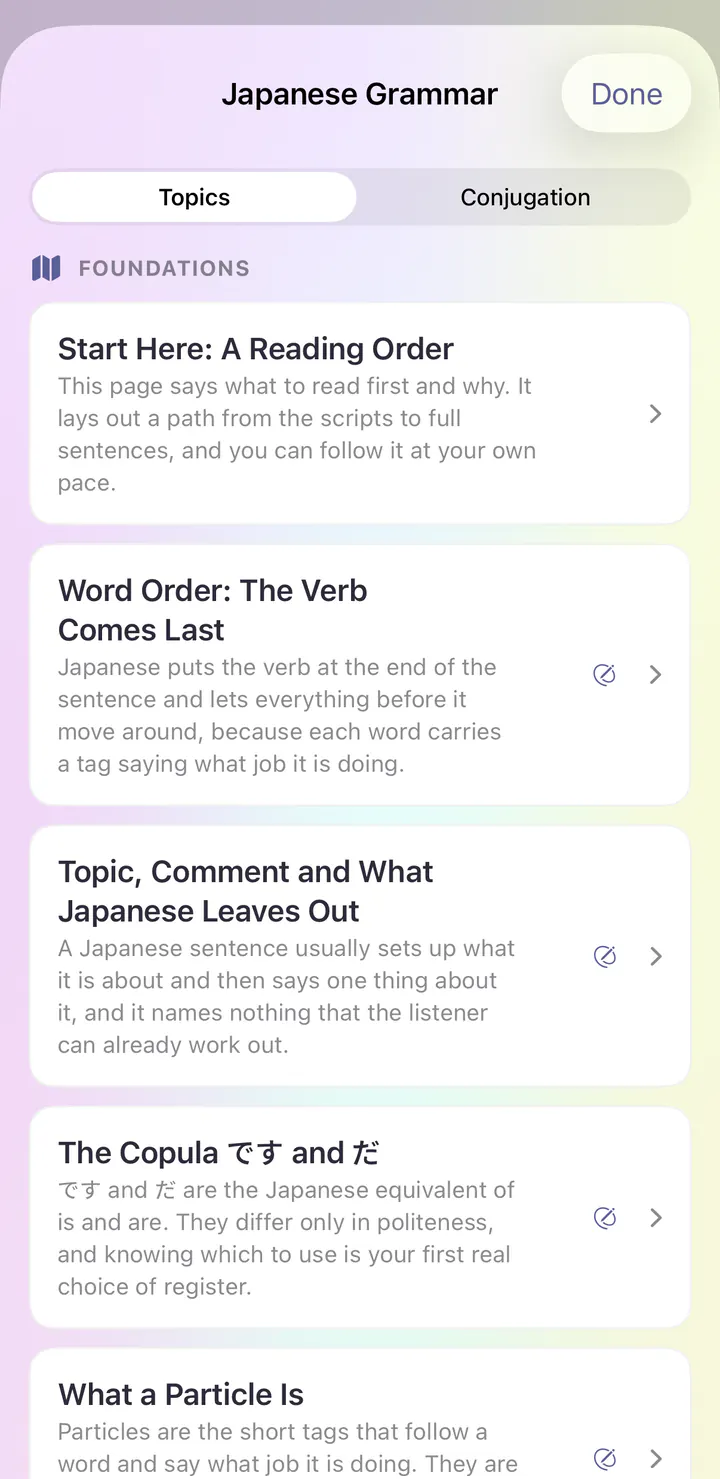
In the Loquus app, Grammar Center keeps topics like this one tap away with focused drills, and spaced review brings the words back before you forget them.
Free to start. No account needed.
By Loquus ·
Sources
- Tokyo University of Foreign Studies: 日本語 文法 AいN:解説
- Tokyo University of Foreign Studies: 日本語 文法 NAなN:解説
- Tokyo University of Foreign Studies: 日本語 文法 Aいです/Aくありません/Aくないです:解説
- Tokyo University of Foreign Studies: 日本語 文法 Aいですか:解説
- Tokyo University of Foreign Studies: 日本語 文法 Aかったです/Aくありませんでした/Aくなかったです:解説
- Tokyo University of Foreign Studies: 日本語 文法 とても・あまり:解説
- Tokyo University of Foreign Studies: 日本語 文法 イ形容詞とナ形容詞:解説
- Tokyo University of Foreign Studies: 日本語 文法 NAです/NAではありません:解説
- Tokyo University of Foreign Studies: 日本語 文法 N1はN2がAい/NAです:解説
- Tokyo University of Foreign Studies: 日本語 文法 形容詞の普通形:解説
- Tokyo University of Foreign Studies: 日本語 文法 名詞述語の普通形:解説
Learning research behind the practice
Worked examples, retrieval practice, and later review inform the activities. These studies do not establish the effectiveness of this specific lesson.