1. Find kanji inside complete Japanese words
Japanese commonly mixes kanji with hiragana and katakana in the same sentence. Kanji often supplies an important part of a content word, while hiragana writes particles (short words placed after a word or phrase to show its role) and many grammatical endings. A beginner does not need to replace all kana with kanji at once. The immediate goal is to recognize a small set of useful written words and understand how the scripts work together.
山 is the ordinary written word for “mountain” when read yama. 木 can mean “a tree” when read ki, and 本 can mean “a book” when read hon. These examples already show why a kanji is not just another kana symbol. Each character is associated with meaning and can occur in words with different readings. A kana chart cannot tell you the correct reading of every kanji word.
Start with the word you actually need. If you are learning 本 for the meaning “book,” learn its shape, the reading hon, and a short phrase in which that meaning fits. Do not try to memorize every dictionary reading and every historical meaning before using it. At the same time, avoid concluding that hon is the only reading 本 can ever have. A small accurate word entry is a useful first step, provided you leave room for additional words and readings later.
山
yama
mountain
木
ki
tree
本
hon
book
2. Compare meaningful shapes without turning every character into a picture
木 and 本 look similar, but the short extra horizontal stroke in 本 distinguishes two different characters. The dictionary history connects 木 with a tree shape and 本 with a mark at the root of that tree. That history can help you remember the distinction. It does not mean that you should translate 本 as “root” in every modern sentence; in the useful word introduced here, it means “book.”
人 is a character meaning “person.” In 休, the person component stands beside 木. The dictionary explains this character historically through a person resting beside a tree. This is a helpful example of a character whose components can support a memory cue. The modern word 休む means “to rest” or “to take time off,” and the full word still needs its kana ending and reading.
Do not extend this small set into a rule that every kanji is a literal picture or that combining component meanings always reveals a word’s modern meaning. Character formation is more varied, and many characters include a component connected with sound. A personal memory story can be useful, but label it as your own aid rather than a proven history. Compare the actual written forms carefully, use a reliable model when writing, and check the word in context. An appealing story does not excuse missing or adding a stroke.
人
hito
person
休む
yasumu
to rest; to take time off
Worked example: distinguish tree and book
A label means “book.” Choose between 木 and 本.
- 木 is the character used in the taught word ki, “tree.”
- 本 has an additional short horizontal stroke and is hon in the word for “book.”
- Copy the complete character 本 and connect it with hon, “book.”
本 is the needed word, read hon.
3. Understand on and kun as reading categories
Kanji readings are often grouped into on readings, historically associated with Chinese readings adapted into Japanese, and kun readings associated with Japanese words. 山 has the kun reading yama and the on reading san, among the information listed in its dictionary entry. 人 has the kun reading hito and on readings jin and nin. These labels describe reading categories; they do not by themselves choose the reading of a sentence.
A common tendency is that many compounds use on readings, while many single character words use kun readings. However, this is a tendency with many limits. 本 meaning “book” is read hon, an on reading, even though the word has just one character. A learner who assumes that a single character word always has a kun reading will get this everyday word wrong.
Learn the reading of the complete word. 山 by itself is yama, while 火山 is kazan, “volcano,” with the 山 part pronounced zan in that compound. 日本人 is Nihonjin, “a Japanese person.” Do not try to obtain every compound by mechanically saying the first reading you learned for each character. Sounds can change within words, and some words have readings that are not predictable that way. The practical question is what this word is and how this word is read in the current context.
火山
kazan
volcano
日本人
Nihonjin
Japanese person
4. Keep the kana that completes the word
Kana written after the kanji in many verbs and adjectives is called okurigana. It is part of the word, not an optional pronunciation note. 書く means “to write,” and 書きます is its polite present form, which also covers future actions. The kanji remains visible while the following kana changes with the grammatical form. Reading only 書 and ignoring the rest would miss information that the sentence needs.
休む and 休みます show the same useful distinction between a dictionary form and a polite form. In this pair, the reading begins with yasu in both forms, but the complete forms are yasumu and yasumimasu. Do not pronounce a dictionary reading of the kanji and then independently add all the kana without checking the full word. A learner’s vocabulary record should give the complete native spelling and complete reading together.
Okurigana also helps identify which word or grammatical form you are looking at. This is one reason that replacing every word with a bare character is not a path to more advanced Japanese. Copy the complete word from a reliable example. When you conjugate a familiar verb, use the verb class and the appropriate ending, then check that the written result still includes the required kana. If you know only a character’s general meaning, you do not yet know enough to construct every word or verb form that contains it.
書く
kaku
to write
書きます
kakimasu
write; will write, polite
休みます
yasumimasu
rest; will rest, polite
Guided example: keep the verb ending
Write the polite present form of 休む, “to rest.”
- The verb 休む changes its final mu sound to mi before ます.
- Keep 休 and write the complete ending みます.
- Read the result as yasumimasu, rather than treating the character as a separate word.
Compare your reasoning
休みます is read yasumimasu.
5. Learn compounds as vocabulary rather than sound arithmetic
学 appears in words connected with learning. 学ぶ, manabu, means “to learn,” while 学生, gakusei, means “a student.” The shared character offers a useful meaning connection, but the readings and the complete words differ. Learn each word as a unit that includes the characters, the reading, and the meaning used in the lesson. Recognizing one familiar component is a starting point for comprehension, not a finished dictionary lookup.
学校 is gakkō, “school.” Its small っ and long final vowel are part of the reading even though those sound details are not displayed as separate kana in the usual kanji spelling. A learner who reads only the individual character names may miss the actual spoken word. This is why a reliable reading beside a new compound matters. Connect the printed compound with the full sound sequence you have learned.
Useful compounds can also organize a small vocabulary set. 木曜日 is mokuyōbi, “Thursday,” and 日曜日 is nichiyōbi, “Sunday.” The characters help distinguish written days, but they do not remove the need to learn the complete readings. A short calendar phrase can then give each word a purpose. Avoid memorizing a disconnected list of every reading for 木, 日, or 曜 before you can recognize a weekday in a schedule. Build accurate words first, then notice patterns across the words you actually know.
学ぶ
manabu
to learn
学生
gakusei
student
学校
gakkō
school
木曜日
mokuyōbi
Thursday
6. Allow whole word readings and use context
今日 is commonly read kyō when it means “today” in an ordinary beginner sentence. That reading cannot be obtained by simply pronouncing the first isolated reading you learned for 今 and 日. Treat it as a complete vocabulary item with its own established reading. Familiarity with the individual characters can still help you recognize the word’s general meaning, but it does not replace learning its sound.
The character 日 illustrates why context and the surrounding word matter. It is hi in a common word for “day” or “sun,” and it appears twice in 日曜日, nichiyōbi, “Sunday,” with different sounds in the complete word. A dictionary entry lists several readings because the character participates in several words and constructions. You should not choose among those readings at random or assume that every reading can be used in every occurrence.
When you encounter an unfamiliar written word, first identify its boundaries and its role in the sentence. Then check the word rather than only looking up one character and stopping at the first result. If a reading is supplied in a learning material, connect that full reading with the full word. Names and specialized vocabulary may require an additional lookup. At this stage, successful reading means recognizing the taught vocabulary accurately and knowing when you need confirmation, rather than producing a confident guess for every new combination of characters.
今日
kyō
today
日曜日
nichiyōbi
Sunday
日
hi
day; sun
7. Build a small word record and retrieve it
A useful kanji vocabulary record has four parts: the complete written word, its reading, its meaning in context, and a short example. For 本, record hon and “book,” then use 本を読みます, “I read a book.” The particle を and the verb ending remain in kana. This sentence makes the character useful while reminding you that real Japanese writing combines scripts rather than presenting isolated symbols alone.
For a second entry, use 休みます in a sentence about your schedule. 今日休みます means “I will take today off” in an appropriate work or study context. Compare this with the dictionary form 休む so that the shared character and changing ending become visible. You are learning a word and its grammar together, not merely attaching one English label to a shape.
Practice in both directions. Look at the native word and retrieve its reading and meaning. Then look at the meaning and attempt the written form before checking. If a detail is wrong, identify the precise difference, such as the extra stroke in 本 or the kana ending in 書きます. Revisit a small set after a break and put the words into a new sentence. Keep the set small enough that you can explain each answer. The goal is dependable recognition and usable vocabulary, with additional characters and readings added through meaningful encounters.
本を読みます。
Hon o yomimasu.
I read a book.
今日休みます。
Kyō yasumimasu.
I will take today off.
Notice the difference
Common mistakes
Don’t write 木 for “book”
Instead of木
For this meaning本
In the word for “book,” the extra short horizontal stroke is required. In the taught example, 木 means “tree.”
Don’t drop き before ます
Instead of書ます
For this meaning書きます
The complete polite form includes き before ます.
Don’t drop み before ます
Instead of休ます
For this meaning休みます
The polite form of 休む includes み before ます.
Don’t sound out 今日 as separate characters
Instead ofima nichi
For this meaningkyō
In the ordinary word 今日, meaning “today,” use the established whole word reading kyō rather than joining isolated readings.
From understanding to using
Make your own example.
Try these without answer choices. Say your answer aloud or write it below, then compare your reasoning with the model.
Your turn 1
Write a sentence saying that you read a book. Use the taught kanji for “book” and retain the object particle.
Compare with a model
本を読みます。 (Hon o yomimasu.)
I read a book.
本 is hon in this word. を marks the book as the object, and 読みます is the polite verb form. The sentence naturally mixes kanji and hiragana.
- Use 本 for “book.”
- Retain を after the object.
- Keep the kana ending みます.
Your turn 2
Write a short message saying that you will take today off. Use 今日 and the polite form of 休む.
Compare with a model
今日休みます。 (Kyō yasumimasu.)
I will take today off.
今日 is learned as the complete word kyō. 休みます keeps the kanji together with its required kana ending.
- Read 今日 as kyō in this message.
- Write 休みます rather than only 休.
- Connect the message with an appropriate schedule context.
Put it into practice
Make the next choice.
Choose a response and learn why it works. Your score reflects your first answer to each question. You can revisit anything you miss.
Choose an answer, then open the explanation to check your reasoning.
Question 1
A vocabulary label means “book.” Which taught character belongs on it?
- 本
- 木
Check the answer
Answer: 本
本: 本 is hon in the ordinary word for “book.”
木: 木 is ki in the taught word for “tree.”
Question 2
You see 山 standing alone as the ordinary word for “mountain.” Which reading fits?
- hon
- yama
Check the answer
Answer: yama
hon: This is the reading of 本 in the word for “book.”
yama: This is the taught standalone word.
Question 3
The word 火山 means “volcano.” Which complete reading did this lesson teach?
- kazan
- hiyama
Check the answer
Answer: kazan
kazan: Learn the full compound reading, including zan.
hiyama: This joins familiar isolated readings instead of using the taught word.
Question 4
What conclusion follows from 本 being read hon in the word for “book”?
- Every single character word must use a kun reading.
- A single character word does not always use a kun reading.
Check the answer
Answer: A single character word does not always use a kun reading.
Every single character word must use a kun reading.: This absolute rule is contradicted by the example.
A single character word does not always use a kun reading.: The reading hon is an on reading, even in this single character word.
Question 5
Which complete form politely means “write” or “will write”?
- 書きます
- 書ます
Check the answer
Answer: 書きます
書きます: The kana きます completes this polite form.
書ます: This omits the required き.
Question 6
Choose the polite present form of 休む.
- 休ます
- 休みます
Check the answer
Answer: 休みます
休ます: This omits み from the complete form.
休みます: The final む changes to み before ます.
Question 7
What is the role of きます in 書きます?
- It is part of the complete written verb form.
- It is an optional decorative note that can be deleted.
Check the answer
Answer: It is part of the complete written verb form.
It is part of the complete written verb form.: The following kana supplies information needed for this form.
It is an optional decorative note that can be deleted.: Deleting it would remove required parts of the word.
Question 8
The word 学生 means “student.” Choose its reading.
- manabusei
- gakusei
Check the answer
Answer: gakusei
manabusei: Do not substitute the reading of 学ぶ into this compound.
gakusei: This is the established reading of the complete word.
Question 9
You are reading 学校, “school.” Which reading preserves its sound sequence?
- gakkō
- gako
Check the answer
Answer: gakkō
gakkō: The reading includes a held k consonant and a long final vowel.
gako: This omits both the consonant length and the long vowel.
Question 10
Your calendar shows 木曜日. Which day is this?
- Sunday
- Thursday
Check the answer
Answer: Thursday
Sunday: Sunday is 日曜日.
Thursday: 木曜日 is mokuyōbi, “Thursday.”
Question 11
In a simple message, 今日 means “today.” How is it read?
- kyō
- ima nichi
Check the answer
Answer: kyō
kyō: The ordinary word for “today” has this complete reading.
ima nichi: This mechanically combines isolated readings instead of reading the word.
Question 12
What does 日曜日 mean in a weekly schedule?
- Monday
- Sunday
Check the answer
Answer: Sunday
Monday: Monday is a different weekday, 月曜日.
Sunday: The complete word nichiyōbi means “Sunday.”
Question 13
You create a personal story to remember a character. What should you call it unless you checked a reliable historical source?
- A personal memory aid
- A confirmed historical origin
Check the answer
Answer: A personal memory aid
A personal memory aid: A useful memory story is not automatically a proven character history.
A confirmed historical origin: That claim requires evidence beyond inventing the story.
Question 14
An unfamiliar compound contains one kanji you recognize. What is the most reliable next step?
- Always use the first reading listed for each character.
- Check the complete word and its reading in context.
Check the answer
Answer: Check the complete word and its reading in context.
Always use the first reading listed for each character.: The first dictionary reading is not guaranteed to fit every compound.
Check the complete word and its reading in context.: The familiar character is a clue, but the word may have another established reading.
Keep the conversation going
What to practice next
After a break, go back to your own examples above and do each task again without looking at the models. Compare the meaning and form with the models, and fix each mistake by explaining its cause. Then use one of your sentences in a short conversation of your own.
Keep it going in the app
Keep the letters close.
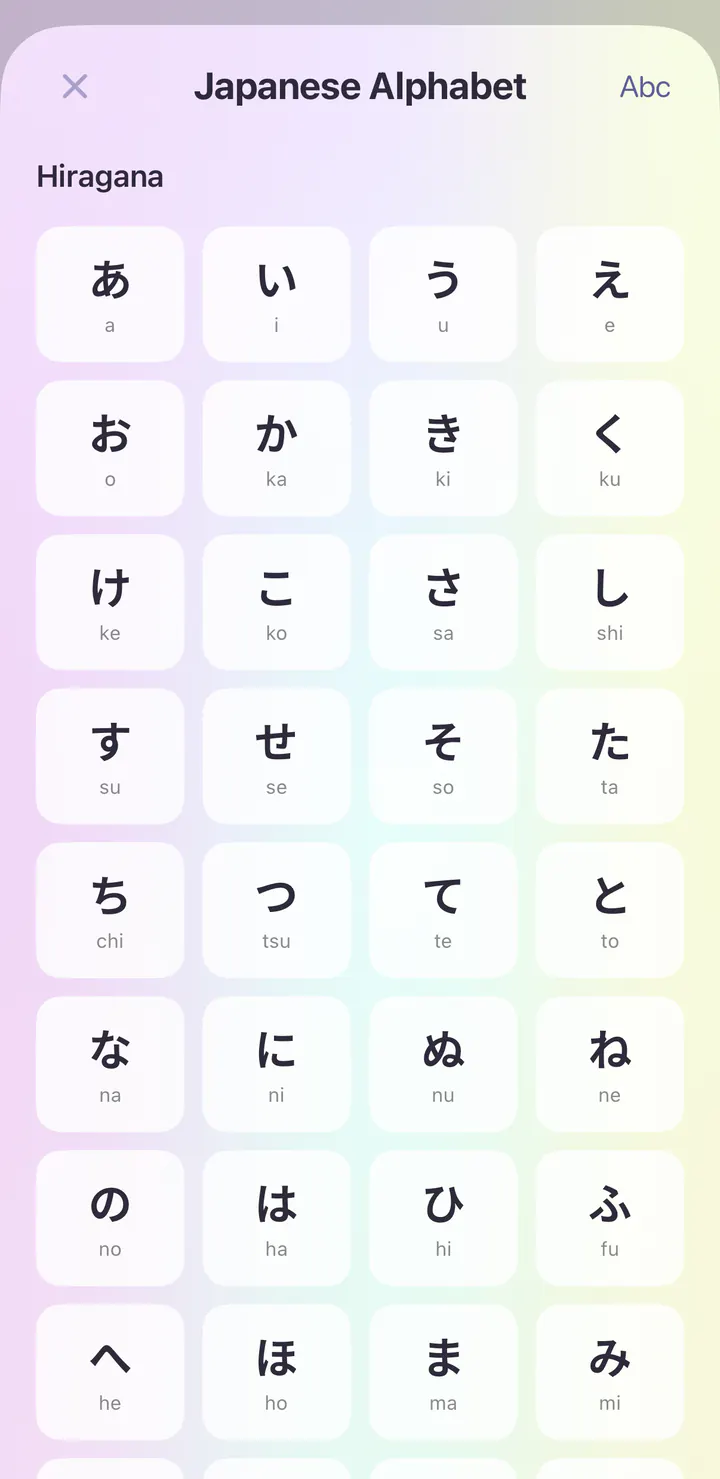
In the Loquus app, the alphabet reference lets you tap any character to hear it, and lessons bring new sounds back until they feel familiar.
Free to start. No account needed.
By Loquus ·
Sources
- Japan Kanji Aptitude Testing Foundation: 本
- Japan Kanji Aptitude Testing Foundation: 日
- Japan Kanji Aptitude Testing Foundation: 学
- Japan Kanji Aptitude Testing Foundation: 山
- Japan Kanji Aptitude Testing Foundation: 人
- Japan Kanji Aptitude Testing Foundation: 休
- Japan Kanji Aptitude Testing Foundation: 木
- Japan Kanji Aptitude Testing Foundation: 書
- Monash University: 7.1 Introduction to Kanji
- Monash University: 8.1 Kanji: 今, 何, 半, 上, 中, 下, 月, 火, 水, 木, 金, 土, 日, 曜
- Tokyo University of Foreign Studies: 日本語 文法 Vます/Vません:解説
- Tokyo University of Foreign Studies: 日本語 文法 NをVます:解説
- Tokyo University of Foreign Studies: 日本語 文法 動詞の3種類:解説
Learning research behind the practice
Worked examples, retrieval practice, and later review inform the activities. These studies do not establish the effectiveness of this specific lesson.