Three consonant series change words
Korean has a plain series, an aspirated series, and a tense series. The main groups are ㄱ, ㅋ, ㄲ; ㄷ, ㅌ, ㄸ; ㅂ, ㅍ, ㅃ; and ㅈ, ㅊ, ㅉ. These are different consonants, not a normal consonant said quietly, loudly, and angrily. Their written shapes show relationships, but the extra strokes or doubled letters identify a different member of the sound system. A listener may understand a different word when the category changes.
Aspirated consonants involve a noticeable release of breath. Tense consonants have a more constricted, firm onset with little aspiration. Plain consonants are a third category. Do not define them simply as English voiced b, d, g, and j. Their sound depends partly on their position, and in contemporary Seoul speech the pitch of the following vowel can also help listeners distinguish consonant categories. Breath alone is therefore an incomplete test. Compare whole syllables spoken by the same speaker in the same position.
Start with a small contrast such as 비 and 피. Both contain the same vowel. Changing the initial consonant changes “rain” to “blood.” The learning goal is to connect a sound category to a spelling and a meaning. Do not add a separate h syllable when you see an aspirated letter. It remains one consonant at the start of the syllable.
비
bi
rain
피
pi
blood
References for this explanation
Practice the consonant groups in matching positions
When comparing ㄱ, ㅋ, and ㄲ, keep your tongue working toward the back of the mouth. For ㄷ, ㅌ, and ㄸ, the contact is farther forward. For ㅂ, ㅍ, and ㅃ, both lips close. The place of articulation, where in the mouth the sound is made, stays broadly the same within each group, while the way the sound is released changes. Practice one group before moving to another. Moving the tongue, changing the vowel, and changing the consonant category all at once makes it harder to hear which feature matters.
The doubled letter in 아빠 represents a tense consonant. It does not tell you to insert a pause, produce two separate p syllables, or increase the volume of the whole word. Likewise, the doubled consonant in 아까 belongs inside an ordinary word. Read the syllable blocks smoothly and keep the vowel after the consonant. A tense consonant can occur at the beginning of a word or within it; its spelling is not a punctuation mark that breaks the word apart.
Plain consonants may sound more voiced between voiced sounds than they do at the start of an utterance. That is one reason a single English sound comparison is unreliable. The word 고기 has two ㄱ letters, yet their precise realization need not sound identical. Keep the spelling stable while allowing the natural pronunciation to depend on position. Use a dictionary recording of the complete word when your English reading of g seems to conflict with what you hear.
아빠
appa
dad
아까
akka
a little while ago
고기
gogi
meat
References for this explanation
- University of Pennsylvania, You Speak Korean! Book 1: Preliminaries I, 들어가기 I
- National Institute of Korean Language: Romanization of Korean
- Tokyo University of Foreign Studies: 東外大言語モジュール|朝鮮語|発音|実践編 1 サバイバルのためにこれだけは 4 [ㄷ] と [ㅌ] と [ㄸ] 01
- Tokyo University of Foreign Studies: 東外大言語モジュール|朝鮮語|発音|実践編 1 サバイバルのためにこれだけは 5 [ㄱ] と [ㅋ] と [ㄲ] 01
Keep the s and j groups separate
The group ㅈ, ㅊ, and ㅉ has the same broad three way distinction as the stop groups. Learn the three spellings together, but do not replace all three with English ch. Korean ㅈ is not a promise that you will hear the English sound at the start of juice in every position. The useful question is which Korean category the speaker used. In 자다, 차다, and 짜다, the first consonant distinguishes three different dictionary forms while the rest of the written pattern stays the same.
The pair ㅅ and ㅆ has two members, not three. Korean has no separate aspirated letter that completes a three member s group. The tense member is written ㅆ. Compare 사다 and 싸다: buying and being inexpensive are different meanings, even though a beginner may initially hear a similar s sound. Learn their complete forms and meanings rather than treating the doubled spelling as optional emphasis.
The sound of ㅅ also changes with the following vowel. Before ㅣ and certain vowels beginning with a y glide, it can sound closer to an English sh than to the s in see. The Korean spelling still uses ㅅ. This positional pronunciation is a different issue from the contrast between ㅅ and ㅆ. Do not invent a new Korean letter every time a familiar letter sounds slightly different in a new word.
자다
jada
to sleep
차다
chada
to kick
짜다
jjada
to be salty
사다
sada
to buy
싸다
ssada
to be inexpensive
Choose the low price word
A vocabulary card asks for “to be inexpensive,” using a dictionary form. Start with 사다 or 싸다.
- Both words have the same vowel and final dictionary ending.
- Identify the remaining contrast: plain ㅅ versus tense ㅆ.
- Retrieve the meaning associated with the tense form.
Compare your reasoning
싸다 means “to be inexpensive.”
References for this explanation
- How to Study Korean: Reading: Quick Reference
- University of Pennsylvania, You Speak Korean! Book 1: Preliminaries I, 들어가기 I
- Tokyo University of Foreign Studies: 東外大言語モジュール|朝鮮語|発音|実践編 1 サバイバルのためにこれだけは 6 [ㅈ] と [ㅊ] と [ㅉ] 01
- Tokyo University of Foreign Studies: 東外大言語モジュール|朝鮮語|発音|実践編 1 サバイバルのためにこれだけは 7 [ㅅ] と [ㅆ] 01
Distinguish the vowels ㅗ and ㅓ
The letters ㅗ and ㅓ are separate vowels. Revised Romanization, the official system for writing Korean in Roman letters, writes them o and eo. The two Roman letters in eo represent one Korean vowel, not an e followed by an o. In a syllable such as 거, keep one continuous vowel sound after the consonant. Turning it into two vowel syllables changes the rhythm and moves you away from the written Korean syllable.
For ㅗ, round the lips and maintain a relatively steady vowel. For ㅓ, use a more open mouth and avoid the strong lip rounding of ㅗ. English vowel comparisons vary with the speaker’s accent, so an instruction such as “say the vowel in a particular English word” is only a rough starting point. Listen to a native model and compare the mouth shape and sound together. Avoid adding the English glide that often occurs at the end of go.
The written contrast is visible in 고기 and 거기. The former means “meat”; the latter means “there.” In this pair the first vowel changes while the surrounding consonants remain written the same way. A restaurant conversation and a conversation about a place need different words. Copying both as an English sounding go sequence loses information. Read from the Hangul first, then use the reading line to check that you noticed o versus eo.
거기
geogi
there
오리
ori
duck
머리
meori
head or hair
Separate meat from a place
A menu needs the noun for “meat.” Choose between 고기 and 거기.
- Compare the first vowel: ㅗ in 고기, ㅓ in 거기.
- Connect the words to their meanings: “meat” versus “there.”
- Choose 고기 and pronounce one steady ㅗ vowel in the first syllable.
고기 means “meat.”
References for this explanation
Distinguish ㅜ and ㅡ without adding a glide
The contrast between ㅜ and ㅡ is another frequent obstacle for English speakers. Revised Romanization writes u for ㅜ and eu for ㅡ. Again, eu represents one vowel. It is not the English word you, and it is not an e sound followed by an oo sound. Seeing two Roman letters should not lead you to create a second syllable.
For ㅜ, round the lips. For ㅡ, keep the lips unrounded while producing a high vowel. The tongue position is different from the front vowel ㅣ, so simply replacing ㅡ with the vowel in English see is not a solution. A mirror can help you notice whether you are rounding the lips, but it cannot confirm all the details of the sound. Compare your pronunciation with a Korean recording, keeping the vowel steady instead of sliding through several English vowel qualities.
The short word 그 contains ㅡ, while 구 contains ㅜ. They are both single syllables despite the reading geu having more Roman letters than gu. Longer words preserve the same distinction. 우리 begins with ㅜ, and 이름 contains ㅡ in its second block. Do not choose a vowel according to how many letters fit conveniently into an English spelling. Identify the Hangul vowel in each block, then pronounce the complete word with the intended number of syllables.
그
geu
that, before a noun
구
gu
nine, in the Sino Korean number system
우리
uri
we or our
이름
ireum
name
References for this explanation
Check where the consonant occurs
This lesson compares consonants most directly at the beginning of syllables. A consonant written at the bottom of a block is a final consonant, and its pronunciation follows additional rules. You cannot assume that every initial contrast remains audible in exactly the same way at the end of a word. Korean final stops are normally unreleased when pronounced before a pause. Avoid attaching a little extra vowel to make them sound like complete English syllables.
Different spellings can share a final sound before a pause. For example, the final ㅅ of 옷 is pronounced as a final t type sound in isolation. That does not mean the spelling should change to ㄷ. When a grammatical ending or particle that begins with a vowel follows, a consonant can link into the following syllable and reveal a different pronunciation. A particle is a short word attached to the end of a noun to show its role in the sentence. The course lesson on final consonants and linking develops that distinction in detail.
Final nasal consonants still need their own places of articulation. The finals ㅁ, ㄴ, and ㅇ are not interchangeable nasal endings. Compare 밤 and 방: the first closes the lips for m, while the second ends in the ng sound. The final ㄹ sounds similar to an English l, but its exact quality need not match the dark l of American English. Position, neighboring sounds, and spelling all contribute to reading a word correctly.
옷
ot
clothes
밤
bam
night
방
bang
room
말
mal
speech or words
References for this explanation
- National Institute of Korean Language: 앞+조사 발음이 어떻게 되나요
- How to Study Korean: Korean Pronunciation
- Tokyo University of Foreign Studies: 東外大言語モジュール|朝鮮語|発音|実践編 1 サバイバルのためにこれだけは 8 終声 [ㅂ][ㄷ][ㄱ] 01
- Tokyo University of Foreign Studies: 東外大言語モジュール|朝鮮語|発音|実践編 1 サバイバルのためにこれだけは 9 終声 [ㅁ][ㄴ][ㅇ] 01
- Tokyo University of Foreign Studies: 東外大言語モジュール|朝鮮語|発音|実践編 1 サバイバルのためにこれだけは 10 終声 [ㄹ] 01
Connect spelling, sound, and meaning
Use a three step practice cycle. First, inspect a small set of written contrasts and explain which letter changes. Second, listen to a Korean recording while looking at the spelling and meaning. Third, hide the reading and produce the word from the Hangul or the meaning. These are different tasks. Recognizing the right printed letter does not prove that you can hear the distinction, and repeating a recording immediately does not prove that you can retrieve the word later.
Keep the comparisons controlled. Practice 비 and 피 together before mixing them with a new vowel. Then compare 사다 and 싸다, where the important change is plain versus tense. Return to 고기 and 거기 for a vowel comparison. If you make an error, identify its type: wrong consonant category, wrong vowel, added syllable, or final consonant problem. A precise diagnosis gives you a smaller thing to practice than a vague instruction to improve your accent.
Some vowel spellings, including ㅐ and ㅔ, may sound merged for many contemporary speakers. Preserve the spelling distinction even when the recording does not provide a dependable contrast. That variation does not make all similar looking vowels interchangeable. The contrasts ㅗ versus ㅓ and ㅜ versus ㅡ remain useful priorities for this beginner lesson. The questions below assess the written distinctions and the principles you can explain from the page; use the linked pronunciation teaching materials for actual listening practice.
개
gae
dog
네
ne
yes
Notice the difference
Common mistakes
Do not replace a tense letter with an aspirated one
Instead of아파
For this meaning아빠
For “dad,” the word needs tense ㅃ. 아파 is a different word, associated with being in pain.
Keep the meat and place vowels separate
Instead of거기
For this meaning고기
For “meat,” use ㅗ in the first syllable. 거기 means “there.”
Do not read eu as the English word you
Instead ofgyu
For this meaninggeu
The reading of 그 uses one unrounded vowel represented by eu, without an added y glide.
Keep spelling even when final pronunciation changes
Instead of옫
For this meaning옷
The noun for “clothes” is spelled 옷, although its isolated final sound is a t type stop.
From understanding to using
Make your own example.
Try these without answer choices. Say your answer aloud or write it below, then compare your reasoning with the model.
Your turn 1
Write two separate vocabulary labels: “rain,” then “blood.” Read them aloud while keeping the same vowel.
Compare with a model
비. 피. (Bi. Pi.)
Rain. Blood.
The vowel stays ㅣ. Plain ㅂ and aspirated ㅍ distinguish the words.
- Use ㅂ for “rain.”
- Use ㅍ for “blood.”
- Do not add a second vowel to either word.
Your turn 2
Write the dictionary forms for “to buy” and “to be inexpensive,” in that order. Explain the consonant contrast.
Compare with a model
사다. 싸다. (Sada. Ssada.)
To buy. To be inexpensive.
The first has plain ㅅ; the second has tense ㅆ. The difference belongs to the word rather than to emotional emphasis.
- Keep the vowels and dictionary ending unchanged.
- Preserve the doubled consonant in the second word.
- Compare both forms with native recordings.
Put it into practice
Make the next choice.
Choose a response and learn why it works. Your score reflects your first answer to each question. You can revisit anything you miss.
Choose an answer, then open the explanation to check your reasoning.
Question 1
A weather note needs the word for “rain.” Which spelling fits?
- 비
- 피
Check the answer
Answer: 비
비: 비 means “rain” and begins with plain ㅂ.
피: 피 means “blood” and begins with aspirated ㅍ.
Question 2
A medical vocabulary card asks for the word “blood.” Which spelling fits?
- 비
- 피
Check the answer
Answer: 피
비: The plain initial gives the different word “rain.”
피: The aspirated ㅍ distinguishes “blood” from “rain.”
Question 3
Which spelling is the ordinary word for “dad”?
- 아빠
- 아파
Check the answer
Answer: 아빠
아빠: ㅃ is the tense member of the group made with both lips, ㅂ, ㅍ, and ㅃ.
아파: 아파 is a different form associated with being in pain; ㅍ is aspirated.
Question 4
You need the dictionary form meaning “to buy.” Which word fits?
- 싸다
- 사다
Check the answer
Answer: 사다
싸다: The tense ㅆ form here means “to be inexpensive.”
사다: The plain ㅅ form means “to buy.”
Question 5
You describe a low price using a dictionary form. Which word fits?
- 싸다
- 사다
Check the answer
Answer: 싸다
싸다: This form means “to be inexpensive.”
사다: This form names buying rather than the low price.
Question 6
You label the action “sleep” with its dictionary form. Which spelling fits?
- 짜다
- 자다
Check the answer
Answer: 자다
짜다: 짜다 begins with tense ㅉ and here means “to be salty.”
자다: 자다 begins with plain ㅈ and means “to sleep.”
Question 7
You need the noun for “meat” on a menu. Which word fits?
- 고기
- 거기
Check the answer
Answer: 고기
고기: 고기 has ㅗ in its first syllable and means “meat.”
거기: 거기 has ㅓ and means “there.”
Question 8
You point to a place near the listener. Which word means “there”?
- 고기
- 거기
Check the answer
Answer: 거기
고기: 고기 means “meat” and has the different vowel ㅗ.
거기: 거기 has ㅓ in its first syllable and means “there.”
Question 9
How many vowel sounds does the reading eo represent in 거?
- One Korean vowel
- Two separate vowels
Check the answer
Answer: One Korean vowel
One Korean vowel: The Roman sequence eo represents ㅓ as one vowel.
Two separate vowels: Reading e and o separately adds a distinction the syllable does not contain.
Question 10
Which letter does Revised Romanization write as eu?
- ㅜ
- ㅡ
Check the answer
Answer: ㅡ
ㅜ: ㅜ is the rounded vowel written u.
ㅡ: Revised Romanization uses eu for ㅡ.
Question 11
Which reading matches the one syllable 그?
- geu
- gu
Check the answer
Answer: geu
geu: The reading eu represents the single vowel ㅡ.
gu: The reading gu corresponds to 구, with ㅜ.
Question 12
Does the s group require a third aspirated consonant letter?
- Yes, every consonant group has three letters.
- No, only the plain and tense members.
Check the answer
Answer: No, only the plain and tense members.
Yes, every consonant group has three letters.: The three member pattern does not apply to every consonant group.
No, only the plain and tense members.: The group has the plain and tense members taught here.
Question 13
Before a pause, should the final consonant of 옷 be pronounced as a full s syllable?
- No, it has a final t type sound.
- Yes, every letter sounds exactly as it does initially.
Check the answer
Answer: No, it has a final t type sound.
No, it has a final t type sound.: Final pronunciation has its own rules, and no extra vowel is added.
Yes, every letter sounds exactly as it does initially.: The assumption ignores final consonant pronunciation.
Question 14
A word reading exercise shows 밤 rather than 방. Which final sound must you preserve?
- The ng sound
- The m sound
Check the answer
Answer: The m sound
The ng sound: That is the final sound of 방, written ㅇ.
The m sound: Final ㅁ closes the lips and distinguishes 밤 from 방.
Keep the conversation going
What to practice next
After a break, go back to your own examples above and do each task again without looking at the models. Compare the meaning and form with the models, and fix each mistake by explaining its cause. Then use one of your sentences in a short conversation of your own.
Keep it going in the app
Keep the letters close.
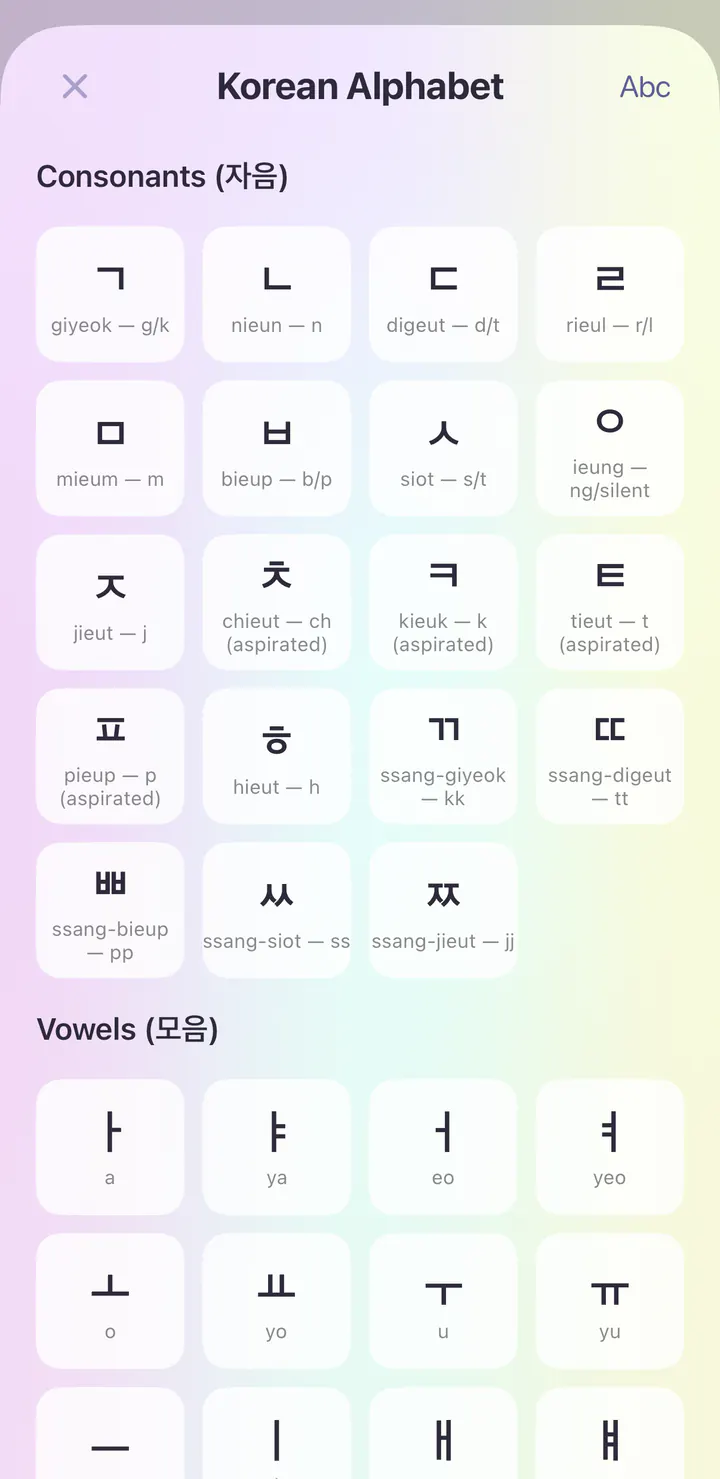
In the Loquus app, the alphabet reference lets you tap any character to hear it, and lessons bring new sounds back until they feel familiar.
Free to start. No account needed.
By Loquus ·
Sources
- How to Study Korean: Korean Word Structure and Basic Letters
- How to Study Korean: Reading: Quick Reference
- How to Study Korean: More Basic Korean Letters
- National Institute of Korean Language: 앞+조사 발음이 어떻게 되나요
- National Institute of Korean Language: Consonant letter formation
- National Institute of Korean Language: Vowel letter formation
- University of Pennsylvania, You Speak Korean! Book 1: Preliminaries I, 들어가기 I
- National Institute of Korean Language: Romanization of Korean
- How to Study Korean: Korean Pronunciation
- Tokyo University of Foreign Studies: 東外大言語モジュール|朝鮮語|発音|実践編 1 サバイバルのためにこれだけは 1 単母音[ㅗ] と [ㅓ] 01
- Tokyo University of Foreign Studies: 東外大言語モジュール|朝鮮語|発音|実践編 1 サバイバルのためにこれだけは 2 [ㅜ] と [ㅡ] 01
- Tokyo University of Foreign Studies: 東外大言語モジュール|朝鮮語|発音|実践編 1 サバイバルのためにこれだけは 3 [ㅂ] と [ㅍ] と [ㅃ] 01
- Tokyo University of Foreign Studies: 東外大言語モジュール|朝鮮語|発音|実践編 1 サバイバルのためにこれだけは 4 [ㄷ] と [ㅌ] と [ㄸ] 01
- Tokyo University of Foreign Studies: 東外大言語モジュール|朝鮮語|発音|実践編 1 サバイバルのためにこれだけは 5 [ㄱ] と [ㅋ] と [ㄲ] 01
- Tokyo University of Foreign Studies: 東外大言語モジュール|朝鮮語|発音|実践編 1 サバイバルのためにこれだけは 6 [ㅈ] と [ㅊ] と [ㅉ] 01
- Tokyo University of Foreign Studies: 東外大言語モジュール|朝鮮語|発音|実践編 1 サバイバルのためにこれだけは 7 [ㅅ] と [ㅆ] 01
- Tokyo University of Foreign Studies: 東外大言語モジュール|朝鮮語|発音|実践編 1 サバイバルのためにこれだけは 8 終声 [ㅂ][ㄷ][ㄱ] 01
- Tokyo University of Foreign Studies: 東外大言語モジュール|朝鮮語|発音|実践編 1 サバイバルのためにこれだけは 9 終声 [ㅁ][ㄴ][ㅇ] 01
- Tokyo University of Foreign Studies: 東外大言語モジュール|朝鮮語|発音|実践編 1 サバイバルのためにこれだけは 10 終声 [ㄹ] 01
- How to Study Korean: Korean Dipthongs: Complex Vowels
Learning research behind the practice
Worked examples, retrieval practice, and later review inform the activities. These studies do not establish the effectiveness of this specific lesson.