Treat Pinyin as a pronunciation system
A familiar letter can represent an unfamiliar Mandarin sound. Start with the whole syllable instead of pronouncing each letter as you would in English. A syllable normally contains a final, often with an initial before it, and a tone. The initial is the consonant at the start of the syllable, such as sh in shū; the final is the rest, such as u. Some words contain one syllable; others contain several. The Pinyin beside an example tells you how its written characters are read in that word. It does not turn those characters into an English spelling. Keep meaning, characters, and pronunciation together in your notes so that recognizing one of them helps you retrieve the other two.
书
shū
book
The mark over the vowel identifies a first tone. This is one complete Mandarin syllable and a useful word. Preserve both its initial sound and its high, level tone when you later use it with a number and a measure word, a counting word that comes before the noun.
中国
Zhōngguó
China
The country name contains two syllables with different tones. The first stays high and level, and the second rises. Pinyin can group the syllables of one word even though the Chinese writing uses two separate characters.
Distinguish the four full tones
Use the four tone categories as a map for listening: first tone is high and level, second rises, third has a low target and may dip and rise in isolation, and fourth falls sharply. These descriptions are relative to your comfortable speaking range. You do not need to copy another person’s absolute pitch. Do not stretch every syllable into a performance of a contour diagram. In ordinary connected speech, tones are shorter and interact with neighboring syllables. Begin with clear isolated words, then listen again in a phrase while keeping each word’s identity in mind.
妈
mā
mom
This character has a first tone reading in the word for “mom.” A level tone is part of the word, not decoration added after learning the consonants and vowel. The longer everyday word for “mom” is often māma, with a light second syllable in the neutral tone, which has no tone mark.
马
mǎ
horse
The third tone belongs to this word’s dictionary reading. When practicing it alone you may hear a low dip and rise. Later, inside a phrase, its pitch shape can change without making it a different word.
Distinguish two words with one sound change
Explain how the readings of 妈 and 马 differ. First hold the consonant and vowel constant.
- Both readings begin with m and contain the vowel a. This comparison isolates tone, so a change in consonant or vowel is not needed to distinguish the two words.
- 妈 has the dictionary reading mā, while 马 has mǎ. The first tone stays high and level; the third has a low target and may dip and rise when demonstrated in isolation.
- Connect each complete reading to its meaning, then cover the model. Retrieve the reading from “mom” or “horse,” and verify the tone before placing the word in a longer phrase.
妈 mā means “mom”; 马 mǎ means “horse.”
Read initials and finals as a coordinated movement
Some Pinyin spellings need a new listening habit. The sounds written j, q, and x are not read as ordinary English letter names. The contrast between b and p, or d and t, involves the release of air rather than simply importing the English voiced versus voiceless contrast. Learn these sounds from a pronunciation model. A rough English comparison can help you begin, but it cannot define the exact tongue position or airflow. Practice one contrast at a time while holding the final and tone steady, then return to useful words that contain it.
八
bā
eight
The initial written b is unaspirated in standard Mandarin: it is released without a strong puff of air. It should not be learned merely by reading the English word bah. Keeping the first tone stable makes it easier to attend to the consonant distinction.
七
qī
seven
The initial q combines with the final i in this number. Listen for the Mandarin consonant rather than the English name of the letter. The first tone remains level through the syllable, including when you count aloud.
Notice the vowel written ü
The vowel written ü is made with rounded lips and a forward tongue position. It is not interchangeable with ordinary u. After n and l, the two dots are visible when this vowel is intended. After j, q, and x, spelling conventions normally omit the dots because the combination already identifies the vowel. This is a spelling convention, not permission to replace the vowel with English oo. Learn a small set of examples and compare their audio. Do not conclude that every letter u in Pinyin represents the same sound in every environment.
女
nǚ
female; woman
The dots distinguish this final from u after n. Both the dots and the third tone mark belong in the Pinyin reading. When copying a vocabulary entry, retaining only the tone mark loses a separate vowel distinction.
去
qù
go
After q the dots are omitted by the spelling convention even though the vowel is the rounded front vowel. The fourth tone falls. This example shows why spelling rules and actual mouth movements must be learned together.
Give neutral syllables less prominence
Some syllables are unstressed and normally written without a tone mark. Their actual pitch depends partly on the preceding tone, so the neutral tone, sometimes called a fifth tone, does not have one fixed melody. Keep them light and relatively short instead of treating every syllable as equally prominent. Common particles (short words with a grammatical job) and the second syllable of some everyday words have this pronunciation. Neutral tone patterns can vary across regions and speaking styles. Learn the standard reading supplied for the particular word, and listen to the speakers whose variety you are studying. Do not erase the mark from every second syllable in a word.
妈妈
māma
mom; mother
The first syllable carries the full first tone, while the repeated second syllable is neutral in this common reading. The missing tone mark on the second syllable is meaningful notation, not a printing error or an invitation to invent a strong contour.
什么
shénme
what
The first syllable rises, and the second is neutral in this common question word. Learn the word as a connected unit. The final light syllable does not need an independent full third or fourth tone to be audible.
Separate dictionary tones from connected speech
When two third tones occur together in a short phrase, the first is normally pronounced with a rising contour. Pinyin generally keeps the original third tone marks, so spelling and spoken pronunciation are not always identical. The negative word 不 also changes: its ordinary fourth tone becomes rising before another fourth tone. The Pinyin here keeps the dictionary spelling so that the written conventions stay consistent across lessons. In longer sequences, grouping and speech rhythm affect the details. Master short pairs first instead of applying a mechanical rule to every written chain without listening.
你好
nǐ hǎo
hello
Both syllables have third tone dictionary readings, but the first normally rises in this greeting. The spelling preserves the base tones. You should be able to recognize the written form and also expect the changed contour in speech.
不是
bù shì
am not; is not; are not
The negative word 不 has the dictionary reading bù, but before the fourth tone of shì it is normally pronounced bú. Keep the spoken change separate from the consistent dictionary spelling used in these examples so neither convention becomes confusing.
Predict the spoken change from the written tones
Read 你好 and 不是. Explain why their first syllables commonly rise in speech even though their dictionary tone marks differ.
- Identify the dictionary readings first: nǐ hǎo and bù shì. Both third tone marks in the greeting and the two fourth tone marks in the negative phrase are meaningful base spellings.
- Apply one rule at a time. The first of two third tones becomes rising; separately, 不 becomes rising before another fourth tone. The second rule is specific to this negative word in this environment.
- The two phrases therefore have rising first syllables for different reasons. Listen to a proficient model and imitate the complete pairs; selecting a written option alone cannot demonstrate successful pronunciation.
Compare your reasoning
Dictionary spelling: nǐ hǎo and bù shì. Usual connected pronunciation: ní hǎo and bú shì.
Practice phrases without losing individual words
A complete pronunciation routine moves from listening to imitation, then to recall without the model. Say a short phrase, record it if possible, and compare one feature at a time: the initials, the finals, and then the pattern of full and neutral tones. Question intonation and emphasis work together with the tones that belong to individual words. They do not let you replace the tone of the last syllable with an English question rise. These written activities cannot evaluate your actual pronunciation. Use them to prepare a focused listening session, and return to the phrase after a break to check whether you can retrieve its pronunciation and meaning together.
老师
lǎoshī
teacher
The first syllable has a third tone and the second a first tone. In connected speech the first is commonly low without the full rise of an isolated demonstration. The second remains a full syllable, unlike a neutral ending.
学生
xuésheng
student
This common mainland reading gives the second syllable a neutral tone. Some varieties and careful pronunciations retain a fuller tone there. Learn the specified model consistently while recognizing that real speakers can differ without making every difference an error.
Notice the difference
Common mistakes
A tone is part of a word
Instead of马 mā
For this meaning马 mǎ
The character for “horse” has the third tone reading mǎ. Do not treat the mark as optional decoration that can be supplied later. Store meaning and tone together, then check the same word inside a phrase. A change in pitch caused by connected speech does not mean that its dictionary tone has disappeared. This correction checks the reading, not the visual identity of the character.
A neutral syllable has no full tone mark
Instead of什么 shénmè
For this meaning什么 shénme
The final syllable is neutral in this common reading. Its pitch is influenced by context and should not be forced into a full fourth tone just because the word ends there. Keep it audible but light. The missing mark signals a pronunciation feature; it does not mean that there is no vowel or that the syllable should be deleted.
The dots distinguish a vowel
Instead of女 nǔ
For this meaning女 nǚ
After n, the dots on ü distinguish its vowel from u. A third tone mark alone does not supply that distinction. Copy the dots and the tone mark together. After j, q, and x the spelling convention is different, which is why qù does not show the dots. Learn the specific environment instead of deleting them everywhere.
From understanding to using
Make your own example.
Try these without answer choices. Say your answer aloud or write it below, then compare your reasoning with the model.
Your turn 1
Write the dictionary Pinyin for “hello” and “is not.” Then explain how the first syllable is usually pronounced in each expression.
Compare with a model
你好, “hello,” is written nǐ hǎo; 不是, “is not,” is written bù shì. In speech, the first syllable usually rises in both: ní hǎo and bú shì. In 你好, the first of two third tones changes; in 不是, the negative word 不 changes before a fourth tone. The dictionary spellings keep their original tone marks.
Hello; is not.
The written models are nǐ hǎo and bù shì. In the greeting, the first of two third tones normally rises. Before shì, the negative word also rises because it precedes a fourth tone. These are two different rules that happen to produce rising first syllables. Keep the dictionary spellings in your notes, then imitate the connected pronunciation from a reliable audio model. A typed answer alone cannot show whether you made the intended sounds, so include an oral attempt in your practice.
- Did the dictionary Pinyin keep both third tone marks in 你好 and both fourth tone marks in 不是?
- Can you explain the two different rules that make the first syllable rise in speech?
- Did you distinguish the written dictionary tones from the spoken tone changes?
Your turn 2
Create a vocabulary card for “teacher” and “student.” Include characters, Pinyin, meaning, and one feature you will listen for.
Compare with a model
老师, “teacher,” is written lǎoshī: listen for a low third tone followed by a full first tone. 学生, “student,” is written xuésheng in the mainland model taught here: listen for a rising first syllable and a light neutral second syllable.
Teacher; student.
Use lǎoshī for “teacher” and xuésheng for the common mainland reading of “student” taught here. For 老师, listen for a low third tone followed by a full first tone. For 学生, listen for the rising first syllable and the lighter second syllable. The important contrast is full versus neutral tone, not simply whether a word has two characters. Cover both Pinyin readings and retrieve them from the meanings, then check the marks. If you hear a fuller second tone in another variety, record that variation with its context.
- Did each card include the Chinese characters, Pinyin, and meaning?
- Did the Pinyin for 老师 keep a first tone mark on its second syllable?
- Did the Pinyin for 学生 show the neutral second syllable taught here, and did you name a listening feature for each word?
Put it into practice
Make the next choice.
Choose a response and learn why it works. Your score reflects your first answer to each question. You can revisit anything you miss.
Choose an answer, then open the explanation to check your reasoning.
Question 1
Choose the dictionary Pinyin reading for this word or phrase: “book.”
书
- shū
- sū
Check the answer
Answer: shū
shū: The mark over the vowel identifies a first tone. This is one complete Mandarin syllable and a useful word. Preserve both its initial sound and its high, level tone when you later use it with a number and a measure word, a counting word that comes before the noun.
sū: Removing the h changes the initial from sh to s. A correct tone does not repair a different consonant, so compare the whole syllable with the model.
Question 2
Choose the dictionary Pinyin reading for this word or phrase: “China.”
中国
- Zhōnggūo
- Zhōngguó
Check the answer
Answer: Zhōngguó
Zhōnggūo: The second syllable is guó, with a rising tone marked on o. Moving the mark to u and changing the tone does not preserve the pronunciation of the country name.
Zhōngguó: The country name contains two syllables with different tones. The first stays high and level, and the second rises. Pinyin can group the syllables of one word even though the Chinese writing uses two separate characters.
Question 3
Choose the dictionary Pinyin reading for this word or phrase: “mom.”
妈
- mā
- mǎ
Check the answer
Answer: mā
mā: This character has a first tone reading in the word for “mom.” A level tone is part of the word, not decoration added after learning the consonants and vowel. The longer everyday word for “mom” is often māma, with a light second syllable in the neutral tone, which has no tone mark.
mǎ: This third tone reading belongs to a different syllable, as in the word for “horse.” Without their marks, the same letters would hide an important difference between words.
Question 4
Choose the dictionary Pinyin reading for this word or phrase: “horse.”
马
- mà
- mǎ
Check the answer
Answer: mǎ
mà: The falling fourth tone is not the reading of the character for “horse.” Changing a word’s tone can change the word even when the consonants and vowels stay identical.
mǎ: The third tone belongs to this word’s dictionary reading. When practicing it alone you may hear a low dip and rise. Later, inside a phrase, its pitch shape can change without making it a different word.
Question 5
Choose the dictionary Pinyin reading for this word or phrase: “eight.”
八
- bā
- pā
Check the answer
Answer: bā
bā: The initial written b is unaspirated in standard Mandarin: it is released without a strong puff of air. It should not be learned merely by reading the English word bah. Keeping the first tone stable makes it easier to attend to the consonant distinction.
pā: The initial p is aspirated: it is released with a strong puff of air. It is a different Pinyin initial, so this spelling cannot serve as the reading of 八, “eight.”
Question 6
Choose the dictionary Pinyin reading for this word or phrase: “seven.”
七
- chī
- qī
Check the answer
Answer: qī
chī: The initials q and ch are distinct in standard Mandarin. The spelling chī is a different syllable, so a familiar first tone alone does not make it the correct reading of 七, “seven.”
qī: The initial q combines with the final i in this number. Listen for the Mandarin consonant rather than the English name of the letter. The first tone remains level through the syllable, including when you count aloud.
Question 7
Choose the dictionary Pinyin reading for this word or phrase: “female; woman.”
女
- nǚ
- nǔ
Check the answer
Answer: nǚ
nǚ: The dots distinguish this final from u after n. Both the dots and the third tone mark belong in the Pinyin reading. When copying a vocabulary entry, retaining only the tone mark loses a separate vowel distinction.
nǔ: Without the dots this spelling represents a different final after n. The third tone is correctly shaped, but the vowel identity no longer matches the word.
Question 8
Choose the dictionary Pinyin reading for this word or phrase: “go.”
去
- qǔ
- qù
Check the answer
Answer: qù
qǔ: The third tone changes the reading. The omitted dots are normal after q, but they do not remove the need to preserve the correct tone of the verb meaning “go.”
qù: After q the dots are omitted by the spelling convention even though the vowel is the rounded front vowel. The fourth tone falls. This example shows why spelling rules and actual mouth movements must be learned together.
Question 9
Choose the dictionary Pinyin reading for this word or phrase: “mom; mother.”
妈妈
- māma
- mámá
Check the answer
Answer: māma
māma: The first syllable carries the full first tone, while the repeated second syllable is neutral in this common reading. The missing tone mark on the second syllable is meaningful notation, not a printing error or an invitation to invent a strong contour.
mámá: This spelling gives both syllables full rising tones. It does not represent the standard neutral ending in the family word taught here, even though the consonants and vowels look familiar.
Question 10
Choose the dictionary Pinyin reading for this word or phrase: “what.”
什么
- shénmè
- shénme
Check the answer
Answer: shénme
shénmè: The last syllable is neutral in this reading, so it takes no fourth tone mark. A question word is not pronounced by adding a falling or rising tone according to the sentence’s punctuation.
shénme: The first syllable rises, and the second is neutral in this common question word. Learn the word as a connected unit. The final light syllable does not need an independent full third or fourth tone to be audible.
Question 11
Choose the dictionary Pinyin reading for this word or phrase: “hello.”
你好
- nǐ hǎo
- nì hǎo
Check the answer
Answer: nǐ hǎo
nǐ hǎo: Both syllables have third tone dictionary readings, but the first normally rises in this greeting. The spelling preserves the base tones. You should be able to recognize the written form and also expect the changed contour in speech.
nì hǎo: The first syllable is not a dictionary fourth tone. The connected speech change produces a rising contour, not a falling one, and it does not justify changing the base reading to nì.
Question 12
Choose the dictionary Pinyin reading for this word or phrase: “am not; is not; are not.”
不是
- bǔ shì
- bù shì
Check the answer
Answer: bù shì
bǔ shì: The negative word does not have a third tone here. Its connected speech change before a fourth tone is to a rising tone, while the dictionary reading remains fourth tone.
bù shì: The negative word 不 has the dictionary reading bù, but before the fourth tone of shì it is normally pronounced bú. Keep the spoken change separate from the consistent dictionary spelling used in these examples so neither convention becomes confusing.
Question 13
Choose the dictionary Pinyin reading for this word or phrase: “teacher.”
老师
- lǎoshī
- lǎoshi
Check the answer
Answer: lǎoshī
lǎoshī: The first syllable has a third tone and the second a first tone. In connected speech the first is commonly low without the full rise of an isolated demonstration. The second remains a full syllable, unlike a neutral ending.
lǎoshi: The model reading gives shī a full first tone. Removing its mark would label it neutral, which is not the standard reading taught for this word.
Question 14
Choose the dictionary Pinyin reading for this word or phrase: “student.”
学生
- xuèsheng
- xuésheng
Check the answer
Answer: xuésheng
xuèsheng: The first syllable has a rising tone in the word for “student.” Regional variation in the second syllable does not make a falling first syllable an equivalent reading.
xuésheng: This common mainland reading gives the second syllable a neutral tone. Some varieties and careful pronunciations retain a fuller tone there. Learn the specified model consistently while recognizing that real speakers can differ without making every difference an error.
Keep the conversation going
What to practice next
After a break, go back to your own examples above and do each task again without looking at the models. Compare the meaning and form with the models, and fix each mistake by explaining its cause. Then use one of your sentences in a short conversation of your own.
Keep it going in the app
Keep the letters close.
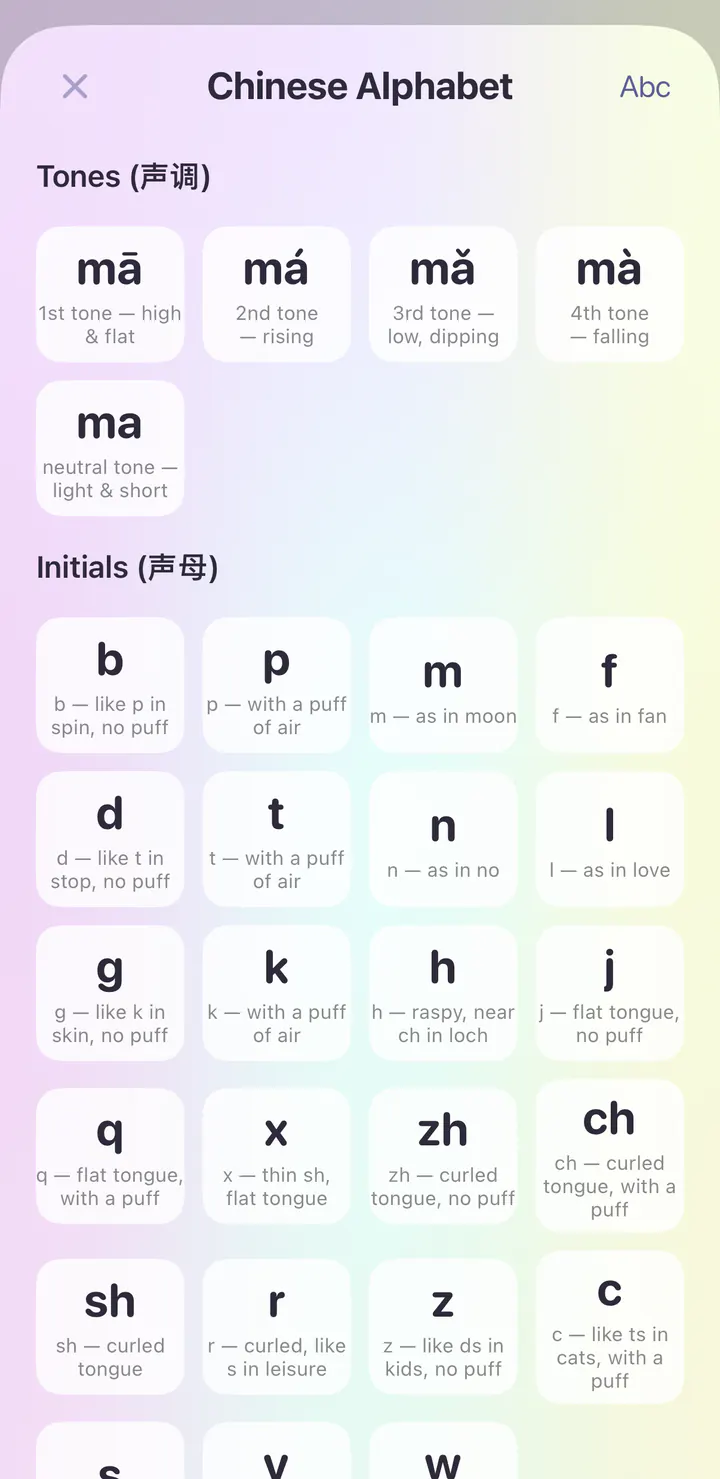
In the Loquus app, the alphabet reference lets you tap any character to hear it, and lessons bring new sounds back until they feel familiar.
Free to start. No account needed.
By Loquus ·
Sources
- MIT OpenCourseWare, Julian Wheatley: Sounds and symbols: An overview of pinyin
- MIT OpenCourseWare, Julian Wheatley: Unit 1
- MIT OpenCourseWare, Julian Wheatley: Unit 2
- MIT OpenCourseWare, Julian Wheatley: Unit 3
- MIT OpenCourseWare, Julian Wheatley: Unit 4
- MIT OpenCourseWare, Julian Wheatley: Character Lesson 1
- The Open University, Getting Started with Chinese 1: Pinyin and tones
- The Open University, Getting Started with Chinese 1: Tone changes
- The Open University, Getting Started with Chinese 1: Pronunciation: initials
- The Open University, Getting Started with Chinese 1: Pronunciation: single finals
- Yoyo Chinese: Pinyin Tone Pairs Table and 20 Essential Words
Learning research behind the practice
Worked examples, retrieval practice, and later review inform the activities. These studies do not establish the effectiveness of this specific lesson.
- Karpicke and Roediger: The critical importance of retrieval for learning
- Butler and Roediger: Feedback enhances the positive effects and reduces the negative effects of multiple choice testing
- Institute of Education Sciences: Organizing Instruction and Study to Improve Student Learning
- Rittle Johnson and Star: Compared to what?