Find the sentence role before changing an ending
In Анна читает книгу, Anna is the subject and the book is the direct object: it is what she reads. The dictionary form книга changes to книгу in this object role. The verb читает agrees with Anna, while the noun ending identifies the book’s relationship to the verb. These are separate grammatical decisions. Changing the object does not normally require changing the verb’s person ending.
The name “accusative” refers to a case form used for many direct objects. It is not a special kind of object in the physical world. A book can be a subject in one sentence and an object in another. Compare Книга здесь, “the book is here,” with Я читаю книгу, “I am reading a book.” English often signals the roles through word order; Russian also uses case forms. However, not every Russian form visibly differs across cases, and word order still carries information. Begin with a clear subject, verb, and object sequence. Ask who is reading and what is being read, then choose the forms that communicate those roles.
Change ordinary nouns in а to у
For a noun such as книга, replace final а with у to form the accusative singular: книгу. The same pattern gives газета to газету, “newspaper,” and музыка to музыку, “music.” You can say Я читаю газету or Я слушаю музыку. The action determines whether the noun is an object; the noun’s ending pattern determines how that object form is written.
Do not treat this as a rule limited to feminine nouns. It applies to nouns of this ending class, including some masculine names and family words. Я знаю папу uses папу from папа, even though the person is male. The noun’s grammatical gender and its declension pattern, the set of case endings it follows, are related but not identical categories. Conversely, not every feminine noun ends in а. A feminine noun ending in a soft sign follows another accusative pattern. For now, learn the small transformation together with a complete sentence. If you memorize only the isolated pair книга and книгу, you may recognize the ending but still choose the wrong role in a conversation.
Watch the decision
Say that you read a newspaper.
- Choose я читаю for the subject and action.
- Identify газета as an а noun used as the object.
- Replace final а with у.
Я читаю газету.
References for this explanation
- University of Kansas Между нами: 3.3 Что чита́ют россия́не?, Немно́го о языке́
- Cornell Russian grammar: The Accusative Singular endings for a declension
- University of Kansas Между нами: 4.5 Кафе́ «Идеа́льная ча́шка», Немно́го о языке́
- Cornell Russian grammar: Masculine, feminine, and neuter nouns
- University of Kansas Между нами: Declension Charts
Change ordinary nouns in я to ю and preserve the stem
The word песня, “song,” has the accusative form песню. Thus Я слушаю песню means “I am listening to a song.” The word история gives историю when it is a direct object, as in Я читаю историю, “I am reading a story.” The final letter changes from я to ю; do not erase the и that belongs before it in история. Compare the complete forms rather than replacing the entire ending with whatever looks shortest.
Names in this pattern behave similarly when used as objects. Анна знает Ваню says that Anna knows Vanya. The form Ваню is the object form of Ваня. It does not make Vanya feminine or change who knows whom. A related useful pattern involves nouns with a separating soft sign before я: статья becomes статью, “article.” The soft sign remains part of the spelling, and it helps indicate the sound sequence in the word. You do not need a new object rule for each of these examples, but you do need to preserve the word’s actual stem. Read the nominative, the dictionary form used for a subject, and the accusative side by side, then place the accusative in a meaningful sentence.
References for this explanation
Recognize objects whose form does not visibly change
Not every accusative noun gets a new ending. A masculine inanimate singular noun (one that names a thing, not a person or animal) such as журнал, “magazine,” keeps its form in Я читаю журнал. A neuter noun such as письмо, “letter,” also keeps its form: Я читаю письмо. A feminine noun ending in ь, such as тетрадь, “notebook,” likewise has an unchanged accusative singular in Я вижу тетрадь, “I see a notebook.”
The lack of a visible change does not mean that the object has stopped being accusative. Case is a grammatical role and form pattern, not a requirement that every word must look different in every sentence. The same issue occurs with ordinary inanimate plurals: Я читаю книги uses книги as the object. If you see a familiar dictionary or plural form after a verb, do not automatically assume it must be the subject. Use the construction and context. At the same time, avoid claiming that endings alone always remove ambiguity. Some nouns have identical subject and object forms, so the rest of the sentence and the conversation can be important for interpreting who acts on what.
Treat animate masculine objects as a different pattern
A masculine singular noun for an animate being, a person or an animal, often has an accusative form matching its genitive, the case that commonly expresses “of.” The word студент becomes студента in Я знаю студента, “I know a student.” The word брат becomes брата in Анна видит брата, “Anna sees her brother” or someone else’s, depending on context. The ending identifies the animate object. It is not an indefinite article, and it does not by itself say whose brother he is.
This pattern contrasts with the unchanged inanimate журнал. But the contrast does not override the а and я noun patterns already learned: папа still becomes папу, not a newly invented form based on the студент model. In the plural, animate nouns generally use an accusative form matching the genitive plural, while inanimate nouns match the nominative plural. The full plural inventory is a later learning task. Also, grammatical animacy is not simply a biology test for whether something is alive at this moment; special nouns can have conventional behavior that should be checked in a dictionary. Practice ordinary people and animals first, and keep the stated noun class visible in each exercise.
References for this explanation
- University of Kansas Между нами: 4.5 Кафе́ «Идеа́льная ча́шка», Немно́го о языке́
- Cornell Russian grammar: Masculine, feminine, and neuter nouns
- University of Kansas Между нами: Declension Charts
- Cornell Russian grammar: Acc. Sg. and Plur. endings and animacy
- Cornell Russian grammar: Genitive Singular forms (nouns and adjectives)
Use object pronouns instead of subject pronouns
The pronoun я is a subject form, while меня is used as a direct object. Compare Я знаю Анну, “I know Anna,” with Анна знает меня, “Anna knows me.” The second sentence does not use я after знает to mean “me.” Other useful object forms are тебя, informal “you”; его, “him” or “it”; её, “her”; нас, “us”; вас, formal or plural “you”; and их, “them.”
Вы знаете меня? asks a formal listener or group whether they know you. Я вас знаю answers from the opposite perspective: “I know you.” The pronouns have changed roles, so mechanically copying the question’s subject into the answer’s object position will not work. Some of these object forms look like possessive words you have already met. In Я вижу её, её means “her” as a person; in её книга, it means “her” before a noun. Recognize the role from the sentence rather than assuming one shape has only one possible job. This lesson practices direct objects without a preposition; after a preposition, a third person pronoun also takes an initial н.
Complete the reasoning
Build the sentence “Anna knows me.”
- Keep Anna as the subject.
- Use знает for third person singular.
- Choose меня as the object pronoun meaning “me.”
Compare your reasoning
Анна знает меня.
Keep related words and the intended meaning together
An adjective or possessive before an object may also need an accusative form. The phrase моя книга becomes мою книгу when it is the object in Я читаю мою книгу. For a common adjective, новая книга becomes новую книгу. The noun and its modifier function as one phrase, so changing only the noun can leave the phrase inconsistent. A later lesson can expand the full adjective tables; here, recognize these frequent feminine singular patterns.
To ask what someone is reading, use Что вы читаете? To ask whom someone knows, use Кого вы знаете? The object question кого differs from subject кто. Before answering, identify whether the missing item is a person or a thing and which role it has. The ordinary positive direct object patterns here do not cover every verb complement or every negative construction. Some verbs govern other cases, and negation can introduce accusative or genitive choices that require context. For practice, keep a known verb and a positive sentence, change only the object, then explain why its form changes or remains the same. This provides a stable foundation without pretending that one case rule explains every Russian sentence.
References for this explanation
- University of Kansas Между нами: 3.3 Что чита́ют россия́не?, Немно́го о языке́
- Cornell Russian grammar: Genitive Singular forms (nouns and adjectives)
- Cornell Russian grammar: Pronouns: the six case forms
- Cornell Russian grammar: Special adjectives
- University of Kansas Между нами: 1.10 Моби́льный телефо́н, Немно́го о языке́
See it in a sentence
Анна читает книгу.
Anna is reading a book.
The form книгу is the direct object.
Книга здесь.
The book is here.
The form книга is the subject.
Я читаю газету.
I am reading a newspaper.
The final а of газета changes to у.
Я слушаю музыку.
I am listening to music.
The form музыку is an accusative object.
Я знаю папу.
I know Dad.
A masculine person word follows the а to у pattern.
Я слушаю песню.
I am listening to a song.
The final я of песня changes to ю.
Я читаю статью.
I am reading an article.
The soft sign stays in статью.
Я читаю журнал.
I am reading a magazine.
The inanimate masculine form remains unchanged.
Я читаю письмо.
I am reading a letter.
The neuter form remains unchanged.
Я знаю студента.
I know a student.
An animate masculine object.
Анна знает меня.
Anna knows me.
The form меня is an object pronoun.
Кого вы знаете?
Whom do you know?
The word кого asks for the person as object.
Notice the difference
Common mistakes
Do not keep the nominative for an а noun object
Instead ofЯ читаю книга.
For this meaningЯ читаю книгу.
The book is what the subject reads, so the а noun takes accusative у. The subject я and its verb читаю already fit; the correction concerns the object rather than changing every word in the sentence.
Do not apply one masculine pattern to every noun
Instead ofЯ знаю студент.
For this meaningЯ знаю студента.
An animate masculine noun of this pattern takes an accusative form matching its genitive. The unchanged object pattern for an inanimate magazine does not apply to this student.
Do not use the subject pronoun я as an object
Instead ofАнна знает я.
For this meaningАнна знает меня.
The person speaking is the object of Anna’s knowing, so use меня. The pronoun я would be appropriate as the subject in a different sentence, such as Я знаю Анну.
From understanding to using
Make your own example.
Try these without answer choices. Say your answer aloud or write it below, then compare your reasoning with the model.
Your turn 1
Say that you are reading an article and listening to music.
Compare with a model
Я читаю статью и слушаю музыку.
I am reading an article and listening to music.
Both actions share the subject я. The word статья becomes статью with the soft sign retained, while музыка becomes музыку. The object endings change according to the nouns’ patterns rather than according to the number of verbs.
- Retain ь in статью.
- Use музыку as the second object.
- Keep both verbs in the я form.
Your turn 2
Ask a formal listener whom they know, then answer that you know Anna and the student.
Compare with a model
Кого вы знаете? Я знаю Анну и студента.
Whom do you know? I know Anna and the student.
The word кого asks for a person in the object role. Анна follows the а to у pattern; студент follows the animate masculine pattern. The formal question uses вы, but the reply naturally changes perspective to я.
- Use кого for the object question.
- Form Анну from Анна.
- Use студента for the animate masculine object.
Put it into practice
Make the next choice.
Choose a response and learn why it works. Your score reflects your first answer to each question. You can revisit anything you miss.
Choose an answer, then open the explanation to check your reasoning.
Question 1
Anna reads a book. Which word is the direct object?
- книгу
- Анна
Check the answer
Answer: книгу
книгу: The form книгу names what is being read.
Анна: Anna is the subject doing the reading.
Question 2
Use книга as the object of читаю.
- Я читаю книга.
- Я читаю книгу.
Check the answer
Answer: Я читаю книгу.
Я читаю книга.: The nominative form does not fit this direct object.
Я читаю книгу.: The form книга changes to accusative книгу.
Question 3
Say you listen to music.
- Я слушаю музыку.
- Я слушаю музыка.
Check the answer
Answer: Я слушаю музыку.
Я слушаю музыку.: The word музыка takes the accusative form музыку.
Я слушаю музыка.: This leaves the noun in nominative.
Question 4
Use папа as the object of знаю.
- Я знаю папа.
- Я знаю папу.
Check the answer
Answer: Я знаю папу.
Я знаю папа.: The subject form is not the required object form.
Я знаю папу.: The а noun pattern gives папу despite the person’s masculine gender.
Question 5
Use песня as a direct object.
- Я слушаю песню.
- Я слушаю песна.
Check the answer
Answer: Я слушаю песню.
Я слушаю песню.: The word песня changes final я to ю.
Я слушаю песна.: This is not the required form of песня.
Question 6
Choose the object form of история.
- исторю
- историю
Check the answer
Answer: историю
исторю: This removes a letter from the stem.
историю: The form историю retains the и before final ю.
Question 7
Choose the object form of статья.
- статью
- статю
Check the answer
Answer: статью
статью: The separating soft sign remains.
статю: The required soft sign has been removed.
Question 8
Say that you are reading a magazine.
- Я читаю журнала.
- Я читаю журнал.
Check the answer
Answer: Я читаю журнал.
Я читаю журнала.: The genitive form is not the ordinary positive object here.
Я читаю журнал.: The accusative singular matches nominative журнал.
Question 9
Which statement about unchanged письмо as an object is correct?
- It can be accusative even without a visible ending change.
- It cannot be an object because its spelling is unchanged.
Check the answer
Answer: It can be accusative even without a visible ending change.
It can be accusative even without a visible ending change.: Several Russian cases share the same written form.
It cannot be an object because its spelling is unchanged.: Case does not require a visible difference in every noun.
Question 10
Say that you know a male student.
- Я знаю студент.
- Я знаю студента.
Check the answer
Answer: Я знаю студента.
Я знаю студент.: The nominative does not fit this object.
Я знаю студента.: The animate masculine accusative matches genitive студента.
Question 11
Say that Anna knows you.
- Анна знает меня.
- Анна знает я.
Check the answer
Answer: Анна знает меня.
Анна знает меня.: The pronoun меня is the required object form.
Анна знает я.: The pronoun я is a subject form.
Question 12
Say “I know you” with formal address.
- Я вы знаю.
- Я вас знаю.
Check the answer
Answer: Я вас знаю.
Я вы знаю.: The pronoun вы is the subject form.
Я вас знаю.: The pronoun вас is the object form for formal or plural “you.”
Question 13
Say that you are reading a new book.
- Я читаю новую книгу.
- Я читаю новая книгу.
Check the answer
Answer: Я читаю новую книгу.
Я читаю новую книгу.: Both the adjective and noun have the needed accusative forms.
Я читаю новая книгу.: The adjective remains nominative while the noun is accusative.
Question 14
Ask whom the listener knows.
- Кто вас знает?
- Кого вы знаете?
Check the answer
Answer: Кого вы знаете?
Кто вас знает?: This asks who knows the listener, reversing the information gap.
Кого вы знаете?: The word кого asks for the object of their knowing.
Keep the conversation going
What to practice next
After a break, go back to your own examples above and do each task again without looking at the models. Compare the meaning and form with the models, and fix each mistake by explaining its cause. Then use one of your sentences in a short conversation of your own.
Keep it going in the app
Make this pattern stick.
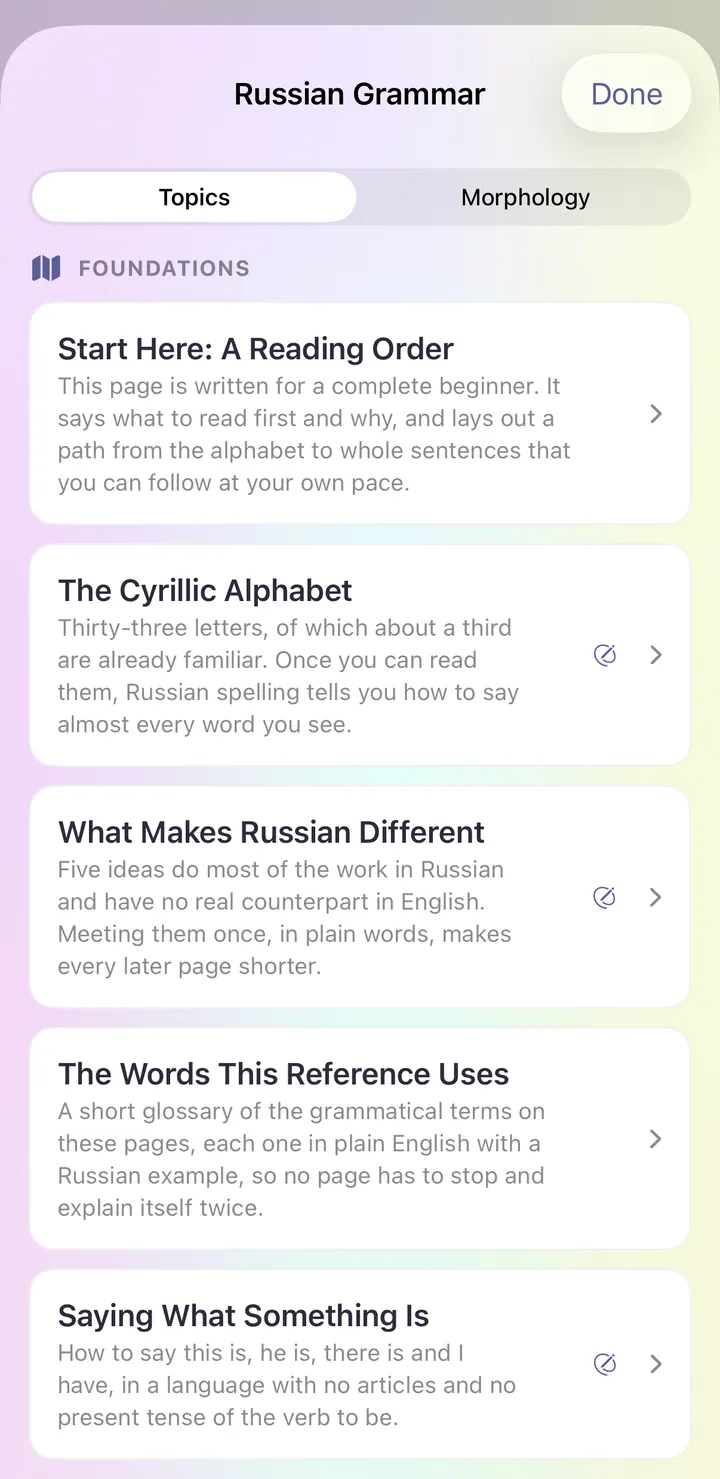
In the Loquus app, Grammar Center keeps topics like this one tap away with focused drills, and spaced review brings the words back before you forget them.
Free to start. No account needed.
By Loquus ·
Sources
- University of Kansas Между нами: 3.3 Что чита́ют россия́не?, Немно́го о языке́
- Cornell Russian grammar: The Accusative Singular endings for a declension
- Cornell Russian grammar: The Nominative case
- University of Kansas Между нами: Noun Case Usage
- University of Kansas Между нами: 4.5 Кафе́ «Идеа́льная ча́шка», Немно́го о языке́
- Cornell Russian grammar: Masculine, feminine, and neuter nouns
- University of Kansas Между нами: Declension Charts
- University of Kansas Между нами: 4.6 Хочу рассказать о Жене, Немно́го о языке́
- Cornell Russian grammar: Acc. Sg. and Plur. endings and animacy
- Cornell Russian grammar: Genitive Singular forms (nouns and adjectives)
- Cornell Russian grammar: Pronouns: the six case forms
- Cornell Russian grammar: Special adjectives
- Cornell Russian grammar: Addressing people: ty vs. vy
- University of Kansas Между нами: 1.9 Чья э́то ку́ртка?, Немно́го о языке́
- University of Kansas Между нами: 1.10 Моби́льный телефо́н, Немно́го о языке́
Learning research behind the practice
Worked examples, retrieval practice, and later review inform the activities. These studies do not establish the effectiveness of this specific lesson.