Build the Russian having pattern instead of copying English
У меня есть книга means “I have a book.” Read literally, it says “a book exists with me.” English uses have here, but Russian organizes this common construction differently. The phrase у меня identifies the person who has something, есть presents its existence or availability, and книга names the thing. The noun for the thing is nominative here, not the accusative object used after a verb such as читать.
Compare Я читаю книгу, “I am reading a book,” with У меня есть книга, “I have a book.” In English, both sentences begin with I, but the Russian constructions require different forms and relationships. The book is an object of reading in the first; it is the thing that exists in the second. Do not combine у меня with an accusative книгу merely because English treats the book as something you have. Learn the whole positive frame first, then substitute a new familiar item. That provides a reliable starting point for questions about tools, belongings, or available things without requiring a word for word match to English.
References for this explanation
- University of Kansas Между нами: 4.1 Моя́ Кварти́ра, Немно́го о языке́
- Cornell Russian grammar: Expressions for ‘to have’ and ‘to have not’
- University of Kansas Между нами: Noun Case Usage
- Cornell Russian grammar: The Nominative case
- Cornell Russian grammar: The Accusative Singular endings for a declension
Change the possessor with the appropriate pronoun form
The common possessor phrases are у меня, “I have”; у тебя, “you have” (familiar); у него, “he has” or “it has”; у неё, “she has”; у нас, “we have”; у вас, “you have” (formal or plural); and у них, “they have.” The preposition у requires the genitive form, so its complement is not the ordinary subject pronoun я, ты, он, or она. The phrases function as units in the early practice.
Notice the initial н in него, неё, and них after у. Do not replace у него with у его merely by copying a familiar possessive word. The phrase его книга means “his book,” while у него есть книга means “he has a book.” The shapes are related, but the constructions are different. У вас есть телефон? can address one person formally or several people. The phrase does not tell you which situation applies without context. In a reply, the perspective often changes: Да, у меня есть телефон. Choose the possessor from the speaker’s viewpoint rather than repeating вас mechanically from the question. This is the same practical skill as changing English you to I in an answer.
Use genitive after у when you name the owner
You can name the possessor instead of using a pronoun. У Анны есть книга says Anna has a book. The name Анна becomes Анны after у. У студента есть телефон says a student has a phone; студент becomes студента. These genitive forms identify the owner or person associated with the thing. They do not make that person the object of an action verb.
The noun patterns are useful beyond names. A common masculine noun in a hard consonant adds а in the genitive singular, while an а noun often replaces а with ы. Spelling rules can require и instead, and soft stems have their own related forms. Learn the exact word you need rather than treating two example endings as the whole case system. For a beginning introduction, an owner’s name plus one object is enough. У Анны есть словарь and У студента есть книга let you change the possessor and item independently. That independence matters: changing Anna to the student changes the owner phrase, while replacing the book with a dictionary changes the nominative item phrase.
Use нет and a genitive item to express absence
У меня нет книги means “I do not have a book.” The possessor phrase у меня stays the same, but есть is replaced by нет and the absent item takes the genitive form книги. The positive and negative constructions therefore differ in two visible places. It is not enough to replace есть with нет while leaving книга unchanged.
Compare У меня есть телефон with У меня нет телефона. A common masculine item adds а in the genitive singular. In У меня нет словаря, the soft masculine noun словарь replaces its soft sign with я. For a feminine noun in ь, нет тетради means “there is no notebook.” The form тетради is singular here, even though the nominative plural of тетрадь is spelled the same way. In нет книги, книги is genitive singular because the intended noun is one book in the construction being practiced. A plural absence claim would require the appropriate genitive plural. The lesson does not require the whole plural system yet. Begin by changing a positive sentence about one item into a negative and explicitly checking the form of that item.
Watch the decision
Turn “I have a phone” into “I do not have a phone.”
- Retain у меня for the same possessor.
- Replace есть with нет.
- Change телефон to genitive телефона.
У меня нет телефона.
References for this explanation
- Cornell Russian grammar: Expressions for ‘to have’ and ‘to have not’
- Cornell Russian grammar: Genitive Singular forms (nouns and adjectives)
- University of Kansas Между нами: 4.2 Где мо́жно купи́ть ча́йник?, Немно́го о языке́
- University of Kansas Между нами: Declension Charts
- Cornell Russian grammar: The ‘net’ construction
Distinguish existence from describing an already known thing
The word есть is especially useful when the question is whether an item exists or is available. У вас есть книга? asks whether the listener has a book. In a sentence describing a property of a known possession, Russian often omits есть. У Анны новая книга says Anna has a new book, with the description in focus. The exact choice depends on what the conversation treats as new information, so do not turn the basic frame into a rule that every sentence with у must contain есть.
Compare an availability question with a descriptive one. У вас есть телефон? asks whether you have a phone at all or have one available in context. A question about whether your phone is new is not the same information gap. This distinction also matters when interpreting a reply: hearing a description does not necessarily mean the speaker is introducing ownership for the first time. For the production tasks here, the intended purpose is stated explicitly. Use the full есть pattern to introduce possession and the нет pattern to deny it. Recognize omitted есть in descriptive sentences without trying to force it into every line you encounter.
Ask who has something and whose thing it is
У кого есть ручка? asks who has a pen. Чья это ручка? asks whose pen this is. The first looks for a person with an available item; the second identifies the owner of a particular item already under discussion. The questions can lead to the same person in some situations, but they do not request the same information. A person holding a borrowed pen may be able to answer the first without being its owner.
In the first question, кого is the form used after у. Do not say у кто by retaining the nominative question word. In the second question, чья agrees with the feminine noun ручка. A short reply to the availability question can be У меня, “I do” (literally “with me”), because the rest of the pattern is recoverable from context. A fuller beginner reply is У меня есть ручка. A short answer may be sufficient in conversation, but a full answer gives you practice in selecting the possessor and the item form. When the situation contains a misunderstanding, name the available or missing item explicitly instead of relying on a bare positive response.
Complete the reasoning
Ask who has a pen available.
- Choose the having construction rather than a “whose” question.
- Use кого after у.
- Keep ручка nominative after есть.
Compare your reasoning
У кого есть ручка?
References for this explanation
- University of Kansas Между нами: 4.1 Моя́ Кварти́ра, Немно́го о языке́
- Cornell Russian grammar: Pronouns: the six case forms
- Cornell Russian grammar: Special adjectives
- University of Kansas Между нами: 1.9 Чья э́то ку́ртка?, Немно́го о языке́
- University of Kansas Между нами: 1.10 Моби́льный телефо́н, Немно́го о языке́
Extend the pattern in time without losing its structure
For positive past possession, a form of быть agrees with the thing that existed: У меня была книга and У меня был телефон. The feminine книга selects была, while masculine телефон selects был. The possessor remains in the same у phrase. It is not the owner’s gender that determines those verb forms. This is a useful contrast with a statement such as Я была дома, where я is the subject controlling agreement.
Negative absence has an impersonal pattern: У меня не было книги, “I did not have a book,” and У меня не будет книги, “I will not have a book.” The absent item remains genitive, and the ordinary negative construction uses singular было or будет rather than agreeing with that item as a subject. These are extensions to recognize after the present pattern is comfortable, not a reason to skip its basic contrast. For retrieval practice, write a positive present sentence, turn it negative, then change the possessor. Explain which part changed at each step. If every word changes together, slow down and separate the owner, existence or absence, and item roles before trying another example.
References for this explanation
- Cornell Russian grammar: The ‘net’ construction
- University of Kansas Между нами: 4.6 Хочу рассказать о Жене, Немно́го о языке́
- Cornell Russian grammar: Verbs: expressing past, present, and future
- Cornell Russian grammar: Masculine, feminine, and neuter nouns
- University of Kansas Между нами: 5.6 Дени́с е́дет в Яросла́вль, Немно́го о языке́
See it in a sentence
У меня есть книга.
I have a book.
The item is nominative.
У тебя есть телефон?
Do you have a phone?
Familiar singular address.
У него есть словарь.
He has a dictionary.
The pronoun after у has initial н.
У неё есть книга.
She has a book.
The possessor phrase is у неё.
У нас есть ручка.
We have a pen.
A plural possessor does not change есть.
У вас есть телефон?
Do you have a phone?
Formal singular or plural address.
У Анны есть словарь.
Anna has a dictionary.
The name takes genitive after у.
У меня нет книги.
I do not have a book.
The absent item is genitive.
У меня нет телефона.
I do not have a phone.
The form телефона is genitive singular.
У кого есть ручка?
Who has a pen?
A question about availability or possession.
Чья это ручка?
Whose pen is this?
A question about a particular item’s owner.
У меня была книга.
I had a book.
The past verb agrees with книга.
Notice the difference
Common mistakes
Do not confuse a possessed item with a direct object
Instead ofУ меня есть книгу.
For this meaningУ меня есть книга.
The item in the ordinary есть construction is nominative. The accusative книгу belongs in a different frame such as reading a book. Translate the relationship, not the English position of the noun.
Put the absent item in the genitive after нет
Instead ofУ меня нет телефон.
For this meaningУ меня нет телефона.
The word нет requires a genitive item in this absence construction. The owner phrase can stay unchanged while the item changes from телефон to телефона.
Keep the initial н after the preposition
Instead ofУ её есть книга.
For this meaningУ неё есть книга.
After a preposition, the pronoun form is неё. The form её can be useful as a possessive before a noun or as an object in other sentences, but it does not replace неё after у.
From understanding to using
Make your own example.
Try these without answer choices. Say your answer aloud or write it below, then compare your reasoning with the model.
Your turn 1
Say you have a dictionary but do not have a notebook.
Compare with a model
У меня есть словарь, но нет тетради.
I have a dictionary, but I do not have a notebook.
The dictionary is nominative after есть. The absent notebook is genitive тетради after нет. The possessor is the same in both parts, so the second у меня can be understood from the first part.
- Use словарь after есть.
- Use тетради after нет.
- Keep the contrast between available and absent items.
Your turn 2
Ask a formal listener whether they have a phone. Reply that you do not have a phone but Anna does.
Compare with a model
У вас есть телефон? У меня нет телефона, а у Анны есть телефон.
Do you have a phone? I do not have a phone, but Anna has one.
The question uses formal вас. The negative reply changes the item to genitive телефона; the positive claim about Anna returns it to nominative телефон. Анны is genitive because it follows у, independently of the item’s form.
- Use вас in the formal question.
- Change телефона back to телефон in the positive clause.
- Use Анны after у.
Put it into practice
Make the next choice.
Choose a response and learn why it works. Your score reflects your first answer to each question. You can revisit anything you miss.
Choose an answer, then open the explanation to check your reasoning.
Question 1
Introduce possession of one book.
- У меня есть книга.
- У меня есть книгу.
Check the answer
Answer: У меня есть книга.
У меня есть книга.: The possessed item is nominative in this construction.
У меня есть книгу.: The form книгу is an accusative object form, which does not fit this frame.
Question 2
Choose the possessor phrase meaning “I have.”
- у я
- у меня
Check the answer
Answer: у меня
у я: The pronoun я is the nominative subject form, which cannot follow у.
у меня: The preposition у takes the genitive pronoun меня.
Question 3
Say he has a phone.
- У него есть телефон.
- У его есть телефон.
Check the answer
Answer: У него есть телефон.
У него есть телефон.: The form него is the one used after у.
У его есть телефон.: The form его, without н, does not follow the preposition у.
Question 4
Ask a shop assistant whether they have a dictionary.
- У тебя есть словарь?
- У вас есть словарь?
Check the answer
Answer: У вас есть словарь?
У тебя есть словарь?: The form тебя is familiar singular address, too casual for a shop assistant.
У вас есть словарь?: The form вас gives the formal address a shop assistant expects.
Question 5
Say that Anna has a book, with her name after у.
- У Анны есть книга.
- У Анна есть книга.
Check the answer
Answer: У Анны есть книга.
У Анны есть книга.: Анна becomes genitive Анны.
У Анна есть книга.: The dictionary form is not used after у here.
Question 6
Say that a male student has a phone.
- У студент есть телефон.
- У студента есть телефон.
Check the answer
Answer: У студента есть телефон.
У студент есть телефон.: The nominative form does not fit the preposition.
У студента есть телефон.: The form студента is genitive after у.
Question 7
Deny possession of a book.
- У меня нет книги.
- У меня нет книга.
Check the answer
Answer: У меня нет книги.
У меня нет книги.: The word нет takes a genitive item.
У меня нет книга.: The form книга is nominative and does not fit the absence construction.
Question 8
Deny possession of a phone.
- У меня нет телефон.
- У меня нет телефона.
Check the answer
Answer: У меня нет телефона.
У меня нет телефон.: The item remains incorrectly nominative.
У меня нет телефона.: The form телефона is the genitive singular.
Question 9
Deny possession of a dictionary.
- У меня нет словаря.
- У меня нет словарь.
Check the answer
Answer: У меня нет словаря.
У меня нет словаря.: The soft masculine noun has genitive словаря.
У меня нет словарь.: The dictionary form is not the required genitive.
Question 10
Which statement about есть is accurate?
- It must occur in every sentence containing у.
- It can be omitted when a known possession’s property is the focus.
Check the answer
Answer: It can be omitted when a known possession’s property is the focus.
It must occur in every sentence containing у.: This would incorrectly force есть into descriptive constructions.
It can be omitted when a known possession’s property is the focus.: The information focus affects its use.
Question 11
Ask who has an available pen.
- У кого есть ручка?
- Чья это ручка?
Check the answer
Answer: У кого есть ручка?
У кого есть ручка?: The question seeks a person with a pen.
Чья это ручка?: This asks who owns a particular pen instead.
Question 12
Ask whose particular pen this is.
- У кого есть ручка?
- Чья это ручка?
Check the answer
Answer: Чья это ручка?
У кого есть ручка?: This asks who has a pen available.
Чья это ручка?: The word чья asks who owns the identified item.
Question 13
Say that you had a book.
- У меня была книга.
- У меня был книга.
Check the answer
Answer: У меня была книга.
У меня была книга.: Feminine книга determines была.
У меня был книга.: The masculine form был does not agree with feminine книга.
Question 14
Say that you did not have a book.
- У меня не была книги.
- У меня не было книги.
Check the answer
Answer: У меня не было книги.
У меня не была книги.: The genitive absent item does not control feminine subject agreement.
У меня не было книги.: The phrase не было is the impersonal form used with genitive книги.
Keep the conversation going
What to practice next
After a break, go back to your own examples above and do each task again without looking at the models. Compare the meaning and form with the models, and fix each mistake by explaining its cause. Then use one of your sentences in a short conversation of your own.
Keep it going in the app
Make this pattern stick.
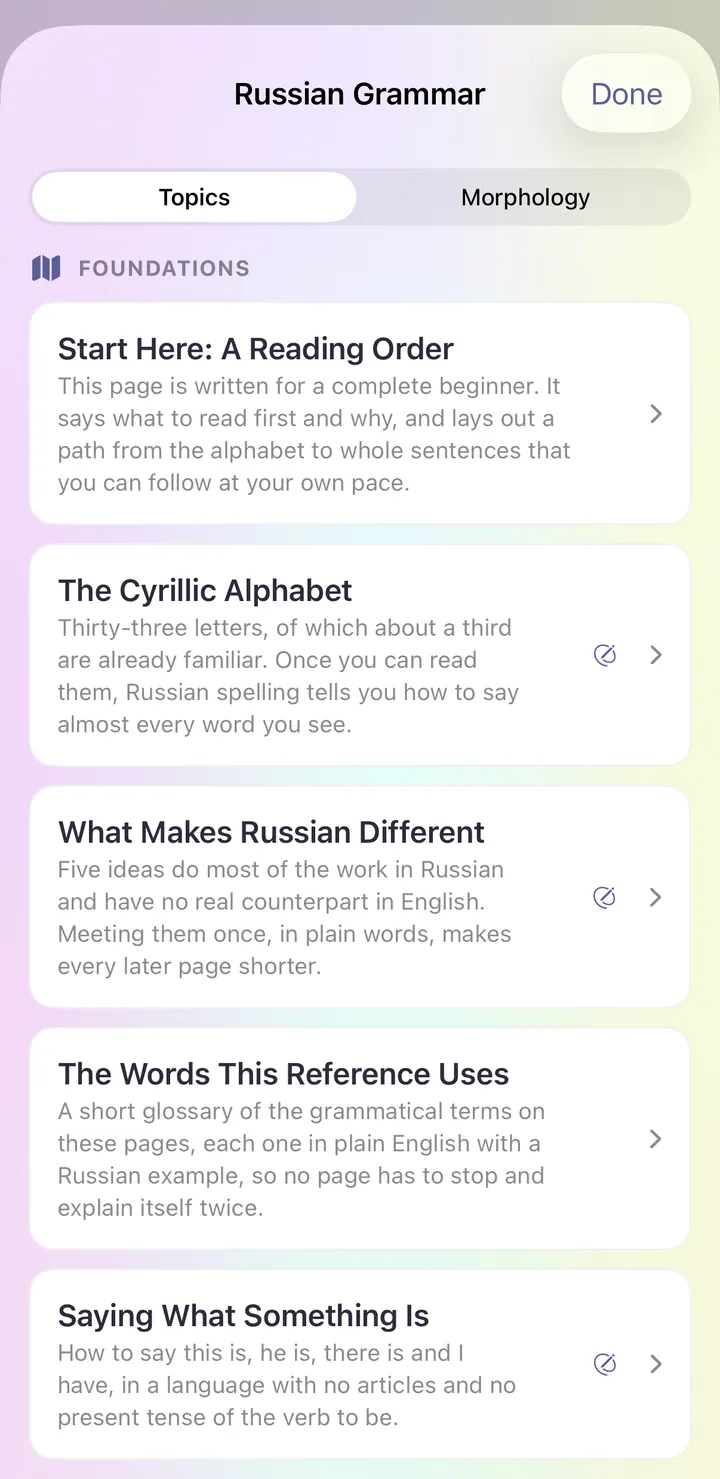
In the Loquus app, Grammar Center keeps topics like this one tap away with focused drills, and spaced review brings the words back before you forget them.
Free to start. No account needed.
By Loquus ·
Sources
- University of Kansas Между нами: 4.1 Моя́ Кварти́ра, Немно́го о языке́
- Cornell Russian grammar: Expressions for ‘to have’ and ‘to have not’
- University of Kansas Между нами: Noun Case Usage
- Cornell Russian grammar: The Nominative case
- Cornell Russian grammar: The Accusative Singular endings for a declension
- Cornell Russian grammar: Pronouns: the six case forms
- Cornell Russian grammar: Special adjectives
- Cornell Russian grammar: Addressing people: ty vs. vy
- Cornell Russian grammar: Use Genitive after certain prepositions
- Cornell Russian grammar: Genitive Singular forms (nouns and adjectives)
- University of Kansas Между нами: 4.2 Где мо́жно купи́ть ча́йник?, Немно́го о языке́
- University of Kansas Между нами: Declension Charts
- Cornell Russian grammar: The ‘net’ construction
- Cornell Russian grammar: Sentence types: structures with a Nominative subject
- University of Kansas Между нами: 1.9 Чья э́то ку́ртка?, Немно́го о языке́
- University of Kansas Между нами: 1.10 Моби́льный телефо́н, Немно́го о языке́
- University of Kansas Между нами: 4.6 Хочу рассказать о Жене, Немно́го о языке́
- Cornell Russian grammar: Verbs: expressing past, present, and future
- Cornell Russian grammar: Masculine, feminine, and neuter nouns
- University of Kansas Между нами: 5.6 Дени́с е́дет в Яросла́вль, Немно́го о языке́
Learning research behind the practice
Worked examples, retrieval practice, and later review inform the activities. These studies do not establish the effectiveness of this specific lesson.