Start with a greeting and one clear request
A small order does not need a long sentence. Чай, пожалуйста means “Tea, please,” and Кофе, пожалуйста means “Coffee, please.” In an established service interaction, the situation supplies the missing idea of requesting the item. The phrase is short but still complete; it does not need a verb to work as a request. Say the item clearly and include пожалуйста as a courteous request word.
Begin an unfamiliar interaction with Здравствуйте, then make the request when the other person is ready. The greeting addresses someone formally or several people. By contrast, Привет belongs to a familiar style and is not the neutral formal greeting practiced here. No phrase guarantees that every interaction will have the same level of formality; relationships, tone, and setting still matter. This lesson provides a dependable small set rather than a script that every café must follow.
Recognize Спасибо as thanks when the item is provided. The word пожалуйста can also occur in a server’s response when handing something over or responding to thanks. Its meaning depends on its role in the exchange. Do not assume that hearing the same word always means the other person is making a new request. Follow what the speaker is doing and which item is currently under discussion.
Use мне or a formal imperative for a fuller order
Мне чай, пожалуйста means “Tea for me, please.” The pronoun мне is a form of я that identifies the recipient here. It is not the subject form я and not the possession phrase у меня. The short ordering frame gives a recipient and an item while leaving the action understood. It is useful when several people are ordering separately, because it makes clear whose request is being stated.
A fuller request is Дайте, пожалуйста, чай, which in a service context means “Please give me tea.” The form дайте is the formal or plural imperative of дать, “to give.” The familiar singular form is дай. Learn this useful irregular pair directly. Do not make a supposed formal request by placing the subject pronoun вы before дай while keeping the familiar verb form. Formality is reflected in the verb form itself.
An imperative is a grammatical request or command form; its name does not mean every use is rude. With an appropriate context, tone, and пожалуйста, a formal imperative can make an ordinary request. At the same time, adding пожалуйста does not erase an aggressive tone. Verbs also have aspect, the way a verb presents an action: a perfective verb such as дать presents it as a complete whole. Aspect influences the shape of invitations and requests, but a rule that every perfective imperative is impolite would be false. The perfective imperative дайте is a useful counterexample to that oversimplification.
Notice the item’s case instead of copying a menu label
Menu entries often present nouns in a dictionary form, but a sentence may need another form. Дайте воду, пожалуйста requests water. The noun вода changes to accusative воду because it is the requested item in the verb’s object position. Дайте пиццу, пожалуйста similarly uses пиццу from пицца. These familiar а nouns replace а with у in this singular object construction.
Compare Дайте суп, пожалуйста. The noun суп is masculine and inanimate (it names a thing, not a person or animal), so its singular accusative looks like its nominative form. The absence of a visible change does not mean the word has no case. Меню, пожалуйста also lets you request the menu itself, while Где меню? asks where it is. Those are different practical moves, even though both contain the same familiar noun.
Do not generalize one ending across every food word. Nouns in different classes can have different forms, and an adjective describing an item may need its own agreement. Start with small requests whose forms you can control. If your request contains a feminine adjective, the accusative agreement appears in both words, as in холодную воду, “cold water.” Identifying the noun, its role, and any agreeing adjective is more reliable than adding one ending to every word on a menu.
Watch the decision
Request water politely with a formal imperative.
- Choose дайте for formal address.
- Make вода the accusative object воду.
- Add пожалуйста to the request.
Дайте воду, пожалуйста.
References for this explanation
- University of Kansas Между нами: 1.5 Где? Здесь и́ли там?
- University of Kansas Между нами: 3.3 Что чита́ют россия́не?, Немно́го о языке́
- Cornell Russian grammar: The Accusative Singular endings for a declension
- Cornell Russian grammar: Acc. Sg. and Plur. endings and animacy
- University of Kansas Между нами: 1.5 Где? Здесь и́ли там?, Немно́го о языке́
Distinguish wanting something from ordering it
Я хочу чай means “I want tea.” Вы хотите чай? asks a formal listener or several people whether they want tea. The verb хотеть has a mixed present pattern: хочу, хочешь, хочет, хотим, хотите, хотят. Do not infer all six forms from only хочу or from the infinitive. The singular and plural groups need to be learned together.
A statement of desire can explain a preference, but it is not the only way to make an order. The shorter item plus пожалуйста frame and the formal дайте request directly accomplish the service task in the examples here. Choose according to what the conversation needs. If a friend asks what you want, Я хочу чай is a suitable statement of preference. If the server is waiting for your order, Чай, пожалуйста is already enough for that purpose.
The verb хотеть can also take an infinitive: Я хочу пить, “I want to drink” or, in context, “I am thirsty.” Compare the noun чай with the infinitive пить after the same conjugated verb. The second verb stays infinitive; it does not become another first person conjugated form. This distinction helps you recognize whether the speaker names a desired item or a desired action, without treating every sentence with хочу as a fixed restaurant formula.
References for this explanation
Specify with or without an ingredient
The phrase чай с молоком means “tea with milk,” while чай без молока means “tea without milk.” The prepositions require different cases. The preposition с, meaning “together with” or “accompanied by,” takes the instrumental here, giving молоком. The preposition без takes the genitive, giving молока. The contrast is not made by swapping only the preposition and leaving the noun unchanged.
The phrase без сахара means “without sugar.” You can attach it to a clear drink request: Чай без сахара, пожалуйста. The phrase tells the listener which ingredient to leave out of the requested drink. Its positive counterpart is с сахаром, “with sugar.” Learn each preposition together with its noun form, then retrieve the pair from meaning instead of relying on their similar appearance.
These phrases describe the requested composition. They do not establish how a kitchen prepares food or whether ingredients have contacted each other. If a detail is important and the response is unclear, obtain a specific answer rather than treating a memorized phrase as confirmation. In ordinary practice here, the exercise is simply to distinguish inclusion from omission and to select the appropriate form. First choose the intended meaning, then the preposition, and finally the noun ending. That sequence prevents a grammatically polished request for the opposite of what you wanted.
Complete the reasoning
Ask for tea without milk.
- Name the drink чай.
- Choose без to exclude milk.
- Use genitive молока after без.
Compare your reasoning
Чай без молока, пожалуйста.
Check availability and repair the item name
У вас есть суп? asks whether soup is available from the listener in the service context. It uses the familiar possession and availability frame with formal or plural вас. A reply such as Супа нет says there is no soup. The negative existence construction puts the absent item in the genitive, so суп becomes супа. It is not the same form change as the accusative in a positive request.
When a server repeats the wrong item, make the correction explicit. Нет, чай, пожалуйста means “No, tea, please,” in a situation where coffee has just been proposed or repeated incorrectly. The initial нет rejects that proposal; it is not the negative existence construction нет чая. Context tells you whether нет is a response word or the predicate expressing absence. This distinction matters because the next noun need not take the same form in those two different structures.
If you did not understand a question, Повторите, пожалуйста asks the person to repeat. It does not mean that you agree to the item they mentioned. A useful repair names the missing information or requests repetition before confirming. Avoid saying да simply to keep the conversation moving when you still do not know what choice you are accepting.
References for this explanation
- Cornell Russian grammar: Addressing people: ty vs. vy
- Cornell Russian grammar: Genitive Singular forms (nouns and adjectives)
- University of Kansas Между нами: 4.1 Моя́ Кварти́ра, Немно́го о языке́
- University of Kansas Между нами: 4.2 Где мо́жно купи́ть ча́йник?, Немно́го о языке́
- Cornell Russian grammar: The ‘net’ construction
- University of Kansas Между нами: 1.4 Здра́вствуйте!
Build an exchange around information that actually changes
Practice a café interaction in small decisions. First identify what is available, then select the item, then specify an ingredient, and finally confirm the complete request. If the server asks about milk after you have selected tea, the answer should resolve the milk question. Repeating only чай at that point leaves the new information gap open. A short answer such as Без молока, пожалуйста directly resolves it.
A full confirmation can combine the choices: Чай без молока, пожалуйста. It may repeat information, but the repetition has a purpose: both speakers can check that the same drink and ingredient choice have been understood. Once the correct item is handed over, Спасибо closes that small action. A thanks line by itself does not tell you which earlier option was selected, so it should not replace the selection.
Before the game, cover the model and produce two orders with different meanings. Change water to tea in one, and “with milk” to “without milk” in the other. Explain which change affected the noun’s case and which changed the preposition. Then role play a misunderstanding: let the other speaker repeat coffee when you wanted tea and repair that specific detail. This gives retrieval practice with a communicative purpose rather than memorizing the dialogue as an uninterrupted string.
References for this explanation
See it in a sentence
Здравствуйте!
Hello!
Formal or plural greeting.
Чай, пожалуйста.
Tea, please.
A short request in a service interaction.
Мне кофе, пожалуйста.
Coffee for me, please.
The pronoun мне marks the recipient.
Дайте воду, пожалуйста.
Please give me water.
The form воду is accusative.
Дайте суп, пожалуйста.
Please give me soup.
The inanimate masculine object has no visible case change.
Я хочу чай.
I want tea.
The form хочу expresses the speaker’s desire.
Вы хотите чай?
Would you like tea?
Formal or plural present form.
Чай с молоком, пожалуйста.
Tea with milk, please.
The preposition с takes the instrumental here.
Чай без сахара, пожалуйста.
Tea without sugar, please.
The preposition без takes the genitive.
У вас есть суп?
Do you have soup?
An availability question in this setting.
Супа нет.
There is no soup.
The absent item is genitive.
Повторите, пожалуйста.
Please repeat.
A request for repetition rather than agreement.
Notice the difference
Common mistakes
Use a recipient form in the short ordering frame
Instead ofЯ чай, пожалуйста.
For this meaningМне чай, пожалуйста.
The short phrase identifies the person receiving the tea with мне. The pronoun я would be the subject form in a different construction such as Я хочу чай.
Keep the case required by без
Instead ofЧай без молоком.
For this meaningЧай без молока.
The preposition без takes genitive молока. The instrumental молоком is correct after с when the intended meaning is “with milk.”
Change the ending а to у in a requested item
Instead ofДайте вода, пожалуйста.
For this meaningДайте воду, пожалуйста.
The request verb takes the item as an object. The noun вода becomes воду in the accusative, even if the printed menu lists вода.
From understanding to using
Make your own example.
Try these without answer choices. Say your answer aloud or write it below, then compare your reasoning with the model.
Your turn 1
Request water for yourself with дайте and пожалуйста.
Compare with a model
Дайте воду, пожалуйста.
Please give me water.
The imperative дайте is the formal or plural request form, and воду is the accusative item. A separate мне is possible when the recipient needs emphasis, but it is understood in this simple service context.
- Use дайте rather than дай.
- Change вода to воду.
- Include пожалуйста.
Your turn 2
Ask whether soup is available, then request tea without sugar.
Compare with a model
У вас есть суп? Чай без сахара, пожалуйста.
Do you have soup? Tea without sugar, please.
The first sentence checks availability with formal вас and nominative суп. The second request uses без plus genitive сахара to exclude sugar. The sentences perform different actions, so they do not share one noun case pattern.
- Use the есть availability frame.
- Name tea explicitly.
- Use сахара after без.
Put it into practice
Make the next choice.
Choose a response and learn why it works. Your score reflects your first answer to each question. You can revisit anything you miss.
Choose an answer, then open the explanation to check your reasoning.
Question 1
Greet a server you have not met before.
- Здравствуйте!
- Привет!
Check the answer
Answer: Здравствуйте!
Здравствуйте!: The greeting Здравствуйте is formal, which suits a server you have not met.
Привет!: The greeting Привет is familiar, too casual for a server you have not met.
Question 2
Request tea rather than coffee.
- Кофе, пожалуйста.
- Чай, пожалуйста.
Check the answer
Answer: Чай, пожалуйста.
Кофе, пожалуйста.: The word кофе names coffee, not tea.
Чай, пожалуйста.: The word чай names tea.
Question 3
Make a short request for tea for yourself.
- Мне чай, пожалуйста.
- Я чай, пожалуйста.
Check the answer
Answer: Мне чай, пожалуйста.
Мне чай, пожалуйста.: The pronoun мне marks the recipient in this ordering frame.
Я чай, пожалуйста.: The pronoun я is the subject form, not the recipient form required here.
Question 4
Ask a stranger to give you something, using дать.
- Дай.
- Дайте.
Check the answer
Answer: Дайте.
Дай.: The form дай addresses one person as ты, which does not suit a stranger.
Дайте.: The form дайте addresses a person as вы, as a stranger expects.
Question 5
Request water using дайте.
- Дайте воду, пожалуйста.
- Дайте вода, пожалуйста.
Check the answer
Answer: Дайте воду, пожалуйста.
Дайте воду, пожалуйста.: The noun вода changes to accusative воду.
Дайте вода, пожалуйста.: The nominative menu form does not fit this object position.
Question 6
Request soup.
- Дайте супом, пожалуйста.
- Дайте суп, пожалуйста.
Check the answer
Answer: Дайте суп, пожалуйста.
Дайте супом, пожалуйста.: The form супом is instrumental, not the accusative object required in this request.
Дайте суп, пожалуйста.: The form суп is the accusative singular in this frame.
Question 7
Ask a formal listener whether they want tea.
- Вы хотите чай?
- Вы хочет чай?
Check the answer
Answer: Вы хотите чай?
Вы хотите чай?: The form хотите agrees with вы.
Вы хочет чай?: The form хочет is third person singular and does not agree with вы.
Question 8
Say that you want to drink.
- Я хочу пью.
- Я хочу пить.
Check the answer
Answer: Я хочу пить.
Я хочу пью.: The form пью is another conjugated first person form and does not fit after хочу.
Я хочу пить.: The verb пить stays infinitive after хочу.
Question 9
Request tea with milk.
- Чай с молоком, пожалуйста.
- Чай без молока, пожалуйста.
Check the answer
Answer: Чай с молоком, пожалуйста.
Чай с молоком, пожалуйста.: The phrase с молоком includes milk.
Чай без молока, пожалуйста.: The phrase без молока excludes milk.
Question 10
Choose the correct noun form after без.
- Без сахаром.
- Без сахара.
Check the answer
Answer: Без сахара.
Без сахаром.: The form сахаром is instrumental and belongs after с, in the phrase meaning “with sugar.”
Без сахара.: The form сахара is genitive after без.
Question 11
Ask whether soup is available.
- У вас есть суп?
- Где суп?
Check the answer
Answer: У вас есть суп?
У вас есть суп?: The есть question checks availability.
Где суп?: The word где asks where the soup is, rather than whether it is available.
Question 12
Say there is no soup.
- Суп нет.
- Супа нет.
Check the answer
Answer: Супа нет.
Суп нет.: The noun remains nominative instead of taking genitive.
Супа нет.: The absent item is genitive супа.
Question 13
You did not understand the question. Ask for repetition.
- Повторите, пожалуйста.
- Да, пожалуйста.
Check the answer
Answer: Повторите, пожалуйста.
Повторите, пожалуйста.: The form повторите asks the person to repeat the question.
Да, пожалуйста.: The word да accepts or affirms something rather than asking for repetition.
Question 14
The server asks whether you want milk in your tea. Decline milk explicitly.
- С молоком, пожалуйста.
- Без молока, пожалуйста.
Check the answer
Answer: Без молока, пожалуйста.
С молоком, пожалуйста.: The phrase с молоком selects milk, which reverses the requested meaning.
Без молока, пожалуйста.: The phrase без молока declines the milk.
Conversation builder
Order tea after checking soup
The customer first asks about soup. After hearing it is unavailable, the customer orders tea. The server then asks about milk, the customer declines it, and the server confirms the drink. Put that exact exchange in order.
- У вас есть суп?
Do you have soup?
- Супа нет.
There is no soup.
- Тогда чай, пожалуйста.
Then tea, please.
- Чай с молоком?
Tea with milk?
- Без молока, пожалуйста.
Without milk, please.
- Хорошо, чай без молока.
All right, tea without milk.
Keep the conversation going
What to practice next
After a break, go back to your own examples above and do each task again without looking at the models. Compare the meaning and form with the models, and fix each mistake by explaining its cause. Then use one of your sentences in a short conversation of your own.
Keep it going in the app
Say it out loud next.
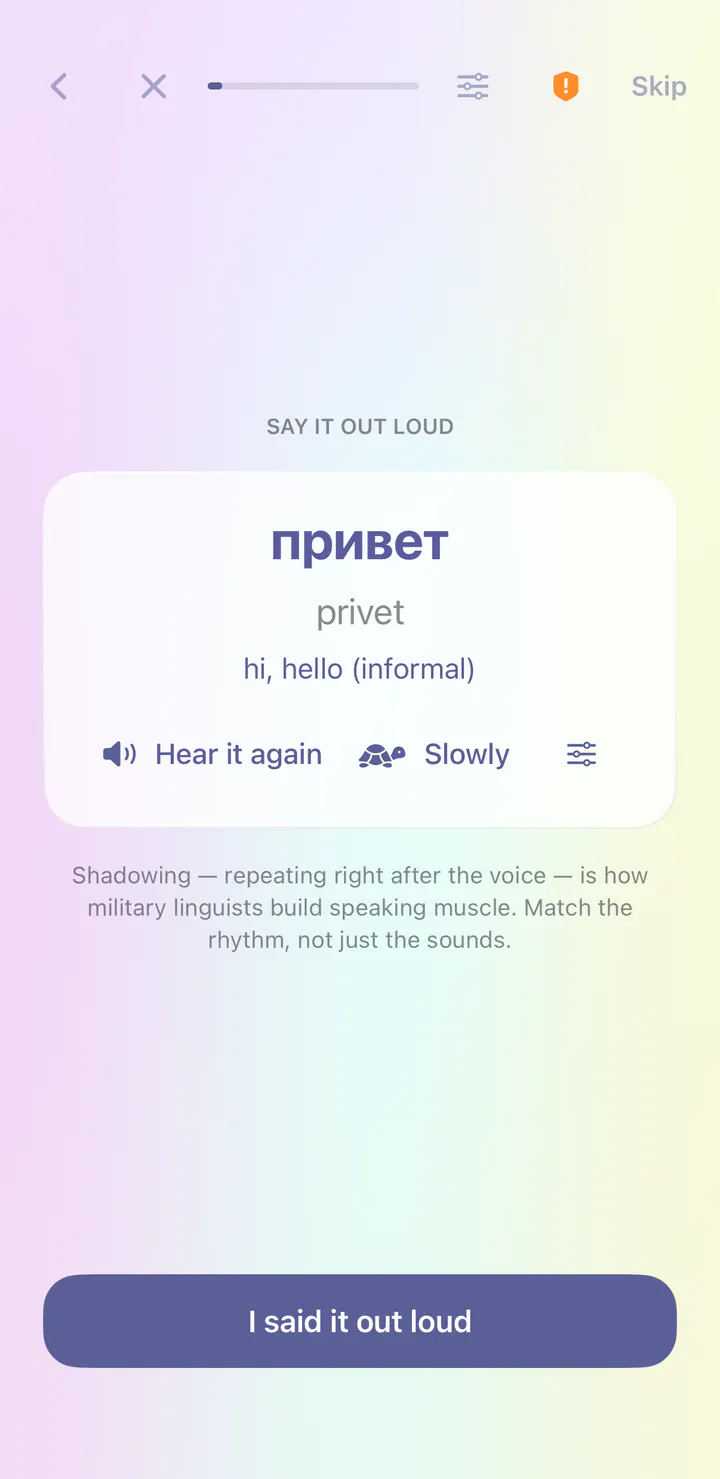
The Loquus app turns lessons like this into guided conversations and speaking practice, with normal and slow audio. On iPhone and iPad, speech recognition runs on your device.
Free to start. No account needed.
By Loquus ·
Sources
- University of Kansas Между нами: 1.5 Где? Здесь и́ли там?
- University of Kansas Между нами: 1.4 Здра́вствуйте!, Немно́го о языке́
- Cornell Russian grammar: Addressing people: ty vs. vy
- Cornell Russian grammar: Pronouns: the six case forms
- Cornell Russian grammar: Imperative forms in detail
- Cornell Russian grammar: Polite imperatives
- University of Kansas Между нами: 4.5 Кафе́ «Идеа́льная ча́шка», Немно́го о языке́
- University of Kansas Между нами: 3.3 Что чита́ют россия́не?, Немно́го о языке́
- Cornell Russian grammar: The Accusative Singular endings for a declension
- Cornell Russian grammar: Acc. Sg. and Plur. endings and animacy
- University of Kansas Между нами: 1.5 Где? Здесь и́ли там?, Немно́го о языке́
- University of Kansas Между нами: 5.3 Име́йл Ке́йтлин, Немно́го о языке́
- University of Kansas Между нами: 3.1 Сегодня суббота, Немно́го о языке́
- University of Kansas Между нами: 3.5 Вы говори́те по испа́нски?, Немно́го о языке́
- University of Kansas Между нами: 7.1 Ру́сская ку́хня, Немно́го о языке́
- Cornell Russian grammar: Genitive Singular forms (nouns and adjectives)
- University of Kansas Между нами: Declension Charts
- University of Kansas Между нами: 4.1 Моя́ Кварти́ра, Немно́го о языке́
- University of Kansas Между нами: 4.2 Где мо́жно купи́ть ча́йник?, Немно́го о языке́
- Cornell Russian grammar: The ‘net’ construction
- University of Kansas Между нами: 1.4 Здра́вствуйте!
- University of Kansas Между нами: 3.2 Ама́нда мно́го и́ли ма́ло рабо́тает?, Немно́го о языке́
Learning research behind the practice
Worked examples, retrieval practice, and later review inform the activities. These studies do not establish the effectiveness of this specific lesson.