Treat stress as part of the word
Russian word stress is not reliably predictable from spelling alone. A syllable can be stressed near the beginning, middle or end of a word, and the position must often be learned with the vocabulary item. Compare ма́ма, студе́нт and телефо́н. The accent in these teaching forms identifies the stressed vowel. Ordinary Russian texts usually omit such marks, so learning the stress now helps you read an unmarked word later.
Do not borrow the stress pattern of a similar English word automatically. The word студе́нт is a useful reminder that a recognizable borrowed word can organize its rhythm differently. Store the Russian spelling, meaning and stress together. A stress mark is a learning aid, not permission to change the ordinary letters around it. When you create vocabulary notes, mark the vowel carrying stress and rehearse the whole word with a native model when available. Reading the accent visually and hearing prominence in speech are related but distinct skills.
References for this explanation
Locate syllables without turning stress into shouting
Vowel letters help you locate syllables. In мои́, the vowels form two syllables and the second is stressed. The form мой has one vowel syllable followed by a glide. In телефо́н, locate the vowel letters and notice that the final syllable receives the main prominence. The soft and hard signs do not add independent vowel syllables. This basic counting procedure is useful before you attempt a longer word.
Stress involves prominence and usually clearer, longer realization of the stressed vowel in comparison with its unstressed neighbors. It does not mean simply shouting one syllable or placing a long pause before it. Keep the word connected. A gentle rhythm tap can help distinguish a stronger syllable from weaker ones, but the final goal is natural speech, not a permanent tapping performance. Practice the stressed syllable within the whole word and then within a short phrase. That keeps stress connected to actual communication rather than a detached counting exercise.
Watch the decision
Model: prepare Росси́я for reading aloud.
- Identify the vowel carrying the teaching accent. The stress falls on и, while the initial written о is unstressed.
- Expect the unstressed о to be reduced rather than pronounced as a full stressed о. Keep the ordinary spelling intact; this is a sound adjustment, not a change of letters.
- Connect the whole word to its meaning, “Russia,” and compare with a native model when available. A rough sound cue can help you notice the difference but does not replace the complete spoken target.
Read Росси́я with stress on и and retain its written о.
Expect reduction in unstressed vowels
In Russian, several vowels change their sound quality when unstressed. Written о often sounds more like an a type vowel or a reduced central vowel outside stress, depending on its position and pronunciation context. The word Росси́я therefore should not be read by giving its initial written о the same full sound as a stressed о. The spelling remains о. Reduction is a pronunciation pattern, not a spelling correction.
This beginner description intentionally avoids the false rule that every unstressed vowel becomes one identical sound. Distance from the stress and neighboring consonants matter. Written а can also be reduced, and vowels after soft consonants have their own patterns. Use the concept to understand why native audio may not match a letter by letter English reading. Then learn the sound of the actual word. A broad awareness of reduction helps listening, but precise pronunciation grows from hearing and practicing specific words in context.
References for this explanation
Connect soft consonants and vowel letters
After many consonants, letters such as е, я and и also signal softness of the preceding consonant. In unstressed positions, the vowel qualities represented by е and я can approach an i type sound in the basic patterns taught by the university materials. The complete syllable matters: softness is produced with the consonant, and the vowel is affected by its unstressed position. Do not add an independent y sound simply because a teaching chart used ya or ye for a letter in isolation.
The useful expression меня́ зову́т contains unstressed vowels whose pronunciation differs from a naive letter reading. Learn the phrase with both its stress marks and its meaning, “my name is.” It gives you practical material for noticing reduction while preparing a real introduction. English approximations can point toward a contrast, but they cannot capture all details consistently. Keep the Russian spelling primary and use audio for the actual target, especially when hard and soft consonants are involved.
Learn a few words that need special attention
The letter ё is almost always stressed. The form моё therefore needs no additional accent mark to identify its stressed final vowel. Do not silently replace ё with е in your own beginner notes, since preserving it makes the pronunciation clearer. Some ordinary writing omits the dots, but the two letters remain distinct in the alphabet and can affect meaning and pronunciation.
Certain frequent words also have pronunciation details that are not explained by vowel reduction alone. The word что is normally pronounced approximately shto, even though the spelling begins with ч. In the greeting здра́вствуйте, the first в is normally not pronounced. Learn such high frequency words as whole spoken units. Do not expand one exceptional word into a rule that every occurrence of its letters changes in the same way.
Complete the reasoning
Guided: change “city” to “cities.”
- Retrieve the singular го́род and the verified plural города́. The change affects both the ending and the stress location.
- Before checking, locate the vowel that should be prominent in the plural. Do not assume that preserving the old stress is always safer.
- Explain the result as a property of this particular noun. It is an example of possible stress movement, not a universal rule for every Russian plural.
Compare your reasoning
The singular го́род becomes города́ in the plural practiced here.
Track stress when the grammatical form changes
A noun’s stress can move when its form changes. Cornell’s noun stress notes give examples of different stress patterns across forms. A useful beginner contrast is го́род, “city,” and города́, “cities.” Another is дом, “house,” and дома́, “houses.” This is why learning the singular stress is valuable but not always sufficient for producing a plural correctly. Store the particular plural with its stress when you learn it.
Do not infer that every Russian plural shifts stress. Some words keep the same stressed syllable and others follow different patterns. The lesson uses a small set of verified examples rather than a universal transformation rule. When a new grammatical form appears, check both its ending and stress. A correctly spelled ending can still be pronounced with the wrong rhythm if you automatically preserve the old stress position. Meaningful pairs make that extra information easier to retain than a separate abstract warning about exceptions.
References for this explanation
Separate word stress from question intonation
Word stress belongs to the vocabulary or grammatical form, while intonation organizes a whole utterance. A yes or no question can place a rise in pitch on a focused part of the sentence without moving the word stress to an arbitrary vowel. An information question with a question word often has a different overall contour. The university materials explicitly caution learners not to interpret an ordinary falling question contour as rudeness merely because it differs from their first language.
Before the game, mark the stressed vowel in four familiar words, then read one short statement and a matching question. Keep the stress of each word while changing the sentence’s communicative purpose. Next explain why the initial vowel of Росси́я may sound unlike an isolated stressed о without changing the spelling. Return later and retrieve both meaning and stress from memory. This checks several connected skills while keeping their causes distinct: word stress, reduction, consonant softness and sentence intonation are not interchangeable names for one phenomenon.
See it in a sentence
ма́ма
mother
The first syllable is stressed.
студе́нт
student
The final syllable is stressed.
телефо́н
telephone
The final syllable carries the stress.
Росси́я
Russia
The initial written о is unstressed and reduced in pronunciation.
меня́ зову́т
my name is
Learn the phrase with stress and reduction together.
мои́
my, with plural nouns
This has two vowel syllables and final stress.
мой
my, with masculine singular nouns
This is one syllable with a final glide.
моё
my, with neuter singular nouns
The letter ё identifies the stressed vowel in this basic form.
что
what
The normal pronunciation begins approximately sht.
го́род
city
The singular is stressed on the first syllable.
города́
cities
This plural shifts stress to the final syllable.
дома́
houses
The plural shown here is stressed on the final syllable.
Notice the difference
Common mistakes
Do not spell a reduced vowel phonetically
Instead ofРасси́я
For this meaningРосси́я
The initial о is reduced in pronunciation, but the ordinary spelling remains Росси́я.
Do not import English stress
Instead ofсту́дент
For this meaningстуде́нт
The Russian word has final stress. Its familiar English counterpart does not determine the Russian pattern.
Do not assume the plural keeps the singular’s stress
Instead ofго́рода
For this meaningгорода́
The nominative plural is города́, with stress on the final syllable, so learn the new stress together with the plural ending.
From understanding to using
Make your own example.
Try these without answer choices. Say your answer aloud or write it below, then compare your reasoning with the model.
Your turn 1
Write the words for “student,” “telephone” and “Russia” with teaching stress marks.
Compare with a model
студе́нт, телефо́н, Росси́я
student, telephone, Russia
Each item must be retrieved with its own stress rather than following an assumed first syllable pattern. The marks are learning aids and are normally omitted from ordinary running text, while the letters remain unchanged.
- Mark a vowel in each word.
- Keep final stress in студе́нт and телефо́н.
- Keep the initial о in Росси́я.
Your turn 2
Write the word for “city” and its plural, then explain the two changes.
Compare with a model
го́род, города́
city, cities
The plural adds its ending and shifts stress to the final syllable. This particular pair demonstrates why a vocabulary note should preserve the plural pronunciation instead of recording only an unaccented written form.
- Keep the plural ending а.
- Move the stress as shown.
- Do not generalize the pattern to all nouns.
Put it into practice
Make the next choice.
Choose a response and learn why it works. Your score reflects your first answer to each question. You can revisit anything you miss.
Choose an answer, then open the explanation to check your reasoning.
Question 1
Which form shows the correct stress for “telephone”?
- телефо́н
- те́лефон
Check the answer
Answer: телефо́н
телефо́н: The verified dictionary form has final stress.
те́лефон: Stress on the first syllable is not correct for this word.
Question 2
Does reduction change the ordinary spelling of Росси́я?
- Yes, always replace the first о with а
- No
Check the answer
Answer: No
Yes, always replace the first о with а: That respelling would be incorrect.
No: Reduction is pronunciation; the written о remains.
Question 3
Which form has two vowel syllables?
- мои́
- мой
Check the answer
Answer: мои́
мои́: The form мои́ has two vowel letters functioning as syllables.
мой: The form мой has one vowel and a final glide.
Question 4
Choose the form meaning “cities.”
- го́рода
- города́
Check the answer
Answer: города́
го́рода: With stress on the first syllable, this is a different form of the noun, not the plural meaning “cities.”
города́: The plural practiced here has final stress.
Question 5
What is the usual beginner pronunciation cue for что?
- shto
- chto
Check the answer
Answer: shto
shto: The common word has the documented sht sequence.
chto: A literal letter reading misses this frequent word’s usual pronunciation.
Question 6
Which statement is accurate?
- Every plural always moves stress to the last syllable.
- Stress may change with a grammatical form.
Check the answer
Answer: Stress may change with a grammatical form.
Every plural always moves stress to the last syllable.: The examples do not establish a universal plural rule.
Stress may change with a grammatical form.: The sources document stress movement in some nouns.
Question 7
What does question intonation change?
- The pitch pattern of the whole sentence, while each word keeps its stress
- Every word’s spelling
Check the answer
Answer: The pitch pattern of the whole sentence, while each word keeps its stress
The pitch pattern of the whole sentence, while each word keeps its stress: Intonation organizes the sentence rather than rewriting the words.
Every word’s spelling: Asking a question does not require changing ordinary spelling.
Question 8
Recall the meaning of ма́ма.
- houses
- mother
Check the answer
Answer: mother
houses: That meaning belongs to дома́. In ма́ма, the first syllable is stressed.
mother: The first syllable is stressed. The complete meaning is “mother.”
Question 9
Recall the meaning of студе́нт.
- student
- Russia
Check the answer
Answer: student
student: The final syllable is stressed. The complete meaning is “student.”
Russia: That meaning belongs to Росси́я. In студе́нт, the final syllable is stressed.
Question 10
Recall the meaning of телефо́н.
- my, with masculine singular nouns
- telephone
Check the answer
Answer: telephone
my, with masculine singular nouns: That meaning belongs to мой. In телефо́н, the final syllable carries the stress.
telephone: The final syllable carries the stress. The complete meaning is “telephone.”
Question 11
Recall the meaning of Росси́я.
- Russia
- city
Check the answer
Answer: Russia
Russia: The initial written о is unstressed and reduced in pronunciation. The complete meaning is “Russia.”
city: That meaning belongs to го́род. In Росси́я, the initial written о is unstressed and reduced in pronunciation.
Question 12
Recall the meaning of меня́ зову́т.
- mother
- my name is
Check the answer
Answer: my name is
mother: That meaning belongs to ма́ма. Learn the phrase with stress and reduction together.
my name is: Learn the phrase with stress and reduction together. The complete meaning is “my name is.”
Question 13
Recall the meaning of мои́.
- my, with plural nouns
- Russia
Check the answer
Answer: my, with plural nouns
my, with plural nouns: This has two vowel syllables and final stress. The complete meaning is “my, with plural nouns.”
Russia: That meaning belongs to Росси́я. The form мои́ has two vowel syllables and final stress.
Question 14
Recall the meaning of мой.
- my, with neuter singular nouns
- my, with masculine singular nouns
Check the answer
Answer: my, with masculine singular nouns
my, with neuter singular nouns: That meaning belongs to моё. The form мой is one syllable with a final glide.
my, with masculine singular nouns: This is one syllable with a final glide. The complete meaning is “my, with masculine singular nouns.”
Keep the conversation going
What to practice next
After a break, go back to your own examples above and do each task again without looking at the models. Compare the meaning and form with the models, and fix each mistake by explaining its cause. Then use one of your sentences in a short conversation of your own.
Keep it going in the app
Keep the letters close.
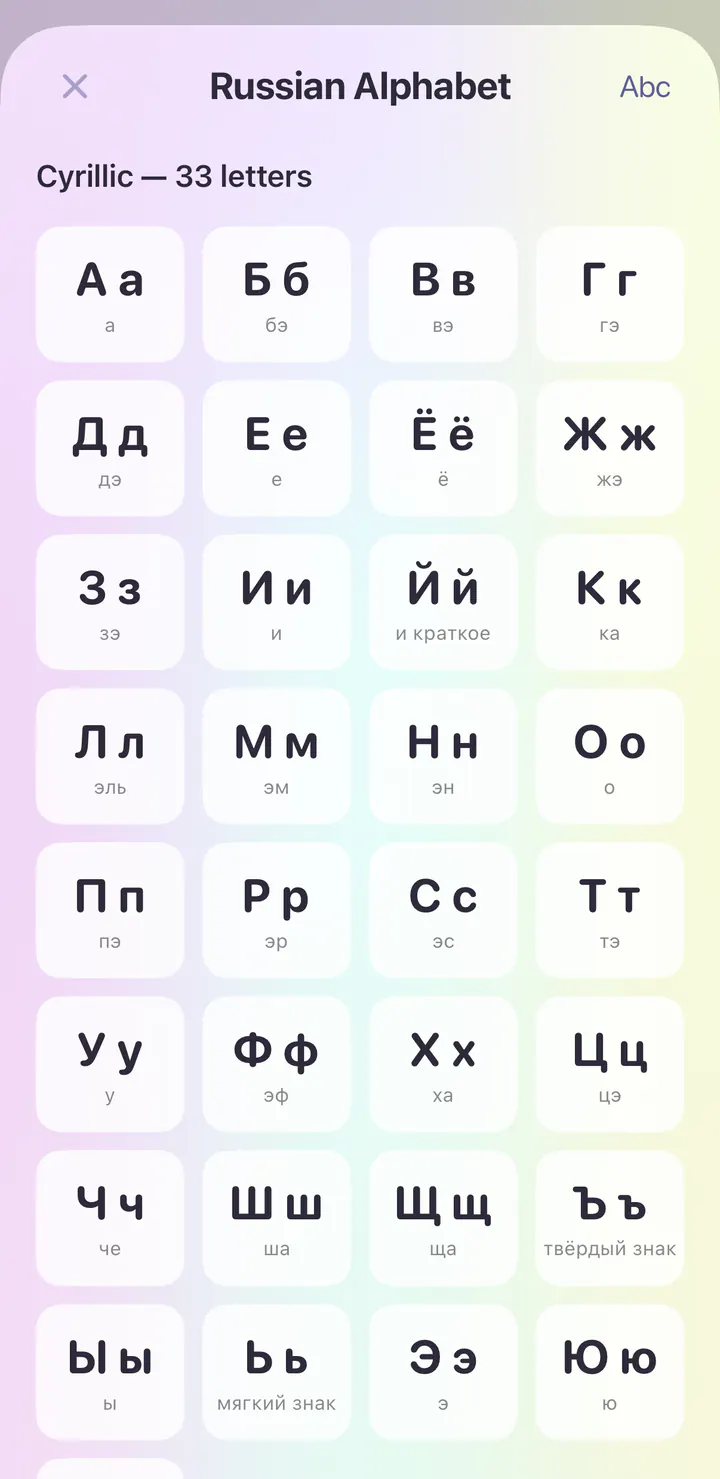
In the Loquus app, the alphabet reference lets you tap any character to hear it, and lessons bring new sounds back until they feel familiar.
Free to start. No account needed.
By Loquus ·
Sources
- University of Kansas Между нами: 1.3 Немно́го о себе́, Немно́го о языке́
- University of Kansas Между нами: 1.4 Здра́вствуйте!, Немно́го о языке́
- University of Kansas Между нами: 1.5 Где? Здесь и́ли там?, Немно́го о языке́
- University of Kansas Между нами: 1.7 Гости́ница Аэроте́ль, Немно́го о языке́
- University of Kansas Между нами: 1.8 Оде́жда, Немно́го о языке́
- University of Kansas Между нами: 1.9 Чья э́то ку́ртка?, Немно́го о языке́
- University of Kansas Между нами: 1.10 Моби́льный телефо́н, Немно́го о языке́
- Cornell Russian grammar: Russian Alphabet
- Cornell Russian grammar: Palatalization and paired/unpaired consonants
- Cornell Russian grammar: Stress patterns for nouns
Learning research behind the practice
Worked examples, retrieval practice, and later review inform the activities. These studies do not establish the effectiveness of this specific lesson.