Choose the verb from the message before choosing the tense
The form war is a Präteritum form of sein, while hatte is a Präteritum form of haben. Compare Ich war müde, I was tired, with Ich hatte Hunger, I was hungry. English uses was for both, but German keeps the two different constructions, müde sein and Hunger haben. The past does not erase a vocabulary choice that was already important in the present.
Use sein for the identities, descriptions and locations practiced here: Ich war Student, Das Zimmer war klein and Wir waren zu Hause. Use haben for possession and familiar expressions such as Zeit haben or Hunger haben. Wir hatten Zeit reports that time was available to us. It does not describe a location or equate the subject with an object. Start from the present meaning if you are unsure: bin müde becomes war müde, and habe Zeit becomes hatte Zeit. Do not translate every English was into war before checking the full phrase. These are high frequency past forms worth learning as complete patterns, because they let you describe a previous situation without building a longer auxiliary and participle combination.
Learn the small set of war forms as subject and verb pairs
The Präteritum of sein is ich war, du warst, er war, sie war, es war, wir waren, ihr wart and sie waren. Formal Sie waren has the same verb form as plural sie waren; only the capital letter on Sie is different. The first and third person singular forms are identical. The familiar singular and familiar plural forms differ: du warst but ihr wart.
Attach a short description or location to each pair. Du warst hier addresses one familiar person, while Ihr wart hier addresses a familiar group. Sie waren hier can mean they were here or formal you were here; at the start of a sentence, only the context tells you which. Do not assume that a past verb form alone identifies every possible subject uniquely. The pronoun or noun phrase supplies information that may not be visible in the ending. A plural noun subject also takes waren: Die Kinder waren hier. For practice, keep hier unchanged and replace only the subject. Then replace the location with a simple adjective such as müde while keeping the subject stable. This separates agreement from the information being asserted. The forms do not need an additional habe or bin before them to become past tense.
Build hatte without adding a second past marker
The Präteritum of haben is ich hatte, du hattest, er hatte, sie hatte, es hatte, wir hatten, ihr hattet and sie hatten. Formal Sie hatten has the same verb form as plural sie hatten; only the capital letter on Sie is different. Compare Ich habe Zeit with Ich hatte Zeit. The second sentence already reports the past; it does not need a separate participle or another conjugated verb in front of hatte.
Keep the double t and the ending in the familiar forms: Hattest du Zeit? and Ihr hattet Zeit. The present form du hast is irregular in its own way, so do not guess hattest by adding a syllable to it. Learn hattest as its own word. A noun subject follows the same agreement pattern: Mira hatte ein Buch, but Mira und Tom hatten ein Buch. The plural verb agrees with the people who had the item, not with the number of items possessed. Two people can share one book, and one person can have several books. Say both kinds of sentence to check that you are selecting the verb ending from the subject rather than from the closest noun.
Watch the decision
Say that you and a friend had time.
- The subject is wir, so choose the plural past form hatten.
- Keep the familiar expression Zeit haben; only the tense changes, not the expression.
- Read the result as a statement about available time in the past.
Wir hatten Zeit.
Keep the noun roles when the tense changes
A change from present to past does not by itself change the noun’s grammatical role. Ich habe einen Stift becomes Ich hatte einen Stift. The pen remains a masculine accusative object of haben. Similarly, Das ist ein Tisch becomes Das war ein Tisch. The identifying noun phrase after sein remains nominative. The difference between possession and identification still matters in the past.
A location phrase keeps the case required by its preposition and meaning. Wir sind im Zimmer becomes Wir waren im Zimmer. The room is still the location, and im still represents in dem. Do not change the article merely because waren looks more unfamiliar than sind. Possessive phrases also retain their underlying role: Mein Bruder war hier has a nominative subject, while Ich hatte meinen Schlüssel has a masculine accusative object. A useful editing method is to mark exactly which words are supposed to change when you move an otherwise identical message into the past. Often only the conjugated verb changes. If you alter an article or a pronoun as well, explain the separate reason. Tense, case and reference are connected in a sentence but are not the same grammatical category.
References for this explanation
- University of Texas Grimm Grammar: Simple past sein
- University of Texas Grimm Grammar: Simple past haben
- University of Texas Grimm Grammar: Nominative case
- University of Texas Grimm Grammar: Accusative case
- University of Texas Grimm Grammar: Two way prepositions
- University of Texas Grimm Grammar: Possessive determiners accusative
Ask and negate without copying English did
A basic yes or no question starts with the Präteritum verb: Warst du zu Hause? or Hattest du Zeit? German does not add an equivalent of did before these forms. With an information question, use Wo warst du?, where were you, or Was hattest du?, what did you have? Keep the same subject agreement that you would use in the statement.
Negation still depends on what is being denied. Ich war nicht müde denies the description tired. Ich hatte kein Buch denies possession of an indefinite book. Ich hatte nicht dein Buch makes a contrast: it denies that the book was yours, not that there was a book. The basic practice emphasizes the first two clear patterns. A negative question can make a bare yes or no less informative, so a full reply helps. German has a special word, doch, for contradicting a negative question, but this lesson does not cover it. Prefer a full statement such as Ich war zu Hause, I was at home, over a bare yes or no. For this lesson, practice full positive or negative statements after the question. Decide from the situation whether each statement is positive or negative, instead of copying the yes or no you would use in English.
Complete the reasoning
Ask one familiar friend where they were.
- The missing information is a location, so use wo.
- The subject is du, so the past form of sein is warst.
- Place the conjugated verb after the question word and then the subject.
Compare your reasoning
Wo warst du?
Place the past situation in time
A time expression makes the reference clearer. Gestern war ich müde means I was tired yesterday. Heute bin ich wieder hier returns to a present situation. The adjective or location can remain unchanged while the verb and time expression establish a different perspective. Do not assume that the past form necessarily means the state lasted a long time or that the present form guarantees permanence.
When a time phrase comes first in a main statement, the conjugated verb remains second and the subject follows: Gestern hatte ich Zeit. The ordering principle is the same as in the present. A dependent reason clause uses its own pattern: Ich bin müde, weil ich gestern lange wach war. The final war belongs to the reason clause; it does not change bin in the main clause. This allows a speaker to connect a present result with a past circumstance. When you first write your own sentences, make the time relationship explicit and keep both clauses short. If you change gestern to heute, decide whether you are still referring to an earlier part of today or to the present moment. A time word provides context; the intended event or state determines which tense you need.
References for this explanation
Combine useful past forms without turning them into a universal rule
The forms war and hatte are ordinary choices in spoken as well as written German. You will also encounter the Perfekt, the tense for most spoken past events, in forms such as ist gewesen and hat gehabt. This lesson is not declaring those forms wrong or requiring all speakers to use the same style in every context. It gives you two compact, widely useful sets of past forms that can appear naturally beside Perfekt descriptions of other events.
For example, Ich war zu Hause und habe ein Buch gelesen says I was at home and read a book. The first clause establishes a past location, and the second reports an activity. The mix does not automatically create two incompatible times. Similarly, Ich hatte Zeit und habe meine Schwester angerufen gives a past circumstance and an action. Do not build forms such as ich habe war by merging pieces from different constructions. Choose either the Präteritum form or a complete Perfekt construction for the meaning you are expressing. To practice, describe yesterday in three short statements: where you were, how you felt and something you had. Then ask another person one corresponding question. Check the subject form and the full construction before adding more details.
References for this explanation
- University of Texas Grimm Grammar: Simple past sein
- University of Texas Grimm Grammar: Simple past haben
- University of Texas Grimm Grammar: Conversational past
- University of Texas Grimm Grammar: Conversational past of irregular verbs with haben
- University of Texas Grimm Grammar: Conversational past separable prefix verbs
- University of Texas Grimm Grammar: Coordinating conjunctions
See it in a sentence
Ich war müde.
I was tired.
The form war is the Präteritum of sein for ich.
Ich hatte Hunger.
I was hungry.
German retains the expression Hunger haben in the past.
Du warst hier.
You were here, addressing one familiar person.
The pronoun du takes warst.
Ihr wart hier.
You all were here, addressing a familiar group.
The pronoun ihr takes wart.
Die Kinder waren zu Hause.
The children were at home.
The plural subject takes waren.
Sie hatten Zeit.
They had time.
The intended plural subject takes hatten.
Ich hatte einen Stift.
I had a pen.
The masculine object remains accusative.
Das war ein Tisch.
That was a table.
Identification after sein uses nominative.
Warst du zu Hause?
Were you at home?
The conjugated past verb opens the question.
Ich war nicht müde.
I was not tired.
The word nicht denies the description.
Ich hatte kein Buch.
I did not have a book.
The word kein denies an indefinite noun phrase.
Gestern hatte ich Zeit.
I had time yesterday.
The conjugated verb follows the opening time phrase.
Notice the difference
Common mistakes
Use haben, not sein, for Hunger
Instead ofIch war Hunger.
For this meaningIch hatte Hunger.
German uses Hunger haben. Changing the time changes habe to hatte, not the whole construction to sein.
Do not put habe in front of war
Instead ofIch habe war müde.
For this meaningIch war müde.
The form war is already a conjugated Präteritum form. A Perfekt construction would use a participle, not put habe in front of war.
Keep familiar singular and plural apart
Instead ofIhr warst hier.
For this meaningIhr wart hier.
The familiar plural subject ihr takes wart. The form warst is used for one familiar listener, du.
From understanding to using
Make your own example.
Try these without answer choices. Say your answer aloud or write it below, then compare your reasoning with the model.
Your turn 1
Say that yesterday you were at home, were tired and had time.
Compare with a model
Gestern war ich zu Hause. Ich war müde. Ich hatte Zeit.
Yesterday I was at home. I was tired. I had time.
The location and description use war, while the expression about available time uses hatte. The first sentence puts gestern before the verb, so ich follows war. The later sentences begin with the subject. No extra auxiliary is needed with either Präteritum form.
- Use war for location and description.
- Use hatte with Zeit.
- Check the word order when the time word comes first.
Your turn 2
Ask a familiar group whether they were here and had a book.
Compare with a model
Wart ihr hier? Hattet ihr ein Buch?
Were you all here? Did you all have a book?
The familiar plural subject is ihr. Its past forms are wart and hattet. Both yes or no questions begin with the conjugated verb, and the number of books does not change the plural subject agreement. Keep the listener group explicit when checking the endings.
- Use the familiar plural subject.
- Recall wart and hattet separately.
- Put the conjugated verb first in each question.
Put it into practice
Make the next choice.
Choose a response and learn why it works. Your score reflects your first answer to each question. You can revisit anything you miss.
Choose an answer, then open the explanation to check your reasoning.
Question 1
You felt tired yesterday.
- Ich war müde.
- Ich hatte müde.
Check the answer
Answer: Ich war müde.
Ich war müde.: The adjective müde combines with sein, whose past form is war.
Ich hatte müde.: The adjective müde is not an object of haben in this expression.
Question 2
You felt hungry yesterday.
- Ich war Hunger.
- Ich hatte Hunger.
Check the answer
Answer: Ich hatte Hunger.
Ich war Hunger.: Hunger goes with haben, not with sein, so war is wrong here.
Ich hatte Hunger.: The German expression uses haben and therefore hatte.
Question 3
Address one close friend about being here.
- Du warst hier.
- Du wart hier.
Check the answer
Answer: Du warst hier.
Du warst hier.: The pronoun du takes warst.
Du wart hier.: The form wart is the familiar plural form for ihr.
Question 4
Address several close friends about being here.
- Ihr warst hier.
- Ihr wart hier.
Check the answer
Answer: Ihr wart hier.
Ihr warst hier.: The form warst belongs to du.
Ihr wart hier.: The pronoun ihr takes wart.
Question 5
Several children were at home.
- Die Kinder waren zu Hause.
- Die Kinder war zu Hause.
Check the answer
Answer: Die Kinder waren zu Hause.
Die Kinder waren zu Hause.: The plural subject requires waren.
Die Kinder war zu Hause.: The form war is singular.
Question 6
Ask a familiar friend whether they had time.
- Hatte du Zeit?
- Hattest du Zeit?
Check the answer
Answer: Hattest du Zeit?
Hatte du Zeit?: The form hatte does not agree with du.
Hattest du Zeit?: The pronoun du takes hattest even in a question.
Question 7
Two people shared one book.
- Mira und Tom hatten ein Buch.
- Mira und Tom hatte ein Buch.
Check the answer
Answer: Mira und Tom hatten ein Buch.
Mira und Tom hatten ein Buch.: The plural possessors control hatten.
Mira und Tom hatte ein Buch.: The singular book does not make the verb singular.
Question 8
You had a pen. Choose the object phrase.
- Ich hatte ein Stift.
- Ich hatte einen Stift.
Check the answer
Answer: Ich hatte einen Stift.
Ich hatte ein Stift.: The Präteritum does not remove the accusative ending.
Ich hatte einen Stift.: The form hatte preserves the masculine accusative object.
Question 9
Identify something as a table in the past.
- Das war ein Tisch.
- Das war einen Tisch.
Check the answer
Answer: Das war ein Tisch.
Das war ein Tisch.: The identifying phrase after sein remains nominative.
Das war einen Tisch.: It is not an accusative object of possession.
Question 10
Ask where your friend was.
- Wo hast du war?
- Wo warst du?
Check the answer
Answer: Wo warst du?
Wo hast du war?: This wrongly adds the auxiliary hast to war, which is already a complete past form.
Wo warst du?: The form warst is a complete Präteritum form and needs no auxiliary.
Question 11
Deny being tired.
- Ich war nicht müde.
- Ich war kein müde.
Check the answer
Answer: Ich war nicht müde.
Ich war nicht müde.: The word nicht negates the adjective description.
Ich war kein müde.: The word kein negates nouns, not adjectives such as müde.
Question 12
Deny having any book.
- Ich hatte nicht ein Buch.
- Ich hatte kein Buch.
Check the answer
Answer: Ich hatte kein Buch.
Ich hatte nicht ein Buch.: The words nicht ein can suggest a contrast rather than the requested neutral denial.
Ich hatte kein Buch.: The word kein is the ordinary neutral denial of an indefinite noun here.
Question 13
Put yesterday first.
- Gestern hatte ich Zeit.
- Gestern ich hatte Zeit.
Check the answer
Answer: Gestern hatte ich Zeit.
Gestern hatte ich Zeit.: The conjugated verb stays in second position, right after the time phrase.
Gestern ich hatte Zeit.: The subject cannot come between the opening time phrase and the conjugated verb.
Question 14
Report a past location and a reading activity.
- Ich habe war zu Hause und gelesen ein Buch.
- Ich war zu Hause und habe ein Buch gelesen.
Check the answer
Answer: Ich war zu Hause und habe ein Buch gelesen.
Ich habe war zu Hause und gelesen ein Buch.: This mixes incompatible pieces and loses the required word order.
Ich war zu Hause und habe ein Buch gelesen.: The first clause uses the Präteritum, and the second a complete Perfekt construction.
Keep the conversation going
What to practice next
After a break, go back to your own examples above and do each task again without looking at the models. Compare the meaning and form with the models, and fix each mistake by explaining its cause. Then use one of your sentences in a short conversation of your own.
Keep it going in the app
Make this pattern stick.
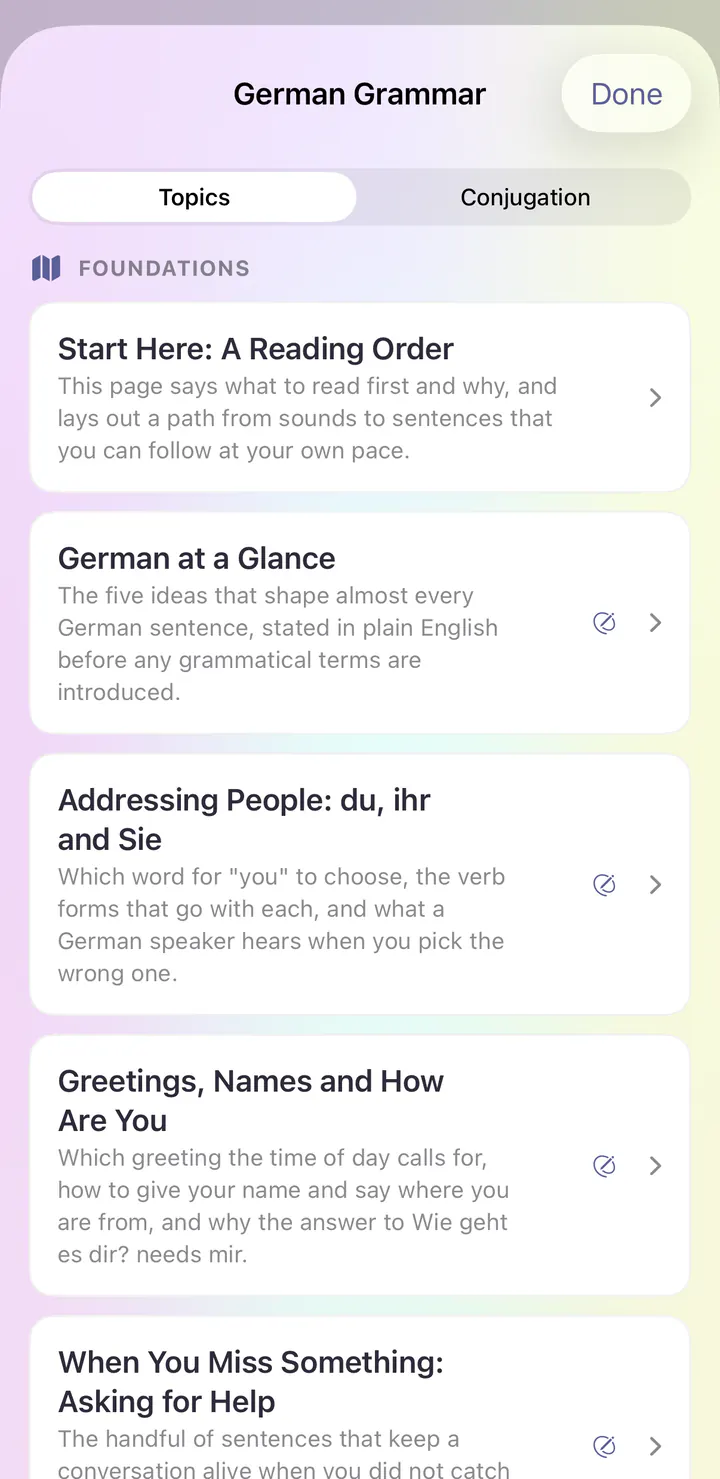
In the Loquus app, Grammar Center keeps topics like this one tap away with focused drills, and spaced review brings the words back before you forget them.
Free to start. No account needed.
By Loquus ·
Sources
- University of Texas Grimm Grammar: Simple past sein
- University of Texas Grimm Grammar: Simple past haben
- University of Texas Grimm Grammar: Sein
- University of Texas Grimm Grammar: Haben
- University of Texas Grimm Grammar: Nominative pronouns
- University of Texas Grimm Grammar: Nominative case
- University of Texas Grimm Grammar: Present regular verbs
- University of Texas Grimm Grammar: Accusative case
- University of Texas Grimm Grammar: Two way prepositions
- University of Texas Grimm Grammar: Possessive determiners accusative
- University of Texas Grimm Grammar: Interrogatives
- University of Texas Grimm Grammar: Word order
- University of Texas Grimm Grammar: Negation
- University of Texas Grimm Grammar: Adverbs of time, frequency, quantity, intensity
- University of Texas Grimm Grammar: Subordinating conjunctions
- University of Texas Grimm Grammar: Conversational past
- University of Texas Grimm Grammar: Conversational past of irregular verbs with haben
- University of Texas Grimm Grammar: Conversational past separable prefix verbs
- University of Texas Grimm Grammar: Coordinating conjunctions
Learning research behind the practice
Worked examples, retrieval practice, and later review inform the activities. These studies do not establish the effectiveness of this specific lesson.