Separate a consonant’s teaching name from a word’s reading
A Devanagari consonant has an inherent short vowel unless a vowel sign or another spelling convention changes it. In an alphabet lesson, क is introduced as ka and म as ma. These labels help you learn the symbols, but reading a whole Hindi word is not the same as reciting every consonant’s alphabet label in succession. The final result depends on the word’s spelling and normal pronunciation.
In कमल, the ordinary Hindi reading is kamal. The final consonant is not normally followed by an extra a. In नाम, the vowel sign explicitly supplies long ā after न, while the final म closes the word. Reading nāma by automatically restoring a final inherent vowel would not match the ordinary Hindi word model here. This distinction is one reason to learn words with a reliable spoken example as well as their letters.
The loss of an inherent vowel in pronunciation is often called schwa deletion. It concerns the short inherent vowel, not permission to erase any vowel that seems inconvenient. A marked long vowel in a word such as काका remains part of its reading. This lesson gives you recognition strategies and carefully selected examples, rather than pretending that one beginner rule predicts every Sanskrit loan, proper name or speech variety.
कमल
kamal
lotus
नाम
nām
name
काका
kākā
uncle, in some family and regional usage
Recognize an explicit instruction to remove the vowel
The halant, also called virama, is the sign ् placed with a consonant to show that it has no inherent vowel at that point. Compare क with क्. The first is the consonant as normally presented with its inherent vowel; the second explicitly represents k without that vowel. The sign is a spelling instruction, not a separate sound to pronounce after the consonant.
A halant can help combine consonants into a cluster. The sequence क् plus य produces क्य in ordinary connected typography. In क्या, this cluster is followed by the long ā sign. Read kyā, without inserting a vowel between k and y. The two consonants begin the same spoken unit. The fact that the font presents them as one compact shape does not turn them into an unrelated new sound.
You will not always see a separate visible halant in the final combined form. Fonts commonly reshape the first consonant or join the sequence into a ligature, a single combined shape. Conversely, a visible halant may remain in some combinations. Both are ways of representing the absence of the inherent vowel. When you type the first consonant, the halant and the following consonant in that order, the font often produces the combined shape. The visual result may vary with the font, while the consonant order stays the same.
क्
k
the consonant k without its inherent vowel
क्या
kyā
what; also a yes or no question marker
वाक्य
vākya
sentence
Read a cluster with an explicit vowel sign
Explain the reading of क्या.
- Recognize क्य as k followed directly by y.
- Do not add the inherent a between those consonants.
- Read the following vowel sign as long ā.
क्या is read kyā.
Look for the surviving parts of half consonants
Many consonants with a vertical stroke on the right lose that stroke when they form the first part of a conjunct. This creates a shape traditionally called a half consonant. The name describes the written form and absence of its vowel; it does not tell you to pronounce the consonant at half volume or to omit half of its identity. The consonant still contributes to the word.
In शब्द, the b and d occur together without an inserted vowel between them in the ordinary reading shabd. In हिन्दी, the n and d are adjacent in the cluster. You may also see the common spelling हिंदी, with a dot representing the nasal consonant in this context. The two spellings should not lead you to invent two unrelated meanings for the language name. Learn the written convention together with the word’s reading.
Not every consonant joins by losing the same stroke. Some shapes stack, and others change more substantially. Use the half form strategy as a visual clue, then confirm the particular combination. Keeping the base letters in mind helps you recognize a new font without memorizing the entire word as a picture. It also keeps the dental consonants, made with the tongue against the upper teeth, distinct from the retroflex ones, made with the tongue tip curled back: the shape of a cluster does not change where in the mouth its consonants are made.
शब्द
shabd
word
हिन्दी
hindī
Hindi
हिंदी
hindī
Hindi, another common spelling
बच्चा
bachchā
child
References for this explanation
Distinguish a doubled consonant from an added vowel
A cluster may contain the same consonant twice, producing a doubled or longer consonant sequence. In पत्ता, the two dental t sounds meet without an intervening vowel. In दिल्ली, the two l positions are written together. Do not simplify every doubled spelling to a single consonant in pronunciation, and do not insert a short a merely to make the cluster easier to say.
Doubled sequences and aspiration, the extra puff of breath released with some consonants, are separate features. अच्छा contains a cluster involving च and छ; the reading guide writes achchhā to preserve the sequence and aspiration cue. In these learning readings, an h after a consonant often marks aspiration rather than a separate English h sound. Return to the consonant lesson if that distinction is unfamiliar. A cluster combines consonants whose individual sound properties still matter.
The written position of a short i sign also remains different from its spoken order. In दिल्ली, the sign ि appears to the left of the consonant it belongs with, but the spoken consonant comes first. In बुद्धि, the short i follows the whole consonant sequence द्ध in speech, even though its sign is written before that whole cluster. Read the cluster and vowel as a structured unit rather than reading every visible mark in simple left to right graphic order.
पत्ता
pattā
leaf
दिल्ली
dillī
Delhi
अच्छा
achchhā
good
बुद्धि
buddhi
intelligence
References for this explanation
- MSU Basic Hindi: 1.2 हिंदी व्यंजन वर्ण “Hindi Consonant Letters”
- Indiana University, A Practical Guide to Hindi Script: 2.1 Discussion
- Indiana University, A Practical Guide to Hindi Script: 5.1 Discussion
- Indiana University, A Practical Guide to Hindi Script: 6.1 Discussion
- MSU Basic Hindi: 1.3 Dependent Vowels, and Vowel Consonant Conjugation
- University of Texas: The Hindi Script
Track the order of r inside a conjunct
र has distinctive combined forms. When an r without a vowel comes before another consonant, it can appear as a small mark above the following written unit, often called reph. In गर्म, the consonant order includes r before m, even though the r mark is displayed above the later letter. Its graphic position is not an instruction to place r after m in speech.
When r follows another consonant inside the cluster, it often appears as a small stroke attached below or toward the lower part of that consonant. In प्रेम, p is followed by r before the vowel e. In ट्रेन, the shape combines the retroflex consonant ट with r. Learn the pair’s underlying order before trying to recognize every font variation. The two r arrangements represent different sequences, not interchangeable decorative styles.
Vowel signs can extend around the combined unit and make the whole shape look more complicated. Identify the consonants first, then the vowel that follows the cluster. In a word such as विद्यार्थी, more than one cluster may appear, so work through one unit at a time. At this beginner stage, recognizing familiar short examples reliably is more useful than guessing every long formal word. Confirm unfamiliar readings with a dictionary or spoken teaching model before treating your first visual guess as established pronunciation.
गर्म
garm
hot
प्रेम
prem
love
ट्रेन
ṭren
train
विद्यार्थी
vidyārthī
student
Compare the two r arrangements
Identify the order of the cluster in गर्म and प्रेम.
- The upper r mark in गर्म represents r before m.
- The lower r attachment in प्रेम represents r after p.
- Use the word’s reading rather than the graphic height of the mark to order the sounds.
Compare your reasoning
गर्म is garm; प्रेम is prem.
Learn opaque shapes as combinations with known readings
Some conjuncts look less like their component letters than ordinary half forms do. The combination क्ष comes from क and ष, while त्र combines त and र. The sequence ज्ञ combines ज and ञ in its traditional analysis, but its common Hindi pronunciation is often represented as gy in a learning reading. A historical letter combination and its modern spoken realization are not always identical.
For this lesson, learn the complete everyday models कक्षा, कक्षा की किताब and ज्ञान with their supplied readings. The reading kakshā uses k followed by the sh sound in the cluster, and gyān reflects a common standard Hindi realization of ज्ञ. More Sanskrit oriented recitation or another language using Devanagari can have different conventions. Do not transfer a reading from one language automatically just because the symbols look familiar.
The same care applies to nasal marks. A dot can represent a nasal consonant associated with a following consonant, while a nasalized vowel, one sounded partly through the nose, is a different sound pattern. In हैं, the vowel is nasalized; it does not simply become the consonant sequence of हिन्दी. The earlier vowel and consonant lessons introduce this contrast. Here it helps you avoid treating every mark above the line as another hidden half consonant. Identify the word, the kind of mark and the expected spoken sequence together.
कक्षा
kakshā
class or classroom
कक्षा की किताब
kakshā kī kitāb
the class’s book
ज्ञान
gyān
knowledge
हैं
haĩ
are; also used for one person spoken of with respect
References for this explanation
Distinguish a written conjunct from unmarked vowel loss
A written conjunct explicitly joins consonants without a vowel between them. Schwa deletion can produce adjacent consonants in natural Hindi even when the spelling does not show an obvious half form at that point. In कमरा, the ordinary reading kamrā does not pronounce an a after म. In लड़का, the ordinary reading laṛkā likewise does not insert a vowel between the middle consonants. These are pronunciation facts about the words, not instructions to rewrite them with new halants.
Do not delete every internal inherent vowel. कमल retains the short vowels that produce kamal, while its final inherent vowel is absent in the ordinary reading. The location of deletion depends on the word’s structure, and broader rules have exceptions and morphological complications. A beginner should use the pattern as a reason to check a reading, rather than a license to shorten any unfamiliar word by guesswork.
For independent practice, first identify explicit vowel signs and written clusters. Next compare the normal reading and mark which inherent vowels are actually heard. Finally say the whole word with a reliable model. Produce the spelling from memory only after you can explain the contrast. The text questions below test these reading decisions, not the quality of your recorded speech. Keep listening practice alongside them so that compact written forms do not become an excuse to replace unfamiliar Hindi sounds with extra English style vowels.
कमरा
kamrā
room
लड़का
laṛkā
boy
कमल
kamal
lotus
किताब
kitāb
book
References for this explanation
Notice the difference
Common mistakes
Do not insert a vowel between k and y in क्या
Instead ofkayā
For this meaningkyā
For क्या, k and y are adjacent before the long vowel.
Do not drop a marked long vowel
Instead ofkamra
For this meaningkamrā
The long ā written at the end of कमरा is still pronounced. Schwa deletion is not deletion of every vowel.
Do not read every alphabet label in full
Instead ofkamala
For this meaningkamal
The ordinary Hindi reading of कमल does not add a final inherent a.
Do not read the r of गर्म after m
Instead ofIn garm, r follows m.
For this meaningIn garm, r comes before m.
The reph’s graphic position above a later unit does not reverse the consonant order.
From understanding to using
Make your own example.
Try these without answer choices. Say your answer aloud or write it below, then compare your reasoning with the model.
Your turn 1
Write the Hindi words for “what” and “Delhi,” then identify the consonant clusters.
Compare with a model
क्या; दिल्ली (kyā; dillī)
what; Delhi
क्या contains k followed by y, and दिल्ली contains a doubled l. The short i sign in दिल्ली is spoken after d.
- Do not insert a vowel inside क्य.
- Keep the doubled l in the reading.
Your turn 2
Write the Hindi words for “room” and “lotus,” then compare their ordinary Hindi readings.
Compare with a model
कमरा; कमल (kamrā; kamal)
room; lotus
कमरा loses the internal inherent vowel after m in its normal reading. कमल keeps the internal short vowels but lacks a final extra a.
- Do not rewrite the words with invented halants.
- Do not delete the explicitly marked long ā in कमरा.
Put it into practice
Make the next choice.
Choose a response and learn why it works. Your score reflects your first answer to each question. You can revisit anything you miss.
Choose an answer, then open the explanation to check your reasoning.
Question 1
Choose the ordinary Hindi reading of कमल in this lesson.
- kamal
- kamala
Check the answer
Answer: kamal
kamal: The final consonant has no extra a in this word’s ordinary reading.
kamala: This adds a final vowel absent from the taught Hindi model.
Question 2
What does a halant explicitly remove from a consonant?
- Its consonant identity
- Its inherent vowel
Check the answer
Answer: Its inherent vowel
Its consonant identity: The consonant itself remains part of the sequence.
Its inherent vowel: It marks the consonant without the inherent vowel at that position.
Question 3
Choose the taught reading of क्या.
- kyā
- kayā
Check the answer
Answer: kyā
kyā: The consonants k and y are adjacent before ā.
kayā: This inserts an unwanted vowel between the consonants.
Question 4
Must every final combined conjunct show a separate visible halant?
- Yes
- No
Check the answer
Answer: No
Yes: The halant may be represented through the combined form rather than a visible separate sign.
No: A font may reshape the consonants into a joined form.
Question 5
In the traditional term half consonant, should the consonant be pronounced at half volume?
- No
- Yes
Check the answer
Answer: No
No: The term describes the written form and lack of its inherent vowel.
Yes: It is not a loudness instruction.
Question 6
Choose the taught reading of शब्द.
- shabad
- shabd
Check the answer
Answer: shabd
shabad: This adds a vowel not present in the ordinary model here.
shabd: The b and d are adjacent without an inserted a.
Question 7
What must be preserved in the reading of पत्ता?
- The doubled dental t sequence
- A new vowel between the two t positions
Check the answer
Answer: The doubled dental t sequence
The doubled dental t sequence: The cluster contains two t positions with no intervening vowel.
A new vowel between the two t positions: The cluster does not supply such a vowel.
Question 8
In दिल्ली, is the short i pronounced before the initial d because its sign appears to the left?
- Yes
- No
Check the answer
Answer: No
Yes: Graphic placement does not reverse the consonant and vowel in speech.
No: The sign is read as the vowel following d.
Question 9
In गर्म, does r come before or after m in the taught reading?
- Before m
- After m
Check the answer
Answer: Before m
Before m: The reading is garm.
After m: The upper placement of the reph does not move r after m.
Question 10
In प्रेम, which order begins the word?
- r then p
- p then r
Check the answer
Answer: p then r
r then p: That reverses the cluster’s order.
p then r: The attached r follows p before the vowel.
Question 11
Which reading reflects the common Hindi model of ज्ञान taught here?
- gyān
- jān
Check the answer
Answer: gyān
gyān: The lesson uses the common Hindi realization gy.
jān: That removes part of the taught cluster.
Question 12
Does the nasal mark in हैं simply represent the same consonant cluster as हिन्दी?
- Yes
- No
Check the answer
Answer: No
Yes: Nasalized vowels and nasal consonants are distinct.
No: हैं has a nasalized vowel; हिन्दी has a nasal consonant in its word structure.
Question 13
Choose the ordinary reading of कमरा.
- kamrā
- kamarā
Check the answer
Answer: kamrā
kamrā: The internal inherent vowel after m is absent, while the marked ā remains.
kamarā: This inserts the internal vowel absent from the taught reading.
Question 14
Should you insert new halants into standard spelling whenever a spoken inherent vowel is absent?
- Yes
- No
Check the answer
Answer: No
Yes: That confuses natural schwa deletion with an explicit spelling change.
No: Pronunciation patterns do not authorize inventing new spellings.
Keep the conversation going
What to practice next
After a break, go back to your own examples above and do each task again without looking at the models. Compare the meaning and form with the models, and fix each mistake by explaining its cause. Then use one of your sentences in a short conversation of your own.
Keep it going in the app
Keep the letters close.
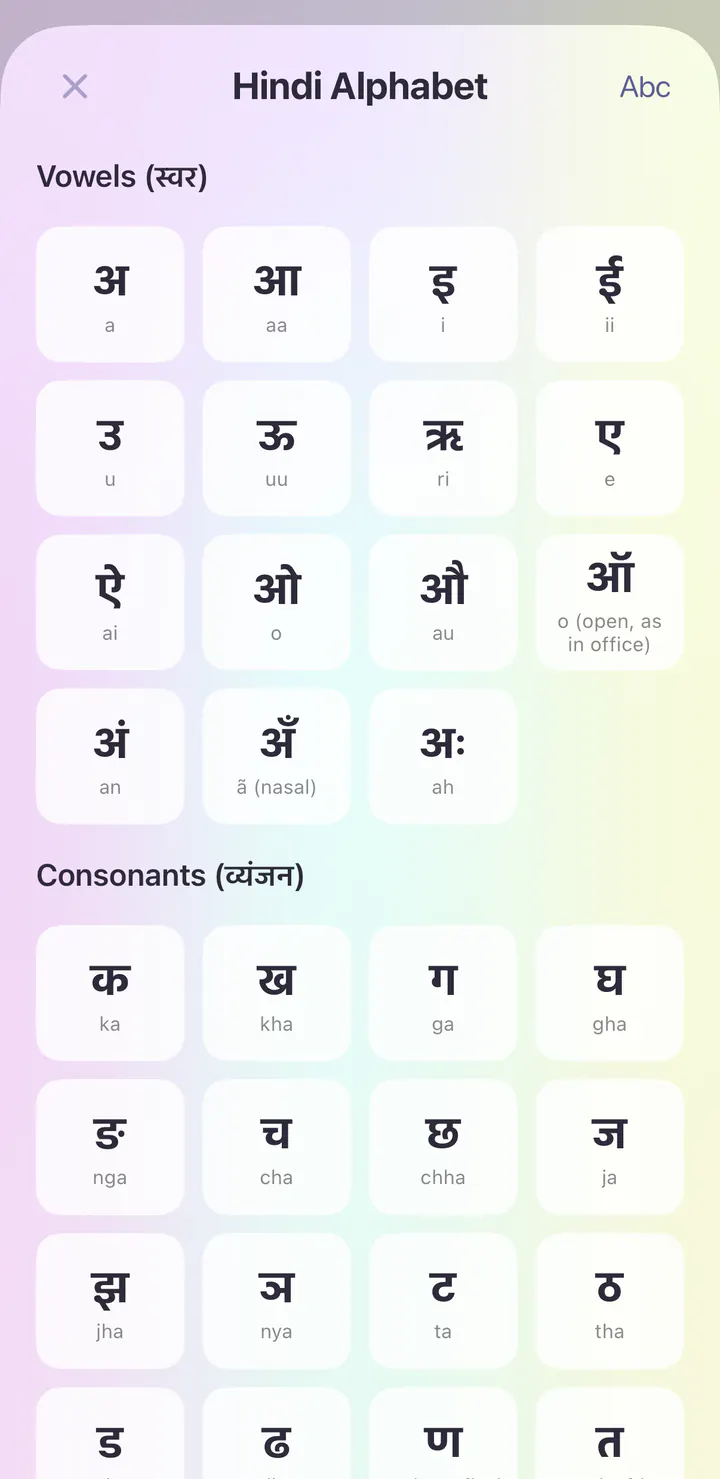
In the Loquus app, the alphabet reference lets you tap any character to hear it, and lessons bring new sounds back until they feel familiar.
Free to start. No account needed.
By Loquus ·
Sources
- Carnegie Mellon University: Letter to Sound Rules
- MSU Basic Hindi: 1.2 हिंदी व्यंजन वर्ण “Hindi Consonant Letters”
- Indiana University, A Practical Guide to Hindi Script: 2.1 Discussion
- Indiana University, A Practical Guide to Hindi Script: 5.1 Discussion
- Indiana University, A Practical Guide to Hindi Script: 6.1 Discussion
- Indiana University, A Practical Guide to Hindi Script: 8.1 Discussion
- MSU Basic Hindi: 1.3 Dependent Vowels, and Vowel Consonant Conjugation
- MSU Basic Hindi: 1.4 Nasal Sounds in Hindi
- University of Texas: The Hindi Script
- MSU Basic Hindi: 1.1 हिंदी स्वर वर्ण “Hindi Vowel Letters”
Learning research behind the practice
Worked examples, retrieval practice, and later review inform the activities. These studies do not establish the effectiveness of this specific lesson.