Identify the conjugation from the infinitive before adding endings
A dictionary gives the infinitive, such as parlare, vedere, or dormire. Removing the final three letters reveals the stem for a regular present pattern. The conjugation, shown by the infinitive ending, then determines which set of endings to use. This procedure works for regular verbs, but it does not turn irregular verbs into regular ones. Learn a new verb with a representative present form, especially when it is very common. The conjugation identifies a useful starting pattern; the subject selects the particular form, and the sentence context supplies the intended present meaning.
Io parlo italiano.
I speak Italian.
The infinitive belongs to the first conjugation, and the speaker form uses its regular ending. The subject is explicit for learning, though ordinary Italian can omit it when context is clear. The language name completes the speaking construction.
Io vedo il mare.
I see the sea.
The verb belongs to the second conjugation and takes the regular speaker ending. The definite noun phrase is the object rather than the subject, so its singular number does not select the verb’s person.
Build the parlare conjugation
The regular present model is parlo, parli, parla, parliamo, parlate, and parlano. These forms correspond to io, tu, the third person singular, noi, voi, and loro. The form used for formal singular Lei is the third person singular. Practice the whole sequence through short messages rather than reciting endings without meaning. A subject pronoun can clarify a contrast, but the verb form often carries enough person information by itself. Avoid keeping one memorized form unchanged when you switch the person who performs the action.
Tu parli italiano.
You speak Italian, addressing a friend.
The familiar singular subject requires this regular ending. It differs from the third person singular even though both describe one person. Grammatical person must be checked separately from singular or plural number.
Noi parliamo italiano.
We speak Italian.
The subject includes the speaker and others, so the first person plural ending is required. This ending is shared across the regular present conjugations, which makes it a useful anchor when comparing them.
Follow a complete example
Build a sentence with this meaning: You speak Italian, addressing a friend. Before looking at the answer, identify which information controls the grammatical choice.
- First, identify the message: You speak Italian, addressing a friend. Keep that message fixed while comparing forms. A sentence can be grammatical yet communicate something different, so meaning is part of the decision.
- The familiar singular subject requires this regular ending. It differs from the third person singular even though both describe one person. Grammatical person must be checked separately from singular or plural number.
- Now read the complete sentence: Tu parli italiano. Check the words around your choice as well as the choice itself. Explain what would change with a different subject or a different message. Then cover this example and rebuild the sentence from its meaning.
Tu parli italiano. You speak Italian, addressing a friend.
Compare the vedere conjugation without changing the task
The second conjugation model is vedo, vedi, vede, vediamo, vedete, and vedono. Several endings resemble the first conjugation, but the third person singular, the plural addressee form, and the third person plural differ. Compare the same person across conjugations: parla beside vede, or parlate beside vedete. This controlled comparison makes the conjugation difference visible without changing both person and vocabulary at once. Many common verbs in this broad conjugation have irregularities in some tenses or forms, so the present model should not be treated as a guarantee about every form of a verb.
Lei vede il mare.
She sees the sea.
The third person singular of this regular second conjugation verb has this ending. The subject is one person, but the correct vowel depends on the verb’s conjugation. Compare it with parla to isolate that difference.
Voi vedete il mare.
You see the sea, addressing several people.
The plural addressee subject takes the second conjugation ending. The sea remains a singular object, which does not control the verb form. Comparing this form with parlate reveals the vowel difference inside otherwise similar endings.
References for this explanation
Use dormire as a basic third conjugation model
The regular model without an added stem element is dormo, dormi, dorme, dormiamo, dormite, and dormono. The plural addressee form provides a clear conjugation contrast: parlate, vedete, dormite. Not all verbs ending in ire follow exactly this visible pattern, so keep a representative form in your vocabulary notes. The present can describe a routine or a current situation depending on context. A sentence about sleeping every night and a sentence about sleeping now can therefore use the same ordinary present form, with the time expression clarifying the message.
Voi dormite qui.
You sleep here, addressing several people.
The plural addressee ending identifies the basic third conjugation pattern. The location does not influence person or number. The same form can support different present meanings when the surrounding time context changes.
Loro dormono qui.
They sleep here.
The third person plural subject takes the regular plural form of this verb. The ending is different from the plural addressee form even though both subjects involve more than one person. Person remains part of the agreement decision.
Recognize the isc pattern with capire
Some verbs in the third conjugation add isc in the three singular persons and the third person plural. A common model is capisco, capisci, capisce, capiamo, capite, and capiscono. The added element is absent from the we and plural you forms. Do not insert it into every verb ending in ire or every person of a verb that uses it. Learn the speaker form alongside the infinitive to identify which pattern a new verb follows. Then compare the singular forms with the first person plural to remember where the addition disappears.
Io capisco la domanda.
I understand the question.
This verb uses the added stem element in the speaker form. The ending still identifies first person singular, but the full form includes more than the basic stem and ending. Learn the complete form with its meaning.
Noi capiamo la domanda.
We understand the question.
The first person plural form omits the added element used in the singular and third person plural. This boundary is part of the verb’s pattern. The subject determines which form to retrieve.
References for this explanation
Preserve spelling and meaning in common transformations
Some regular verbs adjust spelling to keep the same consonant sound. The verb cercare gives cerchi and cerchiamo, with h preserving a hard consonant before the following vowel. This written letter does not create a separately pronounced sound. To make a simple negative, place non before the conjugated verb. Questions can use the same order as statements with question intonation. None of these changes removes the need for the subject’s present ending. Check the full written form and the meaning of the sentence rather than relying only on a familiar sound or a memorized infinitive.
Tu cerchi il libro.
You are looking for the book, addressing a friend.
The familiar singular form preserves the hard consonant with an added written letter. The present can express the current search in this context. The spelling adjustment maintains pronunciation while the ending still marks the subject.
Noi non capiamo la domanda.
We do not understand the question.
The negative word comes before the conjugated verb. The first person plural form does not contain the added element found in some other persons of this verb. Negation preserves that conjugated form rather than replacing it with an infinitive.
Try the reasoning with less help
Build a sentence with this meaning: You are looking for the book, addressing a friend. Before looking at the answer, identify which information controls the grammatical choice.
- First, identify the message: You are looking for the book, addressing a friend. Keep that message fixed while comparing forms. A sentence can be grammatical yet communicate something different, so meaning is part of the decision.
- The familiar singular form preserves the hard consonant with an added written letter. The present can express the current search in this context. The spelling adjustment maintains pronunciation while the ending still marks the subject.
- Now read the complete sentence: Tu cerchi il libro. Check the words around your choice as well as the choice itself. Explain what would change with a different subject or a different message. Then cover this example and rebuild the sentence from its meaning.
Compare your reasoning
Tu cerchi il libro. You are looking for the book, addressing a friend.
Use the present in a short routine or exchange
The Italian present tense can describe what someone does regularly, a current activity, or a generally true situation. Context and time expressions clarify these readings. Do not build an English progressive by adding essere before an already conjugated present verb. Italian has a separate progressive construction, but the ordinary present is sufficient for the beginner messages here. In conversation, an omitted subject can be natural when person is clear. Keep it when you need contrast or clarification. For practice, write one routine from each conjugation and then ask another person about the same activity.
Lavoro qui ogni giorno.
I work here every day.
The regular speaker form can stand without an explicit subject pronoun when the context identifies the speaker. The repeated time expression makes the habitual meaning clear. No extra auxiliary is required for this ordinary present statement.
Parli inglese?
Do you speak English, addressing a friend?
The familiar singular ending identifies the addressee even without an expressed pronoun. Question intonation and punctuation mark the question. Italian does not add an equivalent of English do in this simple present pattern.
Notice the difference
Common mistakes
Do not mix conjugation endings
Instead ofVoi dormete qui.
For this meaningVoi dormite qui.
The infinitive belongs to the third conjugation. Its plural addressee form therefore uses the corresponding vowel, not the one associated with the second conjugation. Compare the three model verbs with the same subject to see this difference directly rather than memorizing an ending without a conjugation.
Do not add isc to the noi form
Instead ofNoi capisciamo.
For this meaningNoi capiamo.
The first person plural omits the added element used in the singular and third person plural of this verb. It is not a permanent part of every present form. Learn a singular form and the noi form together, so that you remember which forms have isc and which do not.
Keep a conjugated verb after negation
Instead ofIo non parlare italiano.
For this meaningIo non parlo italiano.
The negative word does not remove the need for person agreement. Begin with the correct affirmative sentence and place the negative word before its conjugated verb. The dictionary infinitive belongs in other constructions and cannot replace the only conjugated verb in this ordinary statement.
From understanding to using
Make your own example.
Try these without answer choices. Say your answer aloud or write it below, then compare your reasoning with the model.
Your turn 1
Say that you speak Italian, see the sea, and sleep here. Use a verb from each conjugation.
Compare with a model
Parlo italiano. Vedo il mare. Dormo qui.
I speak Italian. I see the sea. I sleep here.
The three verbs belong to different conjugations, but their regular speaker forms share the same final vowel. Their meanings and complements differ, so each complete sentence remains useful vocabulary. The subject pronoun can be omitted because the speaker forms and context identify the person. Change all three subjects to plural you to expose the conjugation differences that are less visible in the speaker forms.
- Does your answer say what the task asked for?
- Does the form match the person or noun in your message?
- Can you explain your choice before looking at the model?
Your turn 2
Say that you understand the question, then say that your group does not understand it, keeping the noun expressed.
Compare with a model
Capisco la domanda. Non capiamo la domanda.
I understand the question. We do not understand the question.
The singular form includes the characteristic added element, while the first person plural does not. The negative word precedes the conjugated verb in the second sentence. This pair changes the person and makes the sentence negative while keeping the object and the basic activity. Explain both changes before checking the model, then try the same person contrast with a basic third conjugation verb that never adds the extra element.
- Does your answer say what the task asked for?
- Does the form match the person or noun in your message?
- Can you explain your choice before looking at the model?
Put it into practice
Make the next choice.
Choose a response and learn why it works. Your score reflects your first answer to each question. You can revisit anything you miss.
Choose an answer, then open the explanation to check your reasoning.
Question 1
Complete the sentence for this meaning: I speak Italian.
Io ___ italiano.
- parlo
- parlare
Check the answer
Answer: parlo
parlo: The infinitive belongs to the first conjugation, and the speaker form uses its regular ending. The subject is explicit for learning, though ordinary Italian can omit it when context is clear. The language name completes the speaking construction.
parlare: The dictionary infinitive cannot serve as the conjugated verb of this ordinary statement. The subject requires a present form.
Question 2
Complete the sentence for this meaning: I see the sea.
Io ___ il mare.
- vedere
- vedo
Check the answer
Answer: vedo
vedere: This is the infinitive. It does not agree with the explicit speaker subject in the requested present statement.
vedo: The verb belongs to the second conjugation and takes the regular speaker ending. The definite noun phrase is the object rather than the subject, so its singular number does not select the verb’s person.
Question 3
Complete the sentence for this meaning: You speak Italian, addressing a friend.
Tu ___ italiano.
- parli
- parla
Check the answer
Answer: parli
parli: The familiar singular subject requires this regular ending. It differs from the third person singular even though both describe one person. Grammatical person must be checked separately from singular or plural number.
parla: This form belongs with a third person singular subject or formal singular address. It does not agree with familiar tu.
Question 4
Complete the sentence for this meaning: We speak Italian.
Noi ___ italiano.
- parlate
- parliamo
Check the answer
Answer: parliamo
parlate: This form addresses several people. It would not agree with the explicit subject noi.
parliamo: The subject includes the speaker and others, so the first person plural ending is required. This ending is shared across the regular present conjugations, which makes it a useful anchor when comparing them.
Question 5
Complete the sentence for this meaning: She sees the sea.
Lei ___ il mare.
- vede
- veda
Check the answer
Answer: vede
vede: The third person singular of this regular second conjugation verb has this ending. The subject is one person, but the correct vowel depends on the verb’s conjugation. Compare it with parla to isolate that difference.
veda: This is not the ordinary present indicative form requested here. A form from another grammatical pattern cannot replace the beginner statement form.
Question 6
Complete the sentence for this meaning: You see the sea, addressing several people.
Voi ___ il mare.
- vediamo
- vedete
Check the answer
Answer: vedete
vediamo: This is the first person plural form. It would present the speaker as part of the subject rather than address the group.
vedete: The plural addressee subject takes the second conjugation ending. The sea remains a singular object, which does not control the verb form. Comparing this form with parlate reveals the vowel difference inside otherwise similar endings.
Question 7
Complete the sentence for this meaning: You sleep here, addressing several people.
Voi ___ qui.
- dormite
- dormete
Check the answer
Answer: dormite
dormite: The plural addressee ending identifies the basic third conjugation pattern. The location does not influence person or number. The same form can support different present meanings when the surrounding time context changes.
dormete: This imports the ending of the second conjugation. The infinitive belongs to the third conjugation and requires its corresponding vowel.
Question 8
Complete the sentence for this meaning: They sleep here.
Loro ___ qui.
- dormite
- dormono
Check the answer
Answer: dormono
dormite: This form addresses several people. It does not describe a third person group named by the subject shown.
dormono: The third person plural subject takes the regular plural form of this verb. The ending is different from the plural addressee form even though both subjects involve more than one person. Person remains part of the agreement decision.
Question 9
Complete the sentence for this meaning: I understand the question.
Io ___ la domanda.
- capisco
- capo
Check the answer
Answer: capisco
capisco: This verb uses the added stem element in the speaker form. The ending still identifies first person singular, but the full form includes more than the basic stem and ending. Learn the complete form with its meaning.
capo: This mechanically removes too much of the established present pattern. The verb requires its characteristic added element in this person.
Question 10
Complete the sentence for this meaning: We understand the question.
Noi ___ la domanda.
- capisciamo
- capiamo
Check the answer
Answer: capiamo
capisciamo: The added element does not appear in the first person plural form. Extending it to every person overgeneralizes the pattern.
capiamo: The first person plural form omits the added element used in the singular and third person plural. This boundary is part of the verb’s pattern. The subject determines which form to retrieve.
Question 11
Complete the sentence for this meaning: You are looking for the book, addressing a friend.
Tu ___ il libro.
- cerchi
- cerci
Check the answer
Answer: cerchi
cerchi: The familiar singular form preserves the hard consonant with an added written letter. The present can express the current search in this context. The spelling adjustment maintains pronunciation while the ending still marks the subject.
cerci: Without the extra letter, the spelling would indicate a different consonant sound. This verb requires the sound preserving form.
Question 12
Complete the sentence for this meaning: We do not understand the question.
Noi ___ la domanda.
- non capire
- non capiamo
Check the answer
Answer: non capiamo
non capire: The subject needs a conjugated present form. A negative word does not make the dictionary infinitive appropriate as the sentence’s only verb.
non capiamo: The negative word comes before the conjugated verb. The first person plural form does not contain the added element found in some other persons of this verb. Negation preserves that conjugated form rather than replacing it with an infinitive.
Question 13
Complete the sentence for this meaning: I work here every day.
___ qui ogni giorno.
- Lavoro
- Sono lavoro
Check the answer
Answer: Lavoro
Lavoro: The regular speaker form can stand without an explicit subject pronoun when the context identifies the speaker. The repeated time expression makes the habitual meaning clear. No extra auxiliary is required for this ordinary present statement.
Sono lavoro: This incorrectly combines a conjugated form of essere with another conjugated present form. It does not create the requested Italian routine statement.
Question 14
Complete the sentence for this meaning: Do you speak English, addressing a friend?
___ inglese?
- Parlare
- Parli
Check the answer
Answer: Parli
Parlare: The infinitive does not show the person that the ordinary question needs. Use the addressee’s conjugated form.
Parli: The familiar singular ending identifies the addressee even without an expressed pronoun. Question intonation and punctuation mark the question. Italian does not add an equivalent of English do in this simple present pattern.
Keep the conversation going
What to practice next
After a break, go back to your own examples above and do each task again without looking at the models. Compare the meaning and form with the models, and fix each mistake by explaining its cause. Then use one of your sentences in a short conversation of your own.
Keep it going in the app
Make this pattern stick.
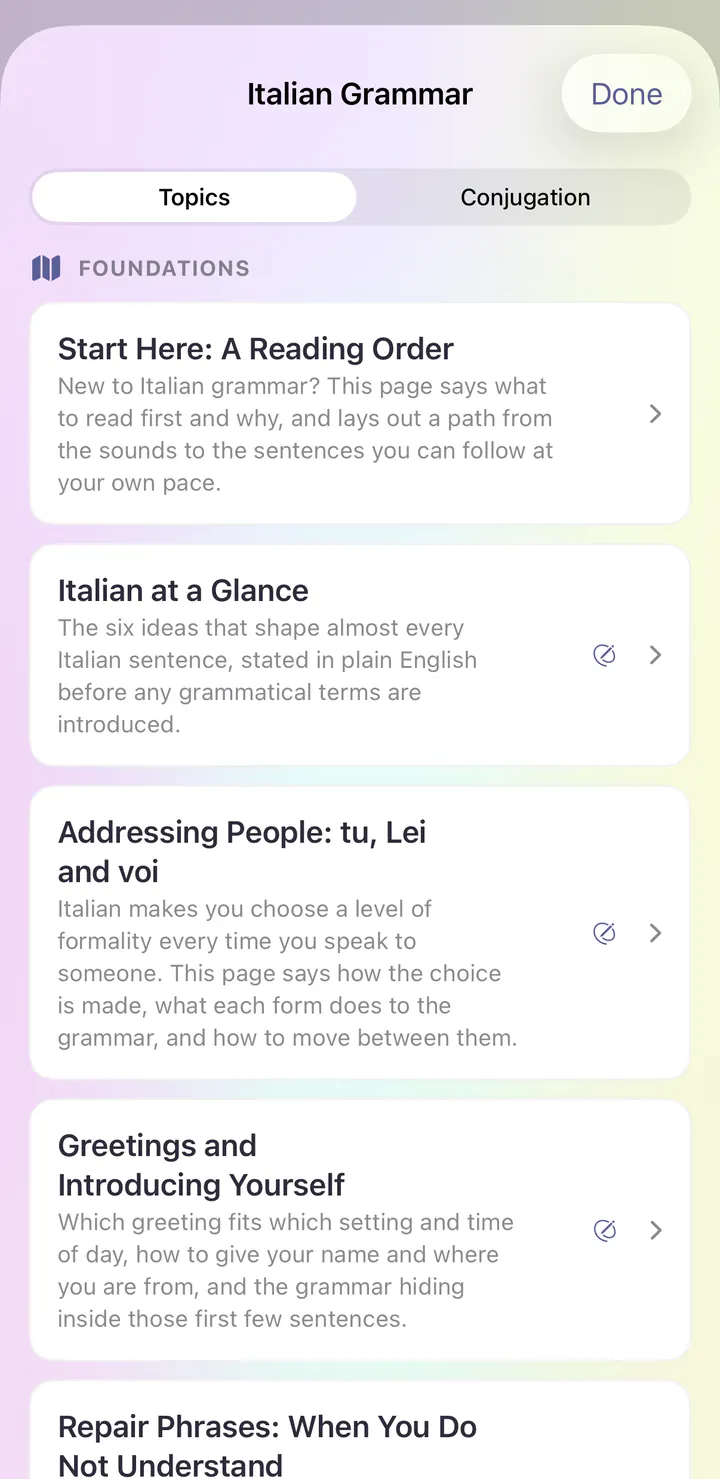
In the Loquus app, Grammar Center keeps topics like this one tap away with focused drills, and spaced review brings the words back before you forget them.
Free to start. No account needed.
By Loquus ·
Sources
- Treccani, La grammatica italiana: Coniugazione
- Treccani, La grammatica italiana: Prima coniugazione
- Treccani, La grammatica italiana: Seconda coniugazione
- Treccani, La grammatica italiana: Terza coniugazione
- Treccani, Enciclopedia dell’Italiano: Presente
- Treccani Vocabolario: parlare
- Treccani Vocabolario: vedere
- Treccani Vocabolario: dormire
- Treccani Vocabolario: capire
- Treccani, La grammatica italiana: Personali, pronomi
- Treccani Vocabolario: non
- Treccani, La grammatica italiana: Diacritici, segni
Learning research behind the practice
Worked examples, retrieval practice, and later review inform the activities. These studies do not establish the effectiveness of this specific lesson.
- Karpicke and Roediger: The critical importance of retrieval for learning
- Butler and Roediger: Feedback enhances the positive effects and reduces the negative effects of multiple choice testing
- Institute of Education Sciences: Organizing Instruction and Study to Improve Student Learning
- Rittle Johnson and Star: Compared to what?