1. Recognize the job of each script
Japanese commonly mixes hiragana, katakana, and kanji in a single sentence. Hiragana often writes grammatical endings, particles (short words placed after a word or phrase to show its role), and words that are not usually written in kanji. Katakana commonly writes loanwords and foreign names, and it can also provide emphasis or other special effects. Kanji carry word meanings and have readings that depend on the word. These are tendencies rather than three sealed categories. A familiar word can appear in a different script for a particular audience or effect.
For this lesson, concentrate on kana and let the meaning identify each example. Hiragana か and katakana カ normally represent the same basic sound, ka. Switching script does not automatically switch the language being spoken. A katakana loanword follows Japanese sound patterns, so its spelling may not reproduce the English pronunciation you expect. Learn カメラ as a Japanese word rather than trying to pronounce the English word camera while looking at Japanese letters.
Roman letters beside an example are a temporary reading aid. They are not a second correct spelling in ordinary Japanese prose and they do not describe every detail of pronunciation. Cover the romanization after an initial reading. Recognizing the kana itself is a separate skill from remembering what the word means, so check both when you review.
か
ka
The hiragana sound ka.
カメラ
kamera
Camera.
Katakana commonly writes loanwords.
2. Build from five vowel categories
The basic vowel row is あ, い, う, え, お, conventionally written a, i, u, e, o. Treat these as Japanese vowel categories, not as instructions to use the English letter names. In particular, the letters e and o do not tell you to add the strong glide common in many English pronunciations of day or go. Listening and imitation help you form the sounds; printed romanization alone cannot do that work.
A kana chart groups many other symbols by a consonant component and one of these vowels. Thus か, き, く, け, こ are ka, ki, ku, ke, ko. Some rows have conventional readings that do not look mechanically regular in familiar romanization: し is shi, ち is chi, and つ is tsu. Learn each symbol with its actual reading. Do not invent si, ti, or tu pronunciations from an English interpretation of a chart heading.
Read short, meaningful combinations before racing through the entire chart. If you can recognize い and え separately but cannot retrieve いえ, practice joining the two vowel units without adding an English y sound as a separate extra beat. Japanese handwriting and printed fonts also differ in details. Compare legitimate forms rather than assuming every visual variation creates a new character.
いえ
ie
House.
Two basic vowel units: i, e.
すし
sushi
Sushi.
The second kana is read shi.
3. Notice marks and the whole character
Continue with the n, h, m, y, and r rows, and the remaining w row characters. Learn a small set at a time, mixing newly learned symbols with earlier ones. Copying a line of identical kana can help your hand, but recognizing one among several alternatives requires recalling it from memory. After studying な and ま, look away and write the one you need in a short word. Then compare the actual shape, not only whether the result seems vaguely familiar.
Two small strokes called dakuten can change the sound category: か becomes が, ka becomes ga. A small circle, called handakuten, appears with the h row to make the p row: は becomes ぱ. These marks belong to the spelling. They are not optional decoration and they do not tell you where to place English style stress. The result should be learned as a distinct written sound unit.
Some kana resemble one another, and some sounds may initially resemble an English category. Avoid assigning a permanent English substitute after one encounter. The Japanese r row, for example, is not simply a command to pronounce the usual English r. Your immediate goal is reliable symbol recognition and the right sequence of sound categories. Refine articulation through repeated listening while preserving the spelling distinctions you already know.
はな
hana
Flower or nose.
Meaning and pitch depend on the word and context.
まど
mado
Window.
The marks on ど matter.
4. Count morae without forcing an English rhythm
A mora is a useful unit for describing Japanese sound timing. For beginner reading, an ordinary kana such as か normally contributes one mora. The nasal ん also contributes one, even though it does not contain a separate written vowel. In ほん, count ho and n: two morae. Do not add a vowel after ん merely to make it resemble an English consonant plus vowel syllable.
Mora counting is not identical to counting English syllables. Nor does it mean that every sound lasts exactly the same number of milliseconds in natural speech. Speaking rate, phrase structure, and the surrounding sounds affect duration. A slow counting exercise makes contrasts visible; fluent speech is more flexible. Use gentle taps as a temporary way to keep a missing unit from disappearing, then return to a natural model.
The pronunciation of ん adjusts to its neighbors, so the same written symbol will not always sound like the English n in no. Preserve its place in the word while listening for the actual realization. In a word such as みんな, the nasal has its own timing contribution before the following な. Do not delete it just because the next consonant is also nasal. This matters more than giving every written letter a separate exaggerated release.
ほん
hon
Book.
Two morae: ho, n.
みんな
minna
Everyone.
Three morae: mi, n, na.
Guided example: find the unit you might lose
Count the morae in がっこう, gakkō, meaning “school,” before looking at the answer.
- First find the ordinary initial が. It contributes one unit.
- Next identify the small っ. It contributes consonant timing rather than the full spoken syllable tsu.
- Finally consider こう. In this word it contains a long o, so it contributes two units. Add the pieces and preserve them in one continuous word.
Compare your reasoning
がっこう has four morae: ga, closure, ko, o. The reading is gakkō, meaning “school.”
5. Keep a long vowel long
A long vowel takes two morae rather than one. In hiragana, its second part is written with a vowel kana. The spelling is not always a simple repetition: long o is often written with う, and long e is often written with い. Other words use お or え. Learn the spelling of the whole word rather than replacing every long vowel with a rule you invented from its sound.
Length can distinguish words. おばさん, obasan, refers to an aunt or a middle aged woman in an appropriate context; おばあさん, obāsan, refers to a grandmother or an elderly woman. These labels also have social contexts, so this is a reading contrast rather than advice to call an unfamiliar person by either label. Count o, ba, sa, n in the first and o, ba, a, sa, n in the second. The added vowel unit changes the word.
Katakana commonly uses the length mark ー. In コーヒー, kōhī, the first mark lengthens o and the second lengthens i. A mark does not have an independent fixed vowel sound. Its value depends on the vowel before it. Romanization in this course uses a macron, as in ō, to flag length, but Japanese spelling still needs to be learned separately.
おばさん
obasan
Aunt; a middle aged woman, depending on context.
Four morae.
おばあさん
obāsan
Grandmother; an elderly woman, depending on context.
Five morae.
コーヒー
kōhī
Coffee.
Four morae: ko, o, hi, i.
6. Separate small ゃ from small っ
Small ゃ, ゅ, and ょ combine with a preceding kana made of a consonant and the vowel i, such as き or し, to represent a single combined unit. Compare きゃ, kya, with きや, kiya. The small character in きゃ forms one mora with き. The full size や in きや starts another mora. Size carries information, so zoom in or use a clear font when you are unsure. Counting printed characters without checking their size gives the wrong result.
Small っ works differently. It represents a timing unit associated with a following long consonant. In きって, kitte, count ki, the consonant closure, and te. Do not pronounce a full tsu in the middle, and do not erase the closure. The romanization doubles the following consonant, but the physical action depends on the consonant: a stop involves a held closure, while a fricative can involve a longer friction interval.
Katakana uses parallel small characters, as in キャ and ッ, and additional small vowel combinations occur in loanwords. You do not need to master every possible loanword spelling today. First distinguish a combined small y kana from small っ. They have different timing effects even though both are visibly smaller than the neighboring character. Apply the distinction to words, not just isolated symbols.
きゃく
kyaku
Guest; customer.
Two morae: kya, ku.
きって
kitte
Postage stamp.
Three morae: ki, closure, te.
Worked example: count before reading
How many morae are in きょう, kyō, meaning “today”?
- Start with character size. The small ょ combines with き, so きょ is one mora rather than two.
- The final う writes the additional part of the long o vowel in this word. Preserve it as another mora.
- Say the long vowel smoothly. The two counted units are a timing aid, not an instruction to insert a break in the middle of the word.
きょう has two morae: kyo, o. It is read kyō, meaning “today.”
7. Read a phrase and keep the limits clear
Kana knowledge supports grammar, but a few grammatical spellings need special readings. The topic particle は, which marks the thing the sentence is about, is pronounced wa. The direction particle へ is pronounced e, and the object particle を is usually pronounced o in standard contemporary Japanese. The same は in a normal word such as はな is ha. Decide whether you are looking at a particle in a sentence, rather than changing every occurrence of the symbol automatically.
Sound timing and pitch accent are different dimensions. Standard Japanese uses pitch patterns that can help distinguish words and organize phrases. An accent is not simply the syllable to say louder in the English manner. The Irodori word list marks pitch falls, while its kana material separately practices long vowels and consonants. Keep those learning tasks separate. A word can have the correct number of morae and still need pronunciation refinement.
Now cover a reading aid, reconstruct the kana, and explain one choice before opening the game. A useful explanation names the feature: a long vowel adds a mora, small ゃ combines, small っ preserves consonant length, or は is being used as a particle. If you get a word wrong, record the specific distinction and revisit it later among different words. Correct recall after a delay is more informative than repeating an answer you have just seen.
わたしは学生です。
Watashi wa gakusei desu.
I am a student.
The topic particle は is wa.
こんにちは。
Konnichiwa.
Hello; good afternoon.
The conventional greeting retains は pronounced wa.
Notice the difference
Common mistakes
Do not erase vowel length
Instead ofおばさん
For this meaningおばあさん
The extra あ distinguishes obāsan from obasan. The shorter word can mean “aunt,” so the missing unit changes meaning rather than merely creating a foreign accent.
Do not read small っ as full tsu
Instead ofきつて = kitsute
For this meaningきって
Full size つ contributes a tsu sound. The smaller っ marks the timing of a long following consonant and has no independent u vowel here.
Do not give small ゃ its own mora
Instead ofきや
For this meaningきゃ
The small ゃ combines with き. Full size や would create a separate unit. Character size is part of reading accuracy.
Do not turn all は into wa
Instead ofwana
For this meaninghana
The special wa reading belongs to the topic particle and certain conventional spellings. Inside this ordinary noun, は is read ha.
From understanding to using
Make your own example.
Try these without answer choices. Say your answer aloud or write it below, then compare your reasoning with the model.
Your turn 1
Write “coffee” in katakana from memory. Then explain what each length mark does.
Compare with a model
コーヒー (kōhī)
Coffee.
The first ー continues the o vowel in コ, and the second continues the i vowel in ヒ. Each long vowel contributes two morae, making four in the whole word. The marks do not both mean o, and they are not stress marks.
- Use katakana.
- Include both length marks.
- Count four morae without adding a vowel after the word.
Your turn 2
Write “postage stamp” in hiragana from the reading kitte. Explain why a full size つ would change the reading.
Compare with a model
きって (kitte)
Postage stamp.
Small っ marks the consonant timing before て. A full size つ would be read tsu and produce a different sound sequence. The model has three morae, with a closure between ki and te rather than a spoken tsu.
- Use small っ.
- Preserve the closure before t.
- Explain the contrast before checking a choice.
Put it into practice
Make the next choice.
Choose a response and learn why it works. Your score reflects your first answer to each question. You can revisit anything you miss.
Choose an answer, then open the explanation to check your reasoning.
Question 1
Which script commonly writes the loanword for “camera”?
- カメラ
- かめら
Check the answer
Answer: カメラ
カメラ: Katakana commonly writes loanwords; read this as the Japanese word kamera.
かめら: Hiragana can represent the sounds, but katakana is the usual spelling requested here.
Question 2
Select the usual reading of し.
- chi
- shi
Check the answer
Answer: shi
chi: The reading chi belongs to ち, a different kana.
shi: This is the conventional reading of し.
Question 3
Which kana spells ga?
- が
- か
Check the answer
Answer: が
が: The dakuten changes か ka to が ga.
か: Without the marks this is ka.
Question 4
How many morae are in ほん, hon?
- One
- Two
Check the answer
Answer: Two
One: The nasal ん contributes timing even without a separate vowel.
Two: The kana ほ and the nasal ん each contribute a mora.
Question 5
Which spelling gives “grandmother,” obāsan?
- おばあさん
- おばさん
Check the answer
Answer: おばあさん
おばあさん: The extra あ preserves the long a.
おばさん: This shorter spelling gives obasan, which can mean “aunt.”
Question 6
How many morae are in コーヒー, kōhī?
- Two
- Four
Check the answer
Answer: Four
Two: Counting only the full kana ignores the two length marks.
Four: Both vowels are long: ko, o, hi, i.
Question 7
What does ー do in the katakana word ノート, meaning “notebook”?
- Lengthens the preceding o
- Adds an independent a
Check the answer
Answer: Lengthens the preceding o
Lengthens the preceding o: The mark continues the preceding vowel; nōto has three morae.
Adds an independent a: The mark has no fixed a reading.
Question 8
Which spelling has one combined kya mora?
- きや
- きゃ
Check the answer
Answer: きゃ
きや: Full size や gives a separate ya after ki.
きゃ: Small ゃ combines with き.
Question 9
How many morae are in きゃく, kyaku?
- Two
- Three
Check the answer
Answer: Two
Two: The mora kya is one, and ku is the other.
Three: The small ゃ does not contribute another mora.
Question 10
Which spelling means “postage stamp,” kitte?
- きて
- きって
Check the answer
Answer: きって
きて: This lacks the closure and gives kite, a different form.
きって: Small っ preserves the consonant length.
Question 11
What is the small っ doing in きって?
- Marking consonant timing
- Adding a spoken tsu syllable
Check the answer
Answer: Marking consonant timing
Marking consonant timing: It is associated with the longer following t, not a full tsu.
Adding a spoken tsu syllable: That would be the reading of full size つ.
Question 12
How is the topic particle は read in わたしは学生です?
- ha
- wa
Check the answer
Answer: wa
ha: The reading ha is normal inside ordinary words, but not for this particle.
wa: The topic particle keeps the spelling は but is read wa.
Question 13
Which statement about Japanese pitch is accurate?
- Pitch patterns are separate from mora count
- The last mora always receives English style stress
Check the answer
Answer: Pitch patterns are separate from mora count
Pitch patterns are separate from mora count: Counting units does not tell you the pitch pattern of a word.
The last mora always receives English style stress: Japanese pitch accent cannot be reduced to that rule.
Question 14
What is the strongest next step after recognizing a word?
- Keep copying while looking at the same model
- Hide the model and reconstruct its spelling
Check the answer
Answer: Hide the model and reconstruct its spelling
Keep copying while looking at the same model: Copying may train the hand, but it does not by itself test independent recall.
Hide the model and reconstruct its spelling: Reconstructing the spelling from memory checks whether you can produce the distinction without a visible answer.
Keep the conversation going
What to practice next
After producing your own examples, try the questions. Return later and explain the same contrast without looking at the model.
Keep it going in the app
Keep the letters close.
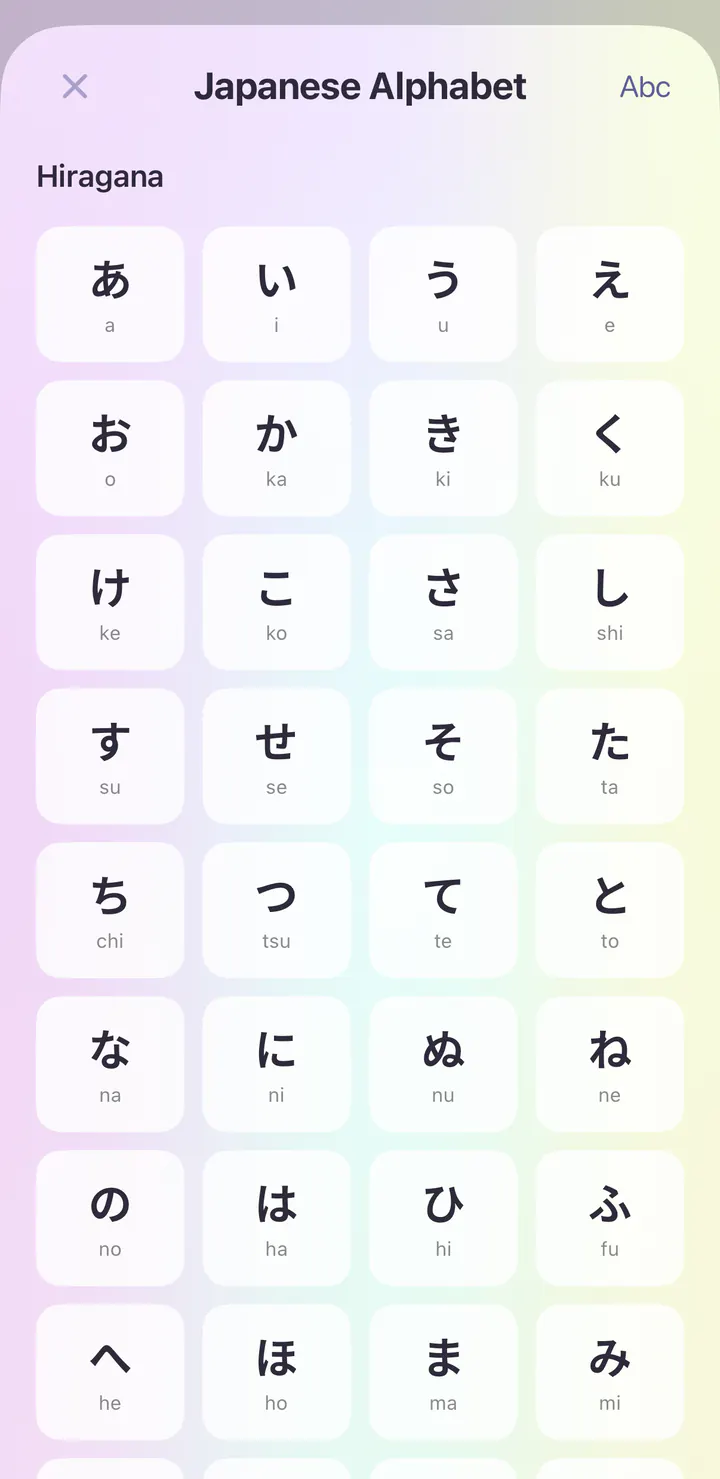
In the Loquus app, the alphabet reference lets you tap any character to hear it, and lessons bring new sounds back until they feel familiar.
Free to start. No account needed.
By Loquus ·
Sources
- Japan Foundation: Irodori Starter grammar notes
- Japan Foundation: Irodori Starter hiragana and katakana
- Japan Foundation: Irodori Starter word list
- Japan Foundation: Marugoto Starter (A1) Rikai, Teachers Notes
- Monash University: 1.1 Introduction to Hiragana
- Monash University: 1.2 あ (a) to こ (ko)
- Monash University: 1.3 さ (sa) to と (to)
- Monash University: 1.4 な (na) to ほ (ho)
- Monash University: 1.5 ま (ma) to よ (yo)
- Monash University: 1.6 ら (ra) to ん (n) and Hiragana Review
- Purdue University: Effects of online repetition practice on promoting mora awareness: Focusing on vowel length
- Tokyo University of Foreign Studies: 日本語 文法 NはNです:解説
Learning research behind the practice
Worked examples, retrieval practice, and later review inform the activities. These studies do not establish the effectiveness of this specific lesson.