Start with a request that fits the situation
Eu gostaria de um café, por favor is a useful courteous order. The form gostaria belongs to the conditional, called futuro do pretérito in Brazilian grammar. You can learn this request as a complete frame before studying that whole tense. Eu queria um café is another common softened request, although queria can also mean “wanted” in a past narrative. Tone and context distinguish those uses. A short Um café, por favor can also be perfectly appropriate; politeness is not measured by the number of verbs in a sentence. The form quero directly states what you want and is not grammatically wrong, but it has a different degree of directness from the specifically requested courteous frame. In practice, preserve the stated construction instead of assuming that every possible order must have exactly the same wording.
Eu gostaria de um café, por favor.
I would like a coffee, please, using gostaria de.
The polite frame keeps the preposition required by gostar. The article introduces one serving, while por favor makes the request courteous.
Eu queria um chá, por favor.
I would like a tea, please, using the softened queria request.
In this ordering context, the imperfect, called pretérito imperfeito in Portuguese, softens a present request. It does not necessarily describe a desire that ended in the past.
References for this explanation
Specify the number of servings
A beverage noun can refer to a substance or to a serving. The word café in a general statement names coffee, while um café in an order usually means “one serving.” Two servings are dois cafés, with a regular plural ending and the written accent retained. This differs from Italian coffee vocabulary, so do not carry an unchanged plural into Portuguese. The word água is feminine, and a counted bottle or serving can be ordered with uma água when the context makes the unit clear. A container makes the request more precise: a glass and a bottle do not necessarily contain the same amount. Quantity words also have gender where relevant. The word dois accompanies a masculine noun, while duas accompanies a feminine one. Check the grammatical noun being counted, rather than the gender of the person who will drink it or the server taking the order.
Dois cafés, por favor.
Two coffees, please.
The number refers to two servings, and the noun takes its ordinary plural ending. The accent remains part of the spelling of the plural word.
Duas águas, por favor.
Two waters, please, with servings understood.
The noun naming the servings is feminine plural, so the number uses its feminine form. The context supplies the unit being ordered.
Follow a complete example
Build a sentence with this meaning: Two coffees, please. Before looking at the answer, identify which information controls the grammatical choice.
- First, identify the message: Two coffees, please. Keep that message fixed while comparing forms. A sentence can be grammatical yet communicate something different, so meaning is part of the decision.
- The number refers to two servings, and the noun takes its ordinary plural ending. The accent remains part of the spelling of the plural word.
- Now read the complete sentence: Dois cafés, por favor. Check the words around your choice as well as the choice itself. Explain what would change with a different subject or a different message. Then cover this example and rebuild the sentence from its meaning.
Dois cafés, por favor. Two coffees, please.
References for this explanation
Name a container and its contents
The phrase um copo de água requests a glass of water, and uma garrafa de água requests a bottle. The linking de identifies the contents. It does not automatically contract just because the following noun is feminine. The contraction da combines de with a definite article, so it normally refers to water already identified in a context such as a particular bottle or source. The neutral container phrase here does not contain that definite article. The same distinction helps with ingredients and measures: a quantity expression can name a unit before it names a substance. Do not translate English some by inserting a French style partitive into every Portuguese food phrase. Portuguese uses bare substance nouns naturally in many such contexts. When accuracy matters, choose a container, amount, or serving and let the rest of the phrase identify what it contains.
Um copo de água, por favor.
A glass of water, please, using the neutral contents phrase.
The container supplies the counted unit, and de água identifies its contents without introducing a definite article for a particular water supply.
Uma garrafa de água mineral, por favor.
A bottle of mineral water, please.
The adjective identifies the type of water. Here, mineral has the same singular form with masculine and feminine nouns, so no invented feminine ending is needed.
References for this explanation
State what should be included or left out
The word com means “with,” while sem means “without.” In an order, café com leite includes milk, and café sem açúcar excludes sugar. The small preposition can therefore change the entire practical meaning of the request. Do not assume that a familiar drink name guarantees every ingredient or that preparation is identical everywhere in Brazil. Ask explicitly about a detail that matters to you and listen to the reply. A question such as Tem leite? can check whether an item contains milk or whether milk is available, depending on the surrounding exchange. If that difference matters, name the item or ask a fuller question. This lesson practices language for clarification rather than making promises about ingredients. Pair each modification with the actual noun it describes, and repeat the essential detail if the server’s confirmation does not match the order.
Um café sem açúcar, por favor.
A coffee without sugar, please.
The preposition explicitly excludes sugar. It supplies the requested modification rather than relying on the café’s usual preparation practice.
Um café com leite, por favor.
A coffee with milk, please.
The preposition introduces the ingredient to include. The noun phrase names the drink first and then clarifies its composition.
References for this explanation
Ask whether you can do something
The form posso is the first person singular of poder. Follow it with an infinitive to ask permission: Posso pagar agora? The first verb carries person and tense; the second names the action. Do not conjugate both verbs independently in this construction. When asking one server to do something, Você pode repetir? uses the singular listener form. The phrases o senhor pode and a senhora pode also use a third person singular verb when you choose that respectful address. They are alternatives to use with social judgment, not mandatory labels for every adult. Tem uma mesa livre? is a common Brazilian availability question. Here the situation usually makes clear that you are asking whether a free table is available. If you name a plural possessor instead, as in a question to several businesses, the verb agreement follows that different subject.
Posso pagar agora?
Can I pay now, asking permission?
The conjugated modal identifies the speaker, and the infinitive names the action. The question requests permission or an opportunity to settle the bill.
Você pode repetir, por favor?
Can you repeat, please, addressing one person with você?
The singular listener takes the third person singular modal, followed by the infinitive. The sentence asks the server to repeat information.
References for this explanation
Distinguish price, the bill, and the payment method
Quanto custa? asks what something costs. A conta, por favor requests the bill for the order or table. These serve different points in an exchange: you may want to know a price before ordering and ask for the bill after the items are settled. Posso pagar com cartão? asks whether card payment is possible, while em dinheiro specifies cash. Other natural payment phrases occur, including no cartão, so the practice here does not present one ordinary alternative as the only grammatical wording. Keep the intended method clear. A question about accepting a card is not a promise that every establishment accepts it. Likewise, procedures for ordering and paying vary. Ask where or when to pay if the next step is unclear. The goal is a usable conversation whose references make sense, not a universal claim about café service throughout Brazil.
A conta, por favor.
The bill, please.
This conventional noun phrase requests the relevant bill. The feminine article agrees with the noun and helps identify the bill associated with the current order.
Posso pagar em dinheiro?
Can I pay in cash?
The conventional phrase identifies cash as the proposed payment method. The modal construction still requires the infinitive pagar.
Try the reasoning with less help
Build a sentence with this meaning: The bill, please. Before looking at the answer, identify which information controls the grammatical choice.
- First, identify the message: The bill, please. Keep that message fixed while comparing forms. A sentence can be grammatical yet communicate something different, so meaning is part of the decision.
- This conventional noun phrase requests the relevant bill. The feminine article agrees with the noun and helps identify the bill associated with the current order.
- Now read the complete sentence: A conta, por favor. Check the words around your choice as well as the choice itself. Explain what would change with a different subject or a different message. Then cover this example and rebuild the sentence from its meaning.
Compare your reasoning
A conta, por favor. The bill, please.
References for this explanation
Correct a detail and close the exchange
If the server repeats the wrong quantity or ingredient, correct that detail explicitly. São dois cafés, não um contrasts the intended number with the mistaken one. Desculpe, não entendi explains that you did not understand, and Pode repetir, por favor? asks for repetition. These are useful complete phrases even before you have studied every tense they contain. A misunderstanding can result from noise, speed, or an unfamiliar menu word as well as grammar. Listen for the repaired information before agreeing. When thanking someone, traditional agreement gives obrigado for a male speaker and obrigada for a female speaker; it follows the person expressing thanks, not the person receiving them. Other thanks expressions can avoid that distinction. In the conversation activity, follow the order details as they are introduced, clarified, and confirmed so that the final payment request refers to an established transaction.
São dois cafés, não um.
It is two coffees, not one, correcting the quantity.
The number supplies the intended count and the following contrast rejects one serving. The plural noun and verb match the corrected quantity.
Muito obrigada.
Thank you very much, using traditional agreement for a female speaker.
The thanks word follows the speaker’s agreement in the traditional pattern taught here. The gender of the server does not determine this form.
References for this explanation
Notice the difference
Common mistakes
Keep the preposition in the request frame
Instead ofEu gostaria um café.
For this meaningEu gostaria de um café.
The courteous gostaria frame keeps the preposition that belongs to gostar. A different verb such as querer follows a different construction, so do not transfer its direct noun pattern into this request.
Use the plural coffee noun
Instead ofDois café, por favor.
For this meaningDois cafés, por favor.
Standard agreement marks the counted noun as plural after dois. The written accent remains in the plural. This differs from the unchanged Italian coffee noun and from reducing final sounds in rapid speech.
Name the action with an infinitive
Instead ofPosso pago agora?
For this meaningPosso pagar agora?
The modal already carries the speaker and tense. The following infinitive supplies the action being requested; using another conjugated form would break this particular verb group.
From understanding to using
Make your own example.
Try these without answer choices. Say your answer aloud or write it below, then compare your reasoning with the model.
Your turn 1
Politely order two coffees without sugar and a bottle of mineral water. Use gostaria de.
Compare with a model
Eu gostaria de dois cafés sem açúcar e uma garrafa de água mineral, por favor.
I would like two coffees without sugar and a bottle of mineral water, please.
The request frame keeps de, while the number and plural coffee noun identify two servings. The word sem excludes sugar from the coffees, and the bottle provides a clear unit for the water. The second de belongs to the container phrase, not to a repeated request verb. Check that the listener can tell which modification belongs to which item.
- Does your answer say what the task asked for?
- Does the form match the person or noun in your message?
- Can you explain your choice before looking at the model?
Your turn 2
Ask one server to repeat, then request the bill and ask whether you can pay in cash.
Compare with a model
Você pode repetir, por favor? A conta, por favor. Posso pagar em dinheiro?
Can you repeat, please? The bill, please. Can I pay in cash?
The first question uses a verb agreeing with the singular listener and an infinitive for the requested action. The last question changes to the speaker’s permission request, so it uses posso. The bill request identifies what should be brought, while the payment phrase identifies the proposed method. These are separate practical steps in the transaction.
- Does your answer say what the task asked for?
- Does the form match the person or noun in your message?
- Can you explain your choice before looking at the model?
Put it into practice
Make the next choice.
Choose a response and learn why it works. Your score reflects your first answer to each question. You can revisit anything you miss.
Choose an answer, then open the explanation to check your reasoning.
Question 1
Complete the sentence for this meaning: I would like a coffee, please, using gostaria.
Eu gostaria ___ um café, por favor.
- de
- a
Check the answer
Answer: de
de: The polite frame keeps the preposition required by gostar. The article introduces one serving, while por favor makes the request courteous.
a: This does not supply the preposition required in the stated gostaria de construction.
Question 2
Complete the sentence for this meaning: I would like a tea, please, using a softened request.
Eu ___ um chá, por favor.
- queremos
- queria
Check the answer
Answer: queria
queremos: This means “we want” and changes both the person and the requested softened wording.
queria: In this ordering context, the imperfeito softens a present request. It does not necessarily describe a desire that ended in the past.
Question 3
Complete the sentence for this meaning: Two coffees, please.
Dois ___, por favor.
- cafés
- café
Check the answer
Answer: cafés
cafés: The number refers to two servings, and the noun takes its ordinary plural ending. The accent remains part of the spelling of the plural word.
café: This singular form does not match the specified count of two in this ordinary complete noun phrase.
Question 4
Complete the sentence for this meaning: Two waters, please, with servings understood.
___ águas, por favor.
- Dois
- Duas
Check the answer
Answer: Duas
Dois: This masculine number does not agree with the feminine noun águas.
Duas: The noun naming the servings is feminine plural, so the number uses its feminine form. The context supplies the unit being ordered.
Question 5
Complete the sentence for this meaning: A glass of water, please.
Um copo ___, por favor.
- de água
- com açúcar
Check the answer
Answer: de água
de água: The container supplies the counted unit, and de água identifies its contents without introducing a definite article for a particular water supply.
com açúcar: This means “with sugar” and does not identify the requested contents as water.
Question 6
Complete the sentence for this meaning: A bottle of mineral water, please.
Uma garrafa de água ___, por favor.
- minerala
- mineral
Check the answer
Answer: mineral
minerala: This is not the standard feminine form. The adjective does not change gender through an added final vowel.
mineral: The adjective identifies the type of water. Here, mineral has the same singular form with masculine and feminine nouns, so no invented feminine ending is needed.
Question 7
Complete the sentence for this meaning: A coffee without sugar, please.
Um café ___ açúcar, por favor.
- sem
- com
Check the answer
Answer: sem
sem: The preposition explicitly excludes sugar. It supplies the requested modification rather than relying on the café’s usual preparation practice.
com: This includes sugar and therefore reverses the specific request, even though the phrase is grammatical for a different order.
Question 8
Complete the sentence for this meaning: A coffee with milk, please.
Um café ___ leite, por favor.
- sem
- com
Check the answer
Answer: com
sem: This excludes milk and does not preserve the drink requested in the meaning.
com: The preposition introduces the ingredient to include. The noun phrase names the drink first and then clarifies its composition.
Question 9
Complete the sentence for this meaning: Can I pay now, asking permission?
Posso ___ agora?
- pagar
- pago
Check the answer
Answer: pagar
pagar: The conjugated modal identifies the speaker, and the infinitive names the action. The question requests permission or an opportunity to settle the bill.
pago: This is a separately conjugated present form and does not fit the infinitive position after posso.
Question 10
Complete the sentence for this meaning: Can you repeat, please, addressing one person with você?
Você ___ repetir, por favor?
- podem
- pode
Check the answer
Answer: pode
podem: This plural form would fit vocês, but the question addresses one person with você.
pode: The singular listener takes the third person singular modal, followed by the infinitive. The sentence asks the server to repeat information.
Question 11
Complete the sentence for this meaning: The bill, please.
___, por favor.
- A conta
- O cardápio
Check the answer
Answer: A conta
A conta: This conventional noun phrase requests the relevant bill. The feminine article agrees with the noun and helps identify the bill associated with the current order.
O cardápio: This asks for the menu and therefore serves a different purpose from settling the order.
Question 12
Complete the sentence for this meaning: Can I pay in cash?
Posso pagar ___?
- sem dinheiro
- em dinheiro
Check the answer
Answer: em dinheiro
sem dinheiro: This means “without money” and does not express the cash payment method requested.
em dinheiro: The conventional phrase identifies cash as the proposed payment method. The modal construction still requires the infinitive pagar.
Question 13
Complete the sentence for this meaning: It is two coffees, not one, correcting the quantity.
São ___ cafés, não um.
- dois
- um
Check the answer
Answer: dois
dois: The number supplies the intended count and the following contrast rejects one serving. The plural noun and verb match the corrected quantity.
um: This repeats the quantity being rejected and conflicts with the plural noun and the intended correction.
Question 14
Complete the sentence for this meaning: Thank you very much, using traditional agreement for a female speaker.
Muito ___.
- obrigado
- obrigada
Check the answer
Answer: obrigada
obrigado: This is the traditional form for a male speaker, so it does not match the speaker specified in the prompt.
obrigada: The thanks word follows the speaker’s agreement in the traditional pattern taught here. The gender of the server does not determine this form.
Conversation builder
Clarify the drinks and pay for the order
Arrange the turns by matching each question to its answer and following details already introduced in the exchange.
- Bom dia! Gostaria de dois cafés, por favor.
Good morning! I would like two coffees, please.
- Com açúcar ou sem açúcar?
With sugar or without sugar?
- Sem açúcar. E uma água mineral, por favor.
Without sugar. And a mineral water, please.
- Água com gás ou sem gás?
Sparkling or still water?
- Sem gás. Posso pagar com cartão?
Still. Can I pay by card?
- Pode, sim. Vou trazer a máquina.
Yes, you can. I am going to bring the card machine.
Keep the conversation going
What to practice next
After a break, go back to your own examples above and do each task again without looking at the models. Compare the meaning and form with the models, and fix each mistake by explaining its cause. Then use one of your sentences in a short conversation of your own.
Keep it going in the app
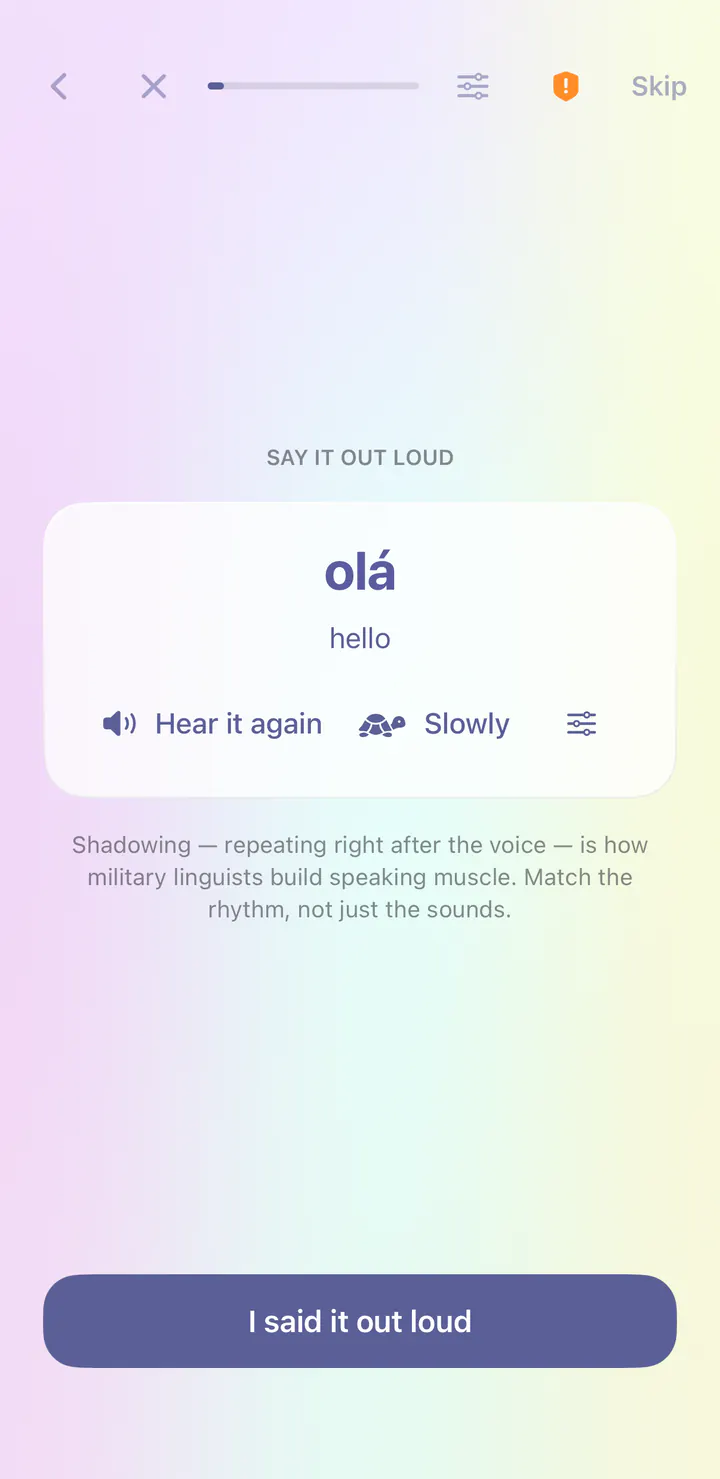
Say it out loud next.
The Loquus app turns lessons like this into guided conversations and speaking practice, with normal and slow audio. On iPhone and iPad, speech recognition runs on your device.
Free to start. No account needed.
By Loquus ·
Sources
- IFSul: Viajando pelo Brasil
- Dicionário Priberam: querer
- Dicionário Priberam: gostar
- Dicionário Priberam: café
- Dicionário Priberam: água
- Dicionário Priberam: artigo
- Dicionário Priberam: de
- Dicionário Priberam: mineral
- Dicionário Priberam: com
- Dicionário Priberam: sem
- Dicionário Priberam: açúcar
- Dicionário Priberam: poder
- Dicionário Priberam: Conjugação de ter
- Dicionário Priberam: conta
- Dicionário Priberam: quanto
- IFSul: Compras no antiquário
- Dicionário Priberam: senhor
- Dicionário Priberam: não
- Dicionário Priberam: obrigado
Learning research behind the practice
Worked examples, retrieval practice, and later review inform the activities. These studies do not establish the effectiveness of this specific lesson.
- Karpicke and Roediger: The critical importance of retrieval for learning
- Butler and Roediger: Feedback enhances the positive effects and reduces the negative effects of multiple choice testing
- Institute of Education Sciences: Organizing Instruction and Study to Improve Student Learning
- Rittle Johnson and Star: Compared to what?