Separate when something happens from what time it is
Когда? asks when. An answer might name tomorrow, a weekday, or a general part of the day. Во сколько? asks at what time and usually calls for a clock time in the planning situations here. Который час? asks what time it is now. These questions overlap in their connection to time, but they do not request the same information.
If a friend asks when you are free, Завтра may be a useful first answer. If the friend then asks Во сколько, repeating завтра does not settle the hour. You need a more precise reply, such as В три часа. Notice the preposition в for an event or availability at a clock time. A statement of the current time can instead be Сейчас три часа, “It is three o’clock now.”
Before choosing a phrase, identify the information gap. Does the other person need the day, the hour, or the present clock reading? A grammatically correct answer to a different question can still leave a plan unresolved. Practicing these as three distinct conversational actions is more useful than treating the English word time as one label and expecting every question that contains it to work the same way.
References for this explanation
Use a weekday in the form required after в
The weekday names are понедельник, вторник, среда, четверг, пятница, суббота, and воскресенье. To say “on” a weekday, use в with the accusative, or во before вторник: во вторник. The phrases в понедельник and в четверг look like the dictionary forms because these inanimate masculine nouns, which name things rather than people or animals, do not change visibly in the accusative. Feminine nouns show the а to у change: в среду, в пятницу, and в субботу.
Do not assume that в always means “in” or always takes the same case. In this weekday construction it connects the event with a day. In a location phrase such as в библиотеке, it has a different role and the noun has a different case. Learning the whole time phrase prevents you from importing a place ending into a day expression.
A weekday alone may be enough when both speakers already know which week they mean. When that reference could be unclear, include enough surrounding information to establish the intended day. The lesson’s dialogues provide that context explicitly. The aim is to form and interpret the weekday phrase, not to assume that a bare Wednesday always identifies an unambiguous date in every real conversation.
References for this explanation
- Cornell Russian grammar: Expressing ‘on’ a day of the week
- Cornell Russian grammar: The Accusative Singular endings for a declension
- University of Kansas Между нами: 3.3 Что чита́ют россия́не?, Немно́го о языке́
- Cornell Russian grammar: The preposition v/vo
- University of Kansas Между нами: 3.7 Где они живут?, Немно́го о языке́
Choose today, tomorrow, or a part of the day
The words сегодня, завтра, and вчера mean “today,” “tomorrow,” and “yesterday.” These familiar time words do not need в in the ordinary adverbial expressions used here. The phrase завтра вечером means “tomorrow evening,” combining the day reference with a general part of that day. The phrase сегодня утром means “this morning,” literally “today in the morning.”
Useful words for parts of the day are утром, “in the morning”; днём, “during the day” or “in the afternoon,” as context supports; вечером, “in the evening”; and ночью, “at night.” Treat these as usable time expressions rather than attempting to create them by translating the English preposition in word for word. The boundaries between parts of a day are contextual; a vocabulary item does not establish a universal fixed hour at which evening must begin.
A broad time expression can be a good first step in a plan, but it may not be precise enough for the final agreement. Tomorrow evening could work for a casual intention to read, while a shared conversation may require an agreed clock time. Add detail as needed, and keep the broad day reference consistent with the hour you eventually select.
Read and say an exact hour with the matching form of час
“At one o’clock” is в час. “At two, three, and four o’clock” are в два часа, в три часа, and в четыре часа. From five through twelve in these simple expressions, use часов: в пять часов, в восемь часов, в двенадцать часов. These are the same counting distinctions introduced for quantities, applied to the noun час in a time expression.
A twelve hour time can need more context. Eight in the morning and eight in the evening are different appointments. The phrases в восемь часов утра and в восемь часов вечера make that distinction explicit. Notice that утра and вечера in these clock phrases differ from the standalone adverbs утром and вечером. Learn the complete phrase appropriate to the task instead of exchanging their endings freely.
A schedule may use a twenty four hour value. The phrase в девятнадцать часов gives 19:00, or seven in the evening. This lesson practices exact hours so that the central distinctions remain clear. Expressions involving halves, quarters, and minutes require additional patterns and should not be guessed from these few forms. When confirming a plan, repeat the full agreed hour and any needed day reference rather than relying on a number whose morning or evening meaning is still uncertain.
Watch the decision
Specify an event at eight in the evening.
- Choose в to express “at” a clock time.
- Use восемь часов for “eight o’clock.”
- Add вечера to distinguish evening from morning.
В восемь часов вечера.
References for this explanation
- Cornell Russian grammar: Telling time: on the hour
- University of Kansas Между нами: 5.4 Кото́рый час?, Немно́го о языке́
- University of Kansas Между нами: 5.6 Дени́с е́дет в Яросла́вль, Немно́го о языке́
- Cornell Russian grammar: Expressing ‘in/at’ a time of day
- Cornell Russian grammar: Genitive after numerals
- Cornell Russian grammar: Nouns and adjectives with numerals pyat’ and higher
Say whether you are busy or free with the right agreement
A male speaker can say Я занят, “I am busy,” or Я свободен, “I am free.” A female speaker uses Я занята or Я свободна. These are short adjective forms describing the subject, not present tense verbs with person endings. The ordinary present sentence does not add есть as a translation of am.
With plural subjects, use Мы заняты and Мы свободны. Formal вы also takes the plural short adjective form when addressing one person: Вы свободны? The choice is therefore not simply a count of how many people are standing in front of you. The grammatical address form matters. With familiar singular ты, choose the relevant singular form, such as Ты свободен? to a male friend or Ты свободна? to a female friend.
Stress is worth learning with the pair: за́нят but занята́. The spelling change and stress change together help you recognize the form. Add a time expression when availability depends on the day: В среду я занята. This tells the listener about Wednesday; it does not imply permanent unavailability. A useful planning reply can decline one proposed day while identifying another possibility, making the reason for the next suggestion clear.
Complete the reasoning
Ask one unfamiliar woman formally whether she is free on Wednesday.
- Choose вы for formal address.
- Use the plural short adjective свободны with вы.
- Use в среду for the weekday.
Compare your reasoning
Вы свободны в среду?
References for this explanation
- University of Kansas Между нами: 5.6 Дени́с е́дет в Яросла́вль, Немно́го о языке́
- Cornell Russian grammar: Addressing people: ty vs. vy
- Cornell Russian grammar: Sentence types: structures with a Nominative subject
- Cornell Russian grammar: Masculine, feminine, and neuter nouns
- Cornell Russian grammar: Stress patterns for nouns
Distinguish a future location from a future activity
Завтра я буду в библиотеке means “I will be at the library tomorrow.” In it, буду is a future form of быть and stands before a location phrase. Завтра я буду читать means “I will read tomorrow” or “I will be reading tomorrow.” Here буду combines with an imperfective infinitive, which presents the action as a process, to express a future activity. The two constructions share a form of быть but have different complements.
Match the conjugated form to the subject: мы будем, ты будешь, вы будете. Keep the following activity verb infinitive in the compound future. Мы будем читать is correct; replacing читать with a second conjugated form читаем does not fit that construction. A day word like “tomorrow” gives a time reference but does not supply the missing grammatical form by itself.
Perfective verbs, which present an event as a complete whole, can express future meaning with their own conjugated forms, as in поговорим, “we will have a talk.” Do not add будем to поговорим just because the event is in the future. Aspect selects different ways of presenting an activity or event. For the small plans in this lesson, learn a limited contrast: будем читать describes the reading activity, while поговорим provides a useful form for a proposed conversation.
References for this explanation
- University of Kansas Между нами: 5.6 Дени́с е́дет в Яросла́вль, Немно́го о языке́
- Cornell Russian grammar: Verbs: expressing past, present, and future
- University of Kansas Между нами: 6.6 Где ты бу́дешь встреча́ть Но́вый год?, Немно́го о языке́
- Cornell Russian grammar: Verbs: Aspect
- Cornell Russian grammar: Expressing “Let’s”
- Cornell Russian grammar: Prepositional case forms (nouns and adjectives)
Suggest an action, resolve the details, and confirm the plan
Давай читать means “Let’s read” when speaking to one familiar person. Давайте читать addresses someone formally or several people. With an imperfective verb such as читать, the suggestion can use the infinitive. With a perfective verb, a first person plural conjugated form is used instead, as in Давай поговорим, “Let’s have a talk.” The forms reflect different verb patterns, so do not treat давай as a word that must always be followed by an infinitive.
An invitation is only the start of a plan. The other person may be busy on the proposed day, free later, or uncertain about the time. Keep the exchange organized around that changing information. First resolve the available day, then the hour, and then the place if the activity requires one. A reply that confirms only Thursday does not necessarily accept an hour that has not yet been proposed.
Before the game, build a short exchange from memory. Ask about one day, reject it for a stated conflict, suggest another day, and repeat the final agreement. Make each reply answer the immediately preceding question. That creates a clear reason for the conversation’s order and gives you practice adapting the expressions to a real decision, rather than merely placing familiar greeting and goodbye lines at opposite ends.
References for this explanation
- University of Kansas Между нами: 5.6 Дени́с е́дет в Яросла́вль, Немно́го о языке́
- Cornell Russian grammar: Addressing people: ty vs. vy
- Cornell Russian grammar: Expressing “Let’s”
- Cornell Russian grammar: The nonpast tense: the person
- University of Kansas Между нами: 3.2 Ама́нда мно́го и́ли ма́ло рабо́тает?, Немно́го о языке́
See it in a sentence
Когда?
When?
A broad time question.
Во сколько?
At what time?
A request for the clock time of an event.
Сейчас три часа.
It is three o’clock now.
A current time statement.
В среду.
On Wednesday.
The weekday is accusative.
В пятницу.
On Friday.
The а noun changes to у.
Завтра вечером.
Tomorrow evening.
No в is added to this adverbial phrase.
В три часа.
At three o’clock.
The event time includes в.
В восемь часов вечера.
At eight o’clock in the evening.
The day part removes morning or evening ambiguity.
Я занята.
I am busy.
A female speaker uses занята.
Вы свободны?
Are you free?
Formal singular or plural address.
Завтра я буду в библиотеке.
I will be at the library tomorrow.
Future location with буду.
Давай поговорим.
Let’s have a talk.
A familiar suggestion with a perfective conjugated form.
Notice the difference
Common mistakes
Use the weekday’s accusative form
Instead ofВ среда.
For this meaningВ среду.
The expression for “on Wednesday” uses в plus the accusative. Its visible а to у change distinguishes it from the dictionary form среда.
Use the plural short adjective with formal вы
Instead ofВы свободна?
For this meaningВы свободны?
The short adjective takes a plural form with formal вы even when the listener is one woman. Feminine свободна belongs with a singular subject such as она or familiar ты referring to a woman.
Keep an infinitive after the compound future auxiliary
Instead ofМы будем читаем.
For this meaningМы будем читать.
The verb будем is the conjugated form that agrees with мы. The following imperfective activity verb remains the infinitive читать, so it does not take a person ending of its own.
From understanding to using
Make your own example.
Try these without answer choices. Say your answer aloud or write it below, then compare your reasoning with the model.
Your turn 1
A female speaker is busy on Wednesday but free on Thursday. State both facts.
Compare with a model
В среду я занята, а в четверг свободна.
I am busy on Wednesday, but free on Thursday.
The short adjectives agree with the female speaker. The weekday phrase в среду shows the feminine accusative change, while в четверг has no visible change. The contrast identifies an alternative day instead of merely rejecting the first one.
- Use занята and свободна.
- Use среду after в.
- Keep the two days attached to their correct availability.
Your turn 2
Suggest a conversation to a familiar friend on Thursday at three o’clock.
Compare with a model
Давай поговорим в четверг в три часа.
Let’s have a talk on Thursday at three o’clock.
The form давай supplies familiar address, and поговорим is the perfective first person plural form used for the suggestion. The weekday and exact hour each have their own в phrase. The number три selects часа in this clock expression.
- Use давай for a familiar friend.
- Keep поговорим without an added будем.
- Include both the day and в три часа.
Put it into practice
Make the next choice.
Choose a response and learn why it works. Your score reflects your first answer to each question. You can revisit anything you miss.
Choose an answer, then open the explanation to check your reasoning.
Question 1
Ask for the clock time of a planned event.
- Во сколько?
- Который час?
Check the answer
Answer: Во сколько?
Во сколько?: The question Во сколько? asks at what time the event occurs.
Который час?: The question Который час? asks for the current time instead.
Question 2
Say it is three o’clock now.
- В три часа.
- Сейчас три часа.
Check the answer
Answer: Сейчас три часа.
В три часа.: The phrase в три часа means “at three o’clock” and answers a different question.
Сейчас три часа.: The word сейчас, “now,” identifies the current clock reading.
Question 3
Say “on Wednesday.”
- В среду.
- В среда.
Check the answer
Answer: В среду.
В среду.: The noun среда changes to accusative среду.
В среда.: The nominative form does not fit this weekday expression.
Question 4
Say “on Friday.”
- В пятнице.
- В пятницу.
Check the answer
Answer: В пятницу.
В пятнице.: The form пятнице is prepositional, not the accusative this expression needs.
В пятницу.: The weekday construction uses accusative пятницу.
Question 5
Say “tomorrow evening.”
- Завтра вечером.
- В завтра вечером.
Check the answer
Answer: Завтра вечером.
Завтра вечером.: The ordinary adverbial phrase needs no в.
В завтра вечером.: The preposition в does not belong before завтра in this expression.
Question 6
Give an event time of four o’clock.
- В четыре часов.
- В четыре часа.
Check the answer
Answer: В четыре часа.
В четыре часов.: The form часов follows five and higher, not четыре.
В четыре часа.: The basic four pattern uses часа.
Question 7
Give an event time of eight o’clock.
- В восемь часов.
- В восемь часа.
Check the answer
Answer: В восемь часов.
В восемь часов.: The number восемь takes часов.
В восемь часа.: The form часа belongs to the two to four pattern, not to восемь.
Question 8
Specify eight in the evening rather than morning.
- В восемь часов утра.
- В восемь часов вечера.
Check the answer
Answer: В восемь часов вечера.
В восемь часов утра.: The word утра specifies the morning and changes the appointment.
В восемь часов вечера.: The word вечера specifies the evening.
Question 9
A female speaker says she is busy.
- Я занята.
- Я занят.
Check the answer
Answer: Я занята.
Я занята.: The form занята is the feminine short adjective.
Я занят.: The form занят is masculine and does not fit a female speaker.
Question 10
Ask one person formally whether they are free.
- Вы свободен?
- Вы свободны?
Check the answer
Answer: Вы свободны?
Вы свободен?: A masculine singular short adjective does not agree with formal вы here.
Вы свободны?: Formal вы takes the plural short adjective свободны.
Question 11
Say we will read.
- Мы будем читать.
- Мы будем читаем.
Check the answer
Answer: Мы будем читать.
Мы будем читать.: The second verb stays infinitive.
Мы будем читаем.: The form читаем is conjugated and does not fit after будем, which needs an infinitive.
Question 12
Say you will be at the library tomorrow.
- Завтра я буду читать.
- Завтра я буду в библиотеке.
Check the answer
Answer: Завтра я буду в библиотеке.
Завтра я буду читать.: This describes reading rather than the requested location.
Завтра я буду в библиотеке.: The location phrase specifies where you will be.
Question 13
Suggest reading to one familiar person.
- Давай читать.
- Давай читаю.
Check the answer
Answer: Давай читать.
Давай читать.: The form читать is the infinitive this frame requires.
Давай читаю.: The form читаю is first person singular, not the infinitive.
Question 14
Choose the suggestion that means “Let’s have a talk.”
- Давай будем поговорим.
- Давай поговорим.
Check the answer
Answer: Давай поговорим.
Давай будем поговорим.: Adding будем before another conjugated future form does not create the intended construction.
Давай поговорим.: The form поговорим is already the conjugated perfective form used in the suggestion.
Conversation builder
Choose a day for a conversation
Two male friends are choosing a time to talk. They first consider Wednesday, reject it because of work, then check Thursday, propose three o’clock on that day, and confirm. Follow that exact sequence.
- Ты свободен в среду?
Are you free on Wednesday?
- Нет, в среду я работаю.
No, I work on Wednesday.
- А в четверг?
And on Thursday?
- В четверг я свободен.
I am free on Thursday.
- Тогда давай поговорим в четверг в три часа.
Then let’s have a talk on Thursday at three o’clock.
- Хорошо, поговорим в четверг в три часа.
All right, we will have a talk on Thursday at three o’clock.
Keep the conversation going
What to practice next
After a break, go back to your own examples above and do each task again without looking at the models. Compare the meaning and form with the models, and fix each mistake by explaining its cause. Then use one of your sentences in a short conversation of your own.
Keep it going in the app
Say it out loud next.
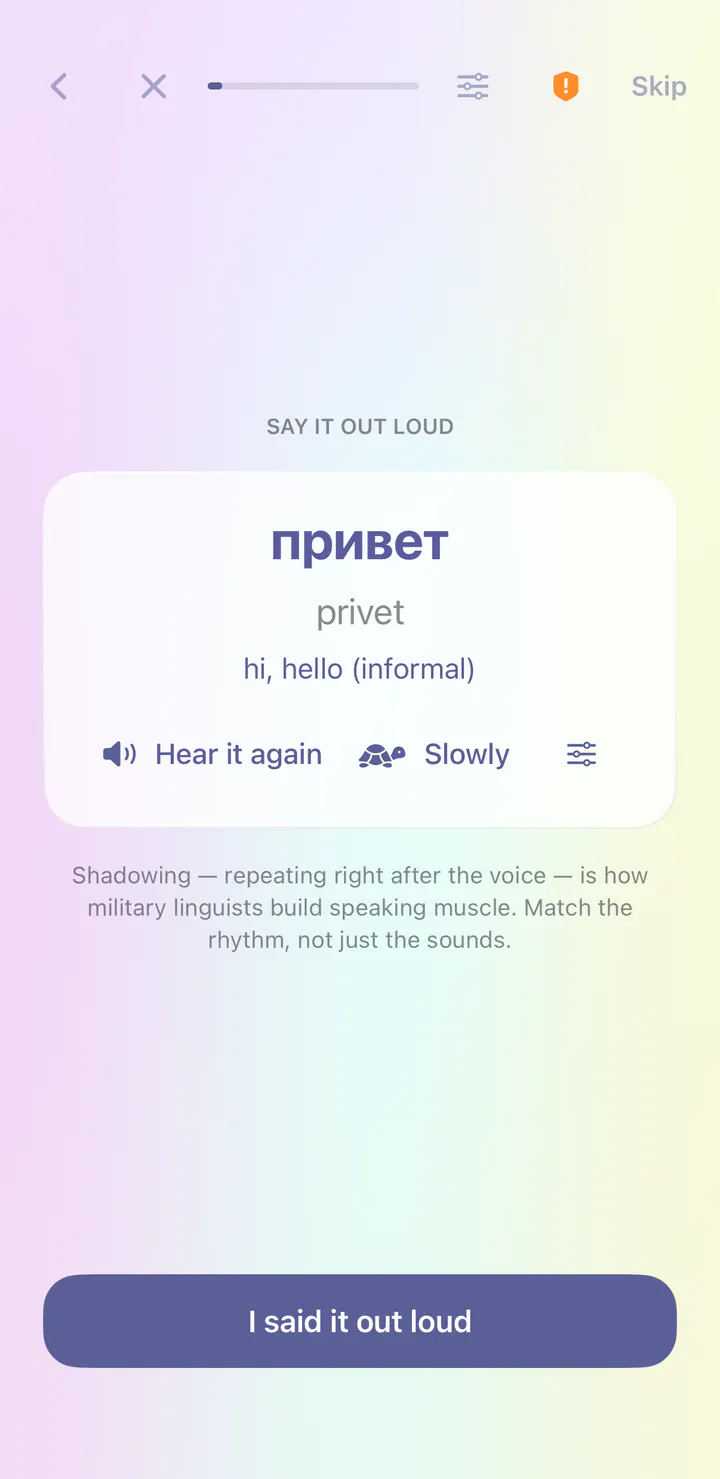
The Loquus app turns lessons like this into guided conversations and speaking practice, with normal and slow audio. On iPhone and iPad, speech recognition runs on your device.
Free to start. No account needed.
By Loquus ·
Sources
- Cornell Russian grammar: Telling time: on the hour
- University of Kansas Между нами: 5.4 Кото́рый час?, Немно́го о языке́
- University of Kansas Между нами: 5.6 Дени́с е́дет в Яросла́вль, Немно́го о языке́
- University of Kansas Между нами: 1.10 Моби́льный телефо́н, Немно́го о языке́
- Cornell Russian grammar: Expressing ‘on’ a day of the week
- Cornell Russian grammar: The Accusative Singular endings for a declension
- University of Kansas Между нами: 3.3 Что чита́ют россия́не?, Немно́го о языке́
- Cornell Russian grammar: The preposition v/vo
- University of Kansas Между нами: 3.7 Где они живут?, Немно́го о языке́
- Cornell Russian grammar: Expressing ‘in/at’ a time of day
- University of Kansas Между нами: 3.1 Сегодня суббота, Немно́го о языке́
- Cornell Russian grammar: Genitive after numerals
- Cornell Russian grammar: Nouns and adjectives with numerals pyat’ and higher
- Cornell Russian grammar: Addressing people: ty vs. vy
- Cornell Russian grammar: Sentence types: structures with a Nominative subject
- Cornell Russian grammar: Masculine, feminine, and neuter nouns
- Cornell Russian grammar: Stress patterns for nouns
- Cornell Russian grammar: Verbs: expressing past, present, and future
- University of Kansas Между нами: 6.6 Где ты бу́дешь встреча́ть Но́вый год?, Немно́го о языке́
- Cornell Russian grammar: Verbs: Aspect
- Cornell Russian grammar: Expressing “Let’s”
- Cornell Russian grammar: Prepositional case forms (nouns and adjectives)
- Cornell Russian grammar: The nonpast tense: the person
- University of Kansas Между нами: 3.2 Ама́нда мно́го и́ли ма́ло рабо́тает?, Немно́го о языке́
Learning research behind the practice
Worked examples, retrieval practice, and later review inform the activities. These studies do not establish the effectiveness of this specific lesson.