Batchim names a position in the written block
Batchim is a consonant written at the bottom of a Hangul syllable block. In 손, “hand,” final ㄴ is batchim; in 소, “cow,” there is no final consonant. The term describes a position, not one particular letter or one sound. Several consonant letters can appear there, and some blocks have a pair of final letters. Always find the vowel first so that a horizontal vowel stroke is not mistaken for a consonant underneath it.
A written block is a helpful reading unit, but fluent speech connects those units. The final consonant may sound different before a following vowel or consonant. That does not mean the spelling is unreliable or that every written consonant disappears. It means pronunciation depends on a larger context than one isolated letter. Learn to inspect the end of the current block and the start of the next before deciding how to say the sequence.
손
son
hand, with final ㄴ
소
so
cow, with no final consonant
Finish a final stop without adding a vowel
At the end of an isolated syllable or word, Korean stop consonants close the airflow without a strong audible release. In 밥, “cooked rice” or “a meal,” the lips close for final ㅂ. Do not add an extra uh sound to make that consonant easier to hear. Likewise, 책 ends with a closure at the back of the mouth. A Roman spelling such as chaek is a reading aid, not an instruction to pronounce a separate English k syllable.
Several different written finals share the same sound in this position. Final ㅅ in 옷 is pronounced as an unreleased t sound when the word stands alone; it is not an extended s hiss. Final ㅊ in 꽃 also has a t type ending in isolation. Their written identities still matter because they can reappear differently when a grammatical vowel follows. Keep both the dictionary spelling and its recorded pronunciation in your notes instead of replacing the spelling with a sound approximation.
밥
bap
cooked rice or a meal
책
chaek
book
옷
ot
clothes
꽃
kkot
flower
Hear the final consonants that can continue
Final ㄴ, ㅁ, and ㅇ are nasal sounds, made with air flowing out through the nose, while final ㄹ is an l type sound. These do not use the same closed stop gesture as final ㄱ, ㄷ, or ㅂ. Compare 산, “mountain,” with 상, “table” or “award” depending on the word’s context. Their final letters point to different nasal positions. A change from n to ng can change the word, so do not treat both as a vague nasal ending.
Initial ㅇ is silent, but final ㅇ is pronounced ng. Final ㄹ is represented by l in Revised Romanization, the official system for writing Korean in Roman letters, while ㄹ before a vowel is often represented by r. This reflects position, not two randomly interchangeable letters. Korean ㄹ does not exactly match every English r or l. Listen to the word as a whole and learn the tongue movement rather than trying to force an English accent rule onto it.
산
san
mountain
밤
bam
night, or chestnut in another word context
방
bang
room
물
mul
water
Connect a final to a following grammatical vowel
A particle is a short word attached to the end of a noun to show its role in the sentence, and a stem is the part of a verb before 다. When a particle or ending that begins with a vowel follows a noun or stem, a final consonant commonly links into the next spoken syllable. 책 plus the subject particle 이 is written 책이 and pronounced approximately chaegi. The initial ㅇ in 이 does not block that connection because it has no consonant sound. The spelling retains 책 so that the noun stays recognizable even though its final consonant is now heard with the next vowel.
The consonant’s original identity can become audible in this connection. 옷 by itself ends with a t type sound, but 옷이 is pronounced osi, with s before the vowel. 꽃을, “flower” plus the object particle, is pronounced kkocheul: the original ㅊ, an aspirated consonant said with a strong puff of air, links to the vowel. These examples concern grammatical particles and endings. Do not turn them into a promise that every space or compound boundary behaves identically; other rules can apply where meaningful word parts meet.
책이
chaegi
book with the subject particle
옷이
osi
clothes with the subject particle
꽃을
kkocheul
flower with the object particle
Read a noun with its particle
Work through 책이.
- Find the noun 책.
- Identify the subject particle 이, which begins with a vowel.
- Link the final consonant into the following vowel without changing the spelling.
책이 is read chaegi.
Consonants also influence their neighbors
A following consonant can change how a final is realized. In 국물, “broth,” the final ㄱ before ㅁ is pronounced as a nasal ng sound; the word is read gungmul. In 한국말, “Korean speech or language,” a similar adjustment occurs before ㅁ. The written noun part 한국 remains recognizable. These changes make connected speech smoother, but you should learn the documented pattern rather than inventing a different spelling that matches your first impression.
Another common change is a tense consonant, one said with a tight throat and almost no puff of air, after a stop. 학교 is normally heard with a tense kk sound at the start of its second syllable. Revised Romanization writes hakgyo and does not spell every predictable tense change. This is a useful reminder that romanization, phonetic guidance, and standard Hangul spelling have different purposes. For a new word, check a recording or dictionary pronunciation instead of assuming that its Roman letters capture every detail.
국물
gungmul
broth
한국말
hangungmal
Korean speech or language
학교
hakgyo
school
Treat two written finals as a combination
Some syllables have two different final consonant letters, such as ㄵ in 앉다, “to sit,” and ㄺ in 읽다, “to read.” Before a consonant or at the end of a word, only one of the cluster’s consonants is normally realized as the final sound. Which one appears depends on the cluster and sometimes the following sound. You cannot safely choose “always the first” or “always the second” as a general rule.
Before a vowel ending, both letters can contribute across the spoken syllable boundary. 앉아요 is pronounced anjayo, while 읽어요 is read ilgeoyo. The first consonant remains as a final and the second begins the next spoken syllable in these examples. The letter ㅎ has additional behavior: it may disappear before a vowel ending or contribute aspiration beside another consonant. This lesson introduces the decision process without asking you to master every cluster exception at once.
앉아요
anjayo
sit or sits, politely
읽어요
ilgeoyo
read or reads, politely
Read a familiar cluster before a vowel
Work through 앉아요.
- Find ㄵ at the bottom of the first block.
- Notice the following vowel ending.
- Keep n as the first final and link j to the next vowel.
Compare your reasoning
앉아요 is read anjayo.
Keep spelling stable when adding particles and endings
Grammar repeatedly creates the environments that make linking useful. A book is 책, but a sentence may contain 책이, 책은, or 책을. Do not relearn each as an unrelated word. Identify the noun, recognize the attached particle, and then connect the sounds. Likewise, 먹다 is the dictionary form for “to eat,” while 먹어요 is an everyday polite form. The stem 먹 remains visible even when its consonant is heard with the following vowel.
This distinction prevents a common copying error. A pronunciation hint in square brackets is not usually a replacement spelling for the written sentence. If you hear chaegi, the noun with its subject particle is still 책이, not a newly invented spelling based only on sound. Reading and listening should support each other: spelling shows recurring pieces, and sound tells you how those pieces meet in a real utterance. Keep the original form beside any temporary pronunciation note.
책은
chaegeun
book with the topic particle
먹어요
meogeoyo
eat or eats, politely
Practice the contrast in a short phrase
Work with a pair such as 옷 and 옷이. Read the isolated noun, add the particle, then return to the noun. Notice the change without inserting a pause inside the connected form. After a few careful repetitions, put the form into a short sentence from the grammar lessons. The aim is to connect a sound pattern to a useful expression, not to perform a list of mouth positions without meaning.
The challenges below check which written pieces and pronunciation patterns you recognize. They do not assess the accuracy of your voice. Use the linked native audio material for an actual sound model, and ask for feedback when a contrast remains hard to hear. When you miss a question, explain whether the issue was final position, linking, or a consonant neighbor. Return later with the examples covered and predict the form again before checking it.
문이
muni
door with the subject particle
집에
jibe
at or to the house
Notice the difference
Common mistakes
Do not rewrite a noun from its sound
Instead of채기
For this meaning책이
The noun 책 keeps its spelling before the subject particle, even when you hear chaegi.
Do not add a syllable to a final stop
Instead of바브
For this meaning밥
밥, “rice” or “a meal,” has one syllable ending in a closed p type sound.
Keep the cluster in the written stem
Instead of일거요
For this meaning읽어요
The standard verb form preserves ㄺ even though the spoken sequence distributes its sounds across syllables.
From understanding to using
Make your own example.
Try these without answer choices. Say your answer aloud or write it below, then compare your reasoning with the model.
Your turn 1
Write the word for “clothes” with the subject particle 이. Explain how it differs from the noun alone.
Compare with a model
옷이
clothes with the subject particle
The spelling retains 옷. The isolated t type ending becomes s before this vowel particle, giving osi.
Your turn 2
Write the polite form of 먹다 already modeled above. Explain why its spelling still includes 먹.
Compare with a model
먹어요
eat or eats, politely
The stem is retained in writing. The final consonant links into the following vowel, giving meogeoyo rather than a pause between the pieces.
Put it into practice
Make the next choice.
Choose a response and learn why it works. Your score reflects your first answer to each question. You can revisit anything you miss.
Choose an answer, then open the explanation to check your reasoning.
Question 1
Which word has final ㄴ?
- 손
- 소
Check the answer
Answer: 손
손: The bottom consonant is ㄴ.
소: This block has no final consonant.
Question 2
What should happen after the final p sound in 밥 when said alone?
- Add a full u vowel
- Close the lips without adding another vowel
Check the answer
Answer: Close the lips without adding another vowel
Add a full u vowel: That would add a syllable absent from the word.
Close the lips without adding another vowel: The final stop is unreleased and the word remains one syllable.
Question 3
How is final ㅅ in isolated 옷 realized?
- As an unreleased t type sound
- As a long s hiss
Check the answer
Answer: As an unreleased t type sound
As an unreleased t type sound: At the end of a word, ㅅ is said as a t type sound; its s sound returns before a vowel particle or ending.
As a long s hiss: That is not the ordinary isolated final sound.
Question 4
Which final has the ng sound?
- ㄴ
- ㅇ
Check the answer
Answer: ㅇ
ㄴ: Final ㄴ is an n sound, not ng.
ㅇ: Final ㅇ is pronounced ng.
Question 5
Which reading aid fits 책이?
- chaegi
- chae ki with a required break
Check the answer
Answer: chaegi
chaegi: The final consonant links to the following particle vowel.
chae ki with a required break: The particle does not require a pause inside the connected word.
Question 6
Choose the usual reading of 옷이.
- oti
- osi
Check the answer
Answer: osi
oti: The isolated final t type sound is not carried into this linked form.
osi: Original s links before the grammatical vowel.
Question 7
Choose the standard spelling of “book” with the subject particle.
- 책이
- 채기
Check the answer
Answer: 책이
책이: The spelling retains the noun and particle.
채기: A pronunciation approximation does not replace the noun’s spelling.
Question 8
What changes in 국물?
- The vowel disappears entirely
- The final g type consonant becomes nasal before m
Check the answer
Answer: The final g type consonant becomes nasal before m
The vowel disappears entirely: The change concerns adjacent consonants, not deletion of the vowel.
The final g type consonant becomes nasal before m: Its ordinary reading is gungmul.
Question 9
Does every written final cluster always keep its first consonant and drop the second?
- No, the cluster and context matter
- Yes, always ignore the second letter
Check the answer
Answer: No, the cluster and context matter
No, the cluster and context matter: Different clusters and environments have different outcomes.
Yes, always ignore the second letter: That shortcut fails when other clusters or vowel endings appear.
Question 10
Which reading fits 앉아요?
- an dayo
- anjayo
Check the answer
Answer: anjayo
an dayo: There is no d consonant in this form.
anjayo: The two written final consonants contribute across the vowel boundary.
Question 11
Which reading fits 읽어요?
- ilgeoyo
- ireoyo
Check the answer
Answer: ilgeoyo
ilgeoyo: The l remains and the g links before the ending vowel.
ireoyo: This drops the g. Before a vowel ending, the l stays as a final and the g begins the next syllable.
Question 12
Does a Roman spelling necessarily show every predictable tense change?
- Yes
- No
Check the answer
Answer: No
Yes: That would make the Roman spelling a complete phonetic transcription.
No: Revised Romanization does not encode every predictable tense consonant change.
Question 13
Choose the polite spelling built from the stem 먹.
- 먹어요
- 머거요
Check the answer
Answer: 먹어요
먹어요: The written stem remains visible before its vowel ending.
머거요: This is a sound based respelling rather than the standard written form.
Question 14
Which reading aid fits 물 in isolation?
- mureu
- mul
Check the answer
Answer: mul
mureu: That adds a syllable that is not in the word.
mul: Final ㄹ is represented by l.
Keep the conversation going
What to practice next
Explain one contrast without looking at the page. Write two examples of your own, compare them with the pattern, and return later to retrieve the forms again. Continue to the next Korean topic when you can explain your answer.
Keep it going in the app
Keep the letters close.
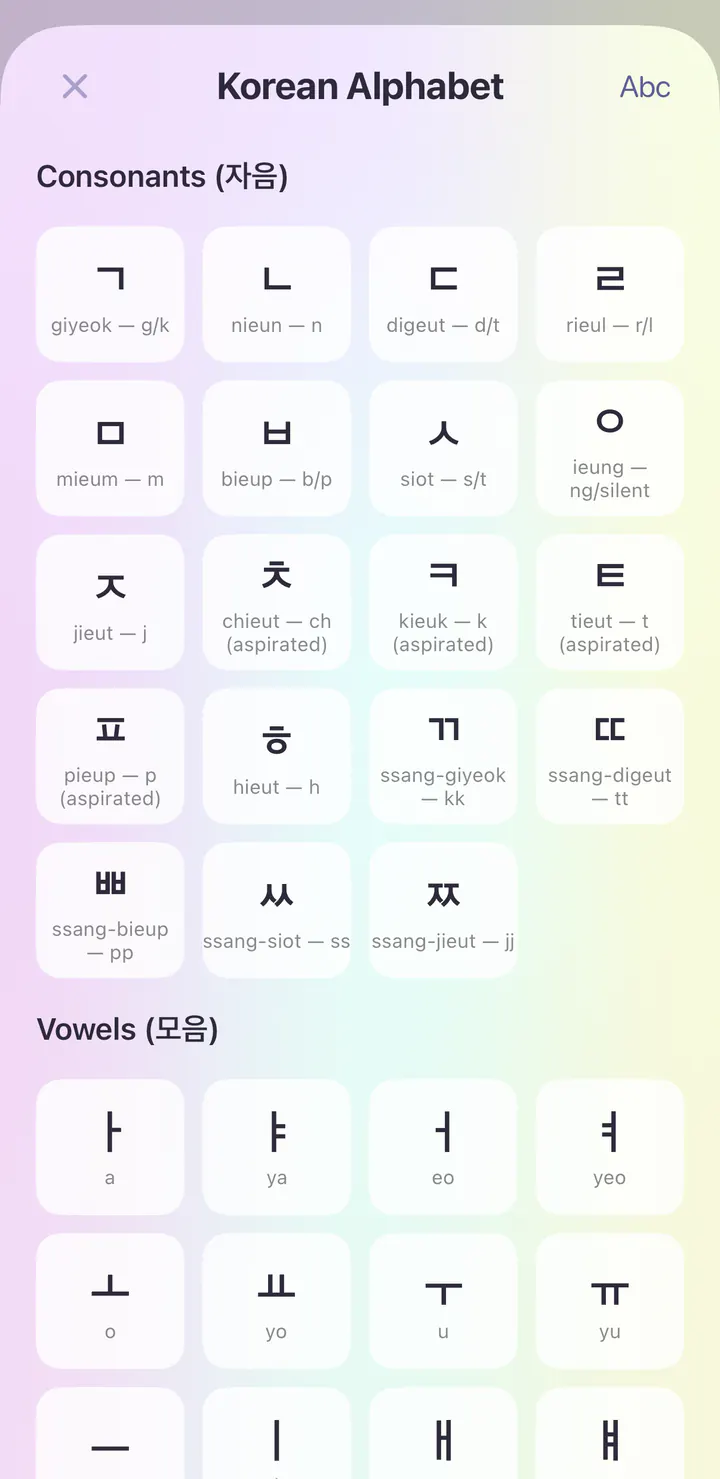
In the Loquus app, the alphabet reference lets you tap any character to hear it, and lessons bring new sounds back until they feel familiar.
Free to start. No account needed.
By Loquus ·
Sources
- National Institute of Korean Language: About Hangeul
- National Institute of Korean Language: Romanization of Korean
- National Institute of Korean Language: The Korean Alphabet Hangeul
- How to Study Korean: Korean Word Structure and Basic Letters
- How to Study Korean: More Basic Korean Letters
- How to Study Korean: Korean Pronunciation
- How to Study Korean: Reading: Quick Reference
- How to Study Korean: Names of Korean Letters
- National Institute of Korean Language: 앞+조사 발음이 어떻게 되나요
- How to Study Korean: Lesson 1: Basic Korean Sentences
- How to Study Korean: Lesson 2: Korean Particles 이/가
- How to Study Korean: Lesson 5: Korean Conjugation: Past, Present, Future
- How to Study Korean: Lesson 6: Korean Honorifics
Learning research behind the practice
Worked examples, retrieval practice, and later review inform the activities. These studies do not establish the effectiveness of this specific lesson.