An alphabet arranged into blocks
Hangul writes Korean with consonant and vowel letters, arranged into compact syllable blocks. A block is not a picture representing a whole idea, and it is not normally a whole word. The word 나무, “tree,” has two blocks. Each block combines smaller letters: 나 contains ㄴ and ㅏ, while 무 contains ㅁ and ㅜ. Recognizing those reusable pieces is the first step toward reading unfamiliar words instead of memorizing their overall outlines.
You will often see two different letter counts. The basic alphabet has fourteen consonants and ten vowels, giving twenty four basic letters. Including doubled consonants and compound vowels gives nineteen possible initial consonants and twenty one vowel letters in modern blocks. These counts describe different inventories, so neither means you must memorize thousands of unrelated symbols. Begin with a few letters and build useful combinations. A new block can become readable because you already know its components.
나무
namu
tree
바다
bada
sea
Put a vertical vowel beside the first consonant
A block has an initial consonant position followed by a vowel position. With a mainly vertical vowel such as ㅏ, ㅓ, or ㅣ, place the vowel to the right of the initial consonant. Thus ㄴ with ㅏ becomes 나. Read the initial first and then the vowel. Although the pieces share a square space, their positions provide an ordered route through the syllable. You do not choose a random direction because the letters look decorative.
Compare 마, 머, and 미. The initial ㅁ stays the same, while the vowel changes. The different short strokes on a vowel are meaningful; they are not optional handwriting flourishes. Romanization, the spelling of Korean in Roman letters, labels these vowels a, eo, and i, but an English spelling analogy will only approximate their sounds. In particular, eo represents one Korean vowel here, not a sequence of the English letter names e and o. Use the native recording links in the sources below to establish the sound.
마
ma
m plus a, a practice syllable
머
meo
m plus eo, a practice syllable
미
mi
m plus i, a practice syllable
Put a horizontal vowel below the first consonant
Vowels such as ㅗ, ㅜ, and ㅡ have a horizontal main line. They sit below the initial consonant. Combine ㄱ with ㅗ to make 고, and ㄱ with ㅜ to make 구. The writing order still corresponds to initial then vowel, even though the visual route now moves downward. Learn the vowel shape before deciding the block layout. It is more reliable than trying to remember the appearance of every syllable separately.
The short stroke distinguishes ㅗ from ㅜ: one projects upward, the other downward. The vowel ㅡ has no short projecting stroke. Its romanization eu is another label for one vowel, not an instruction to pronounce an English word like you. These three shapes will appear in many words. Copy one clear model, cover it, and reconstruct it while naming the parts. If a block is wrong, identify which vowel feature changed instead of simply copying the whole word several more times.
고
go
g plus o, a practice syllable
구
gu
g plus u, a practice syllable
그
geu
g plus eu, a practice syllable
Use initial ㅇ when a syllable starts with a vowel
Every written block needs an initial position. When the spoken syllable begins with a vowel, the letter ㅇ, called ieung, fills that position without adding a consonant sound. Write 아 for a and 우 for u. The circles in 우유, “milk,” are therefore silent initial letters. Leaving them out produces isolated vowel letters, which are useful on an alphabet chart but are not the normal spelling of the word.
The same shape has a different job at the bottom of a block. Final ㅇ represents the ng sound, as in 방, “room.” Position matters as much as identity. Do not pronounce an ng at the start of every block containing a circle, and do not assume all circles are silent. First ask whether ㅇ occupies the initial position or the final position. This one distinction lets you read many vowel beginnings and common noun endings correctly.
아이
ai
child
우유
uyu
milk
방
bang
room
Read two vowel beginnings
Decode 우유.
- Locate two blocks.
- Find silent initial ㅇ in each.
- Read ㅜ as u and ㅠ as yu.
Compare your reasoning
우유 means “milk.”
Place a final consonant below the rest
A syllable can end in a consonant. Its final consonant is called batchim, a consonant written at the bottom of a Hangul syllable block, beneath the initial and vowel. Start with 가, then add ㄴ below to make 간. Start with 무, then add ㄴ below to make 문, “door.” A block with a vertical vowel can become wider at the top, while a horizontal vowel block forms a stack. Both follow the same sequence: initial, vowel, final.
Do not insert an extra vowel after the final consonant. 문 is one syllable, not mu followed by a new neu syllable. Some blocks have two written final consonants, but those combinations follow pronunciation rules covered in the next lesson. For now, identifying the bottom position accurately is enough. Reading a final letter is not always identical to reading that letter at the beginning of a block. The spelling tells you what to investigate; listening supplies the connected spoken form.
문
mun
door
손
son
hand
물
mul
water
Build a complete block
Combine ㅁ, ㅜ, and ㄴ.
- Place the initial ㅁ first.
- Put horizontal ㅜ below it.
- Place final ㄴ below the initial and vowel.
문 means “door.”
Keep small letter differences visible
Korean distinguishes plain, aspirated, and tense consonants in several sets. An aspirated consonant is said with a strong puff of air, and a tense consonant with a tight throat and almost no puff of air. For example, ㄱ, ㅋ, and ㄲ are three different letters. The doubled shape ㄲ does not mean that you should add another syllable, and ㅋ is not merely a decorative version of ㄱ. These sound contrasts do not line up perfectly with English g and k. Treat a Roman label as a reminder while learning the Korean sound from a model.
Compound vowels also fit inside one vowel position. The vowel ㅘ combines elements of ㅗ and ㅏ and appears in 와. It is still one written syllable with initial ㅇ. Other spellings can be close in contemporary speech: many speakers pronounce ㅐ and ㅔ alike or very similarly. Keep their written distinction even if you cannot hear a difference in a particular voice. Regional and generational variation is a reason to check examples, not a reason to remove letters from spelling.
가
ga
plain initial g sound in a practice syllable
카
ka
aspirated initial k sound in a practice syllable
까
kka
tense initial kk sound in a practice syllable
와
wa
wa, a practice syllable
Read words rather than inserting spaces between blocks
Hangul blocks are joined into words. 한국어, “Korean language,” has three syllable blocks, but no spaces between those blocks. A noun and its grammatical particle, a short word attached to the end of a noun to show its role in the sentence, are normally written together: 책, “book,” becomes 책은 when the topic particle is attached. The extra block does not mean that the first block has changed its spelling. This will matter later when particles and polite endings begin to make your sentences longer.
Letter names help you discuss spelling, but they are not the sounds you read aloud inside a word. The letter ㄴ is named 니은, nieun; reading 나 does not require saying the full letter name followed by a vowel name. Use names when explaining an error, then return to the sound of the complete syllable. On a Korean keyboard, enter the component letters in initial, vowel, final order and let the input method compose the block. A Roman input method can use different keystrokes.
한국어
hangugeo
Korean language
책은
chaegeun
book with the topic particle
Build a small reading routine you can check
Choose three short words whose meanings you know. For each, identify the blocks, name the initial and vowel in each block, and then check for a final consonant. Read the whole word after analyzing it. Cover the model and write it from memory before checking each component. This separates a shape mistake from a pronunciation mistake and prevents a good guess from feeling like complete mastery.
The choices below test block structure and spelling. They do not listen to your voice or evaluate handwriting. After answering, return to a reliable audio example and compare the rhythm of the word with your own speech. Try the same word later among different neighbors, so you recognize its letters rather than its position in a list. Next, study batchim and linking to understand why a familiar spelling can sound different when a vowel or another consonant follows it.
오이
oi
cucumber
구두
gudu
dress shoes
Notice the difference
Common mistakes
Do not leave out the silent initial ㅇ
Instead ofㅏ이
For this meaning아이
The first vowel syllable needs silent initial ㅇ. The normal word for “child” has two complete blocks.
Do not add a vowel after a final
Instead of무느
For this meaning문
문, “door,” is one syllable with final ㄴ. Adding 느 changes the number and contents of the blocks.
Keep the word together
Instead of나 무
For this meaning나무
The two syllables form one word, 나무, “tree,” so ordinary spelling joins them.
From understanding to using
Make your own example.
Try these without answer choices. Say your answer aloud or write it below, then compare your reasoning with the model.
Your turn 1
Write the word for “tree” from the syllables na and mu. Then identify the two vowels.
Compare with a model
나무
tree
The first block uses vertical ㅏ and the second uses horizontal ㅜ. Rebuild the word without copying its outline.
Your turn 2
Write the word for “door” using ㅁ, ㅜ, and ㄴ. Explain the bottom letter.
Compare with a model
문
door
The initial is ㅁ, the vowel is ㅜ, and final ㄴ closes the syllable. Do not create a new syllable after it.
Put it into practice
Make the next choice.
Choose a response and learn why it works. Your score reflects your first answer to each question. You can revisit anything you miss.
Choose an answer, then open the explanation to check your reasoning.
Question 1
Which spelling combines ㄴ and ㅏ in one block?
- 나
- ㄴㅏ
Check the answer
Answer: 나
나: The vertical vowel sits to the right of the initial consonant.
ㄴㅏ: These are separated component letters rather than a composed syllable block.
Question 2
Which block combines ㅁ and ㅜ?
- 머
- 무
Check the answer
Answer: 무
머: This contains ㅓ, a different vowel.
무: The horizontal vowel sits below the initial.
Question 3
Choose the normal spelling for the vowel syllable a.
- 아
- ㅏ
Check the answer
Answer: 아
아: Initial ieung fills the initial position silently.
ㅏ: This is the isolated vowel letter rather than the complete block.
Question 4
How many syllable blocks does 나무 contain?
- Four
- Two
Check the answer
Answer: Two
Four: Four component letters form two blocks.
Two: 나 and 무 are two separate blocks in one word.
Question 5
Which block ends with ㄴ?
- 문
- 무
Check the answer
Answer: 문
문: The final nieun sits at the bottom.
무: This block has no final consonant.
Question 6
What is initial ㅇ doing in 우?
- Adding an ng sound before u
- Filling the initial position silently
Check the answer
Answer: Filling the initial position silently
Adding an ng sound before u: Initial ieung is silent here.
Filling the initial position silently: Its sound value differs from final ieung.
Question 7
What does final ㅇ represent in 방?
- The ng sound
- A silent placeholder
Check the answer
Answer: The ng sound
The ng sound: Final ieung has a consonant sound.
A silent placeholder: Ieung is silent only in the initial position, not the final position used here.
Question 8
Choose the block with vowel ㅗ.
- 구
- 고
Check the answer
Answer: 고
구: This contains ㅜ, with a downward short stroke.
고: Its vowel has an upward short stroke.
Question 9
Choose the block with vowel ㅡ.
- 그
- 기
Check the answer
Answer: 그
그: This horizontal vowel lacks a short projecting stroke.
기: This uses the vertical vowel ㅣ.
Question 10
Which spelling is one syllable containing ㅘ?
- 오아
- 와
Check the answer
Answer: 와
오아: This has two separate vowel blocks.
와: The compound vowel occupies one vowel position.
Question 11
How should eo in Korean romanization be treated here?
- As a label for one Korean vowel
- As two separate English vowel names
Check the answer
Answer: As a label for one Korean vowel
As a label for one Korean vowel: It does not ask you to say two English letter names.
As two separate English vowel names: Romanization is not English spelling.
Question 12
Which block begins with ㄲ?
- 카
- 까
Check the answer
Answer: 까
카: This starts with aspirated ㅋ, not tense ㄲ.
까: The doubled consonant belongs to one initial position.
Question 13
Choose the normal spacing for “Korean language.”
- 한국어
- 한 국 어
Check the answer
Answer: 한국어
한국어: Its three blocks form one word.
한 국 어: Ordinary word spelling does not insert a space between every syllable.
Question 14
What should you read when you see 나 in a word?
- The full name nieun followed by a vowel name
- The syllable na
Check the answer
Answer: The syllable na
The full name nieun followed by a vowel name: Letter names discuss spelling rather than supplying the spoken word.
The syllable na: A letter name and its sound in a syllable are different.
Keep the conversation going
What to practice next
Explain one contrast without looking at the page. Write two examples of your own, compare them with the pattern, and return later to retrieve the forms again. Continue to the next Korean topic when you can explain your answer.
Keep it going in the app
Keep the letters close.
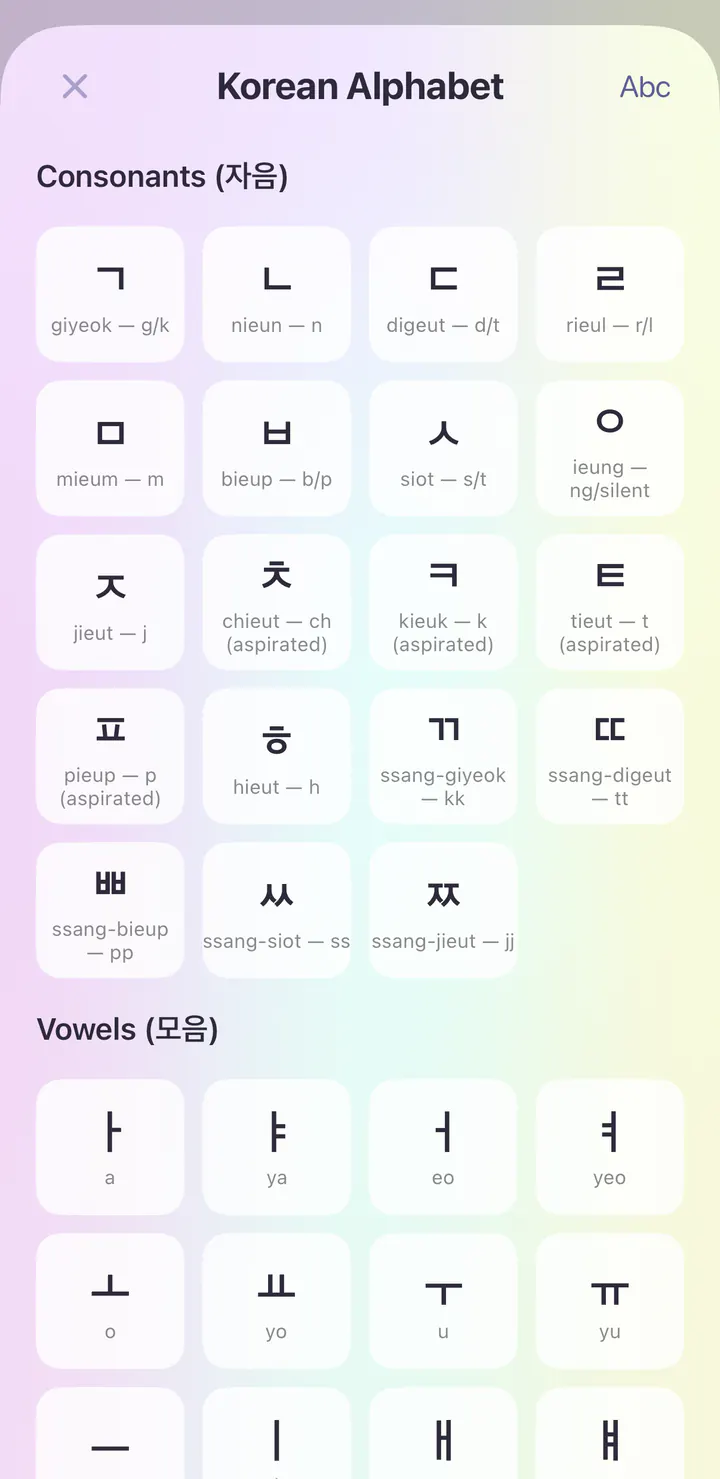
In the Loquus app, the alphabet reference lets you tap any character to hear it, and lessons bring new sounds back until they feel familiar.
Free to start. No account needed.
By Loquus ·
Sources
- National Institute of Korean Language: About Hangeul
- National Institute of Korean Language: Romanization of Korean
- National Institute of Korean Language: The Korean Alphabet Hangeul
- How to Study Korean: Korean Word Structure and Basic Letters
- How to Study Korean: More Basic Korean Letters
- How to Study Korean: Korean Dipthongs: Complex Vowels
- How to Study Korean: Korean Pronunciation
- How to Study Korean: Reading: Quick Reference
- How to Study Korean: Names of Korean Letters
- How to Study Korean: Lesson 1: Basic Korean Sentences
Learning research behind the practice
Worked examples, retrieval practice, and later review inform the activities. These studies do not establish the effectiveness of this specific lesson.